On this page
Key takeaways
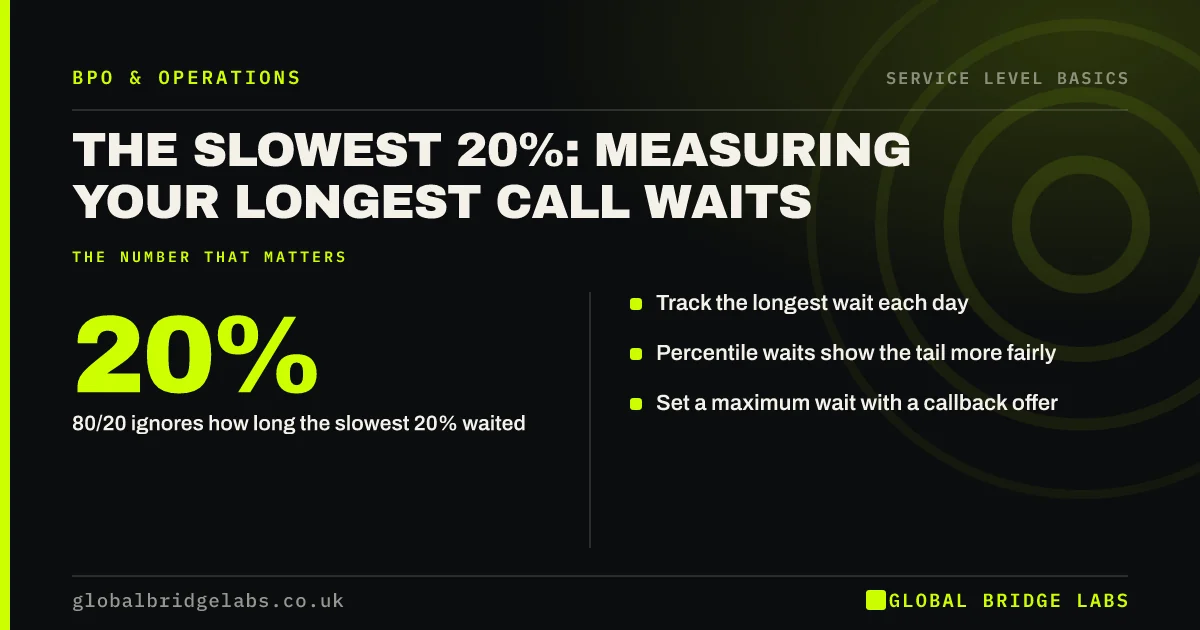
An 80/20 service level says nothing about the other 20% of callers. Some may wait 25 seconds, others ten minutes. Track the longest wait each day and the 90th or 95th percentile wait, and consider a maximum wait rule, such as no caller waiting over three minutes without being offered a callback.
- 80/20 ignores how long the slowest 20% waited.
- Track the longest wait each day.
- Percentile waits show the tail more fairly.
- Set a maximum wait with a callback offer.
Want to know how long your slowest callers wait? Message us on WhatsApp.
Chat on WhatsApp →Why measure the tail?
Because unhappy callers come from the tail. A caller answered in 15 seconds rarely complains, while one who waited eight minutes often does, and may leave a review. The 80/20 figure treats a 25-second wait and an eight-minute wait the same way: both are simply late.
What should you measure?
Three figures cover it. The longest wait of the day shows the worst case. The 90th percentile wait, the time within which 90% of callers were answered, shows how long a typical late caller waits. And the number of callers who waited over a set limit, such as three minutes, gives a simple count to drive down.
- Longest wait each day.
- 90th or 95th percentile wait.
- Count of waits over your limit.
Where do long waits come from?
Usually from short spells when everyone is busy at once: a rush after opening, a lunch gap, a staff member on a long call, or an outage that triggers many calls together. Long waits cluster in a few half hours, so the interval report usually shows where to look.
- Why a daily service level hides your worst half hours
- Intraday management: fixing the day as it happens
Want help setting a maximum wait? Send us a week of call data on WhatsApp.
Chat on WhatsApp →How do you cut the longest waits?
Offer a callback after a set time in the queue, so nobody sits on hold indefinitely. Use overflow to another team or provider when the queue passes a limit. And tell callers how long the wait is, so they can choose to wait, call back or use another channel.
What does this look like in practice?
A pattern we see: service level is steady at 80/20, but the longest wait each day is between six and nine minutes. Adding a callback offer at two minutes brings the longest wait down sharply, and wait-time complaints fall within a month.
Longest wait checklist
- Report the longest wait each day.
- Add a 90th percentile wait.
- Count callers over your limit.
- Offer a callback before that limit.
- Check which half hours cause long waits.
Next step
Pick a maximum wait that fits your callers, start counting waits over it, and add a callback offer just before the limit.
Message us on WhatsApp to tackle your longest waits, or book a 30-minute consultation.
Chat on WhatsApp →Sources and further reading
- UK Customer Satisfaction Index · Institute of Customer Service
- Stop trying to delight your customers (Dixon, Freeman and Toman, 2010) · Harvard Business Review
Frequently asked questions
What is the longest delay in queue?
It is the longest time any caller waited before being answered, or before hanging up, in a period such as a day. It shows the worst experience a caller had. Report it alongside service level, because a good percentage can still hide a few callers who waited many minutes.
What is a percentile wait time?
A 90th percentile wait is the time within which 90% of callers were answered. If it is 45 seconds, nine in ten callers waited 45 seconds or less. It is fairer than the single longest wait, because one extreme call cannot distort it, and it shows the tail better than an average does.
Should I set a maximum wait time?
Yes, many businesses find it useful. A simple rule, such as offering a callback after two minutes or never letting a caller wait more than three, protects the slowest callers that 80/20 ignores. Choose a limit based on when your callers start giving up.
Written by

Global Bridge Labs (GBL) is a UK–Sri Lanka partner for social media, websites and BPO. Everything here comes from client delivery, not theory.