On this page
- 01Key takeaways
- 02Does answer speed affect satisfaction?
- 03What matters more after the call is answered?
- 04Can chasing speed make service worse?
- 05How do you measure the link for your business?
- 06What does this look like in practice?
- 07Speed and satisfaction checklist
- 08Next step
- 09Sources and further reading
- 10Frequently asked questions
Key takeaways
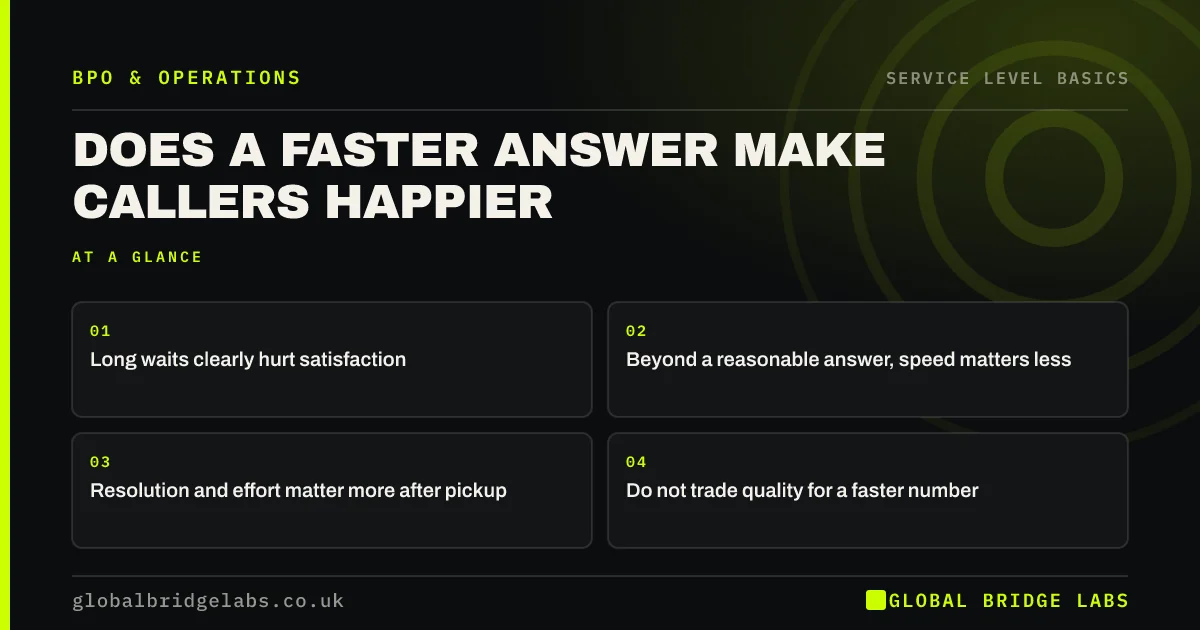
A faster answer helps satisfaction up to a point. Callers notice long waits and dislike them, but once a call is answered reasonably quickly, what happens next matters more: whether the problem is solved, whether they are transferred and how much effort it takes. Set a sensible speed target, then put your effort into resolution.
- Long waits clearly hurt satisfaction.
- Beyond a reasonable answer, speed matters less.
- Resolution and effort matter more after pickup.
- Do not trade quality for a faster number.
Want to know where your callers lose patience? Message us on WhatsApp.
Chat on WhatsApp →Does answer speed affect satisfaction?
Yes, especially at the extremes. A caller who waits several minutes starts the conversation annoyed and may never call again. The UK Customer Satisfaction Index tracks satisfaction across sectors and shows that ease and timeliness both matter. But the difference between a ten-second and a 20-second answer is rarely what callers remember.
What matters more after the call is answered?
Getting the problem solved on that call, without being passed around or asked to repeat details. Research on customer effort in the Harvard Business Review found that reducing effort did more for loyalty than going beyond expectations. Transfers, repeat calls and unclear next steps all add effort.
Can chasing speed make service worse?
It can. Teams under pressure to answer fast may rush calls, skip notes or transfer callers to get back to the queue. That lifts service level and lowers satisfaction. Balance the speed target with a resolution or quality measure so neither is improved at the other's expense.
- Rushed calls lead to repeat calls.
- Quick transfers add effort for callers.
- Pair speed with a resolution measure.
Want a balanced set of call targets? Send us your current ones on WhatsApp.
Chat on WhatsApp →How do you measure the link for your business?
Ask a short question after calls, then compare scores against how long each caller waited. Most businesses find satisfaction drops sharply after a certain wait, and barely changes below it. That point is a good guide for your threshold and maximum wait.
What does this look like in practice?
A pattern we see: a firm pushes from 80/20 to 90/10 and satisfaction barely moves. A review of comments shows callers are unhappy about being transferred. Fixing routing does more for satisfaction than the faster answer did.
Speed and satisfaction checklist
- Set a sensible answer target.
- Add a maximum wait for the slowest callers.
- Measure resolution on the first call.
- Ask callers a short question afterwards.
- Compare scores with wait times.
Next step
Run a two-question survey for a month, match scores to wait times, and set your target at the point where satisfaction starts to fall.
Message us on WhatsApp to link speed and satisfaction, or book a 30-minute consultation.
Chat on WhatsApp →Sources and further reading
- UK Customer Satisfaction Index · Institute of Customer Service
- Stop trying to delight your customers (Dixon, Freeman and Toman, 2010) · Harvard Business Review
Frequently asked questions
Do customers care how fast you answer?
Yes, but mostly when the wait becomes noticeable. A long wait sets a bad tone and increases hang-ups. Once calls are answered within a reasonable time, callers care much more about whether their problem is solved and how easy the call was than about a few seconds either way.
Is first contact resolution more important than speed?
For satisfaction, it often is. A caller answered quickly but asked to ring back later has a worse experience than one who waited a little and got a full answer. Most businesses should hold a reasonable speed target and focus improvement effort on resolving more calls first time.
How can I tell if my answer speed is good enough?
Compare satisfaction scores, complaints and abandonment with wait times. If satisfaction holds steady and few callers hang up below a certain wait, your speed is good enough there. If scores fall and hang-ups rise in some half hours, those are the places to improve.
Written by

Global Bridge Labs (GBL) is a UK–Sri Lanka partner for social media, websites and BPO. Everything here comes from client delivery, not theory.