
On this page
- 01Key takeaways
- 02Why is service level harder for a small team?
- 03What target is realistic?
- 04How do you cover breaks and absence?
- 05When does overflow make sense?
- 06What does this look like in practice?
- 07Small team service level checklist
- 08Next step
- 09Sources and further reading
- 10Frequently asked questions
Key takeaways
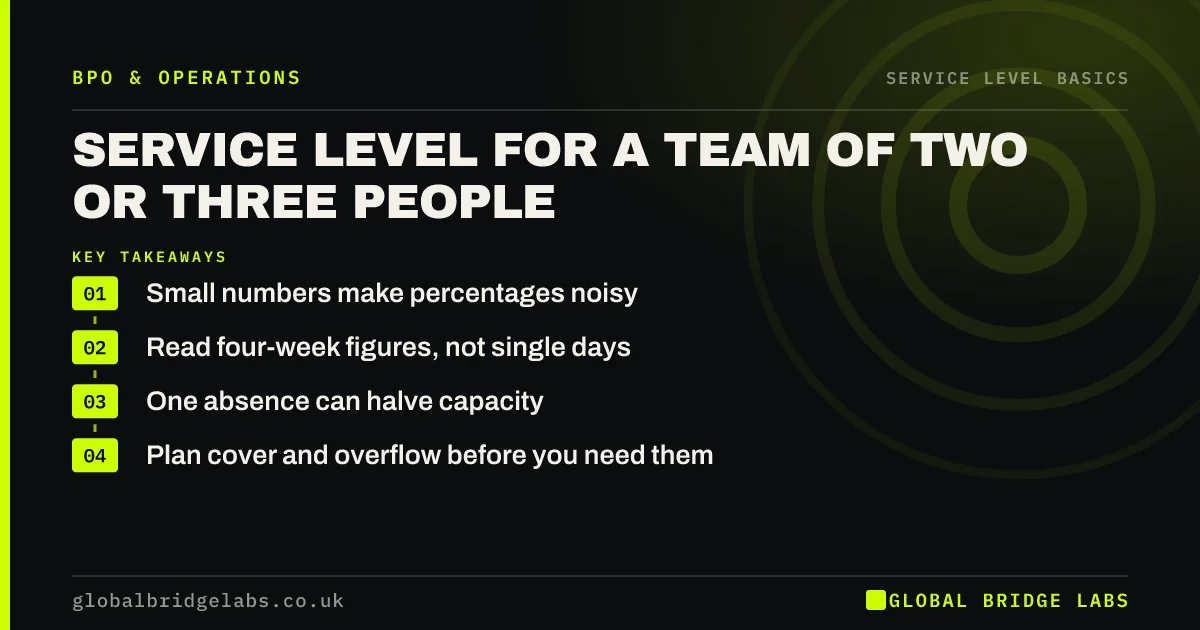
A small team can use service level, but not the way a large contact centre does. With few calls per half hour, percentages swing wildly, and covering breaks or a sick day can halve capacity. Use weekly or four-week figures, set a realistic target, add a maximum wait and plan cover for the times one person is away.
- Small numbers make percentages noisy.
- Read four-week figures, not single days.
- One absence can halve capacity.
- Plan cover and overflow before you need them.
Running a small team on the phones? Message us on WhatsApp.
Chat on WhatsApp →Why is service level harder for a small team?
Calls arrive randomly, and a small team has little spare capacity to absorb a cluster. Two calls at once with one person free means someone waits. With few calls per half hour, a single late call can drop the figure by ten points or more, so daily percentages say little.
What target is realistic?
Many small teams find 80/30 or 70/30 realistic for general lines, with a maximum wait such as two minutes before a callback is offered. For urgent calls, a separate rule, such as answer or call back within five minutes, often works better than a percentage.
How do you cover breaks and absence?
Plan breaks so the team is never down to one person in the busiest hour. Cross-train someone from the office to answer during lunch. And decide in advance what happens on a sick day: a reduced service message, voicemail with a callback promise, or overflow to an external team.
- Stagger breaks around peaks.
- Cross-train one back-up person.
- Agree a sick-day plan in advance.
Want to see what overflow would cost for your quiet and busy hours? Message us on WhatsApp.
Chat on WhatsApp →When does overflow make sense?
When peaks are short and predictable, such as Monday mornings, or rare and sharp, such as after a product issue. Overflow means extra calls go to another team only when yours is busy, so you pay for cover only when you need it.
What does this look like in practice?
A pattern we see: a three-person office misses its target mainly in the hour after opening and during lunches. Moving one start time earlier, staggering lunches and adding overflow on Mondays brings the four-week figure up and keeps the longest wait under two minutes.
Small team service level checklist
- Use four-week figures, not daily ones.
- Set a realistic target and a maximum wait.
- Stagger breaks around the busiest hour.
- Cross-train one back-up person.
- Agree a sick-day and overflow plan.
Next step
Look at four weeks of calls by hour, set a target you can hit with your current team, and decide what happens when someone is away.
Message us on WhatsApp to plan cover for a small team, or book a 30-minute consultation.
Chat on WhatsApp →Sources and further reading
- Maximum weekly working hours · GOV.UK
- Holiday entitlement · GOV.UK
Frequently asked questions
Is 80/20 realistic for a team of two?
It can be on quiet lines, but often only with a lot of idle time. Two people can rarely absorb clusters of calls, so a looser target such as 80/30, plus a maximum wait with a callback offer, is usually more realistic and fairer to both callers and staff.
How do I cover the phones at lunchtime?
Stagger lunches so at least one person is always on the phones, and avoid the busiest half hour if you can. Cross-train someone from another role to help at lunch, or use overflow for that hour. Check the half-hourly report to confirm lunch is covered.
What should happen when one person is off sick?
Agree it before it happens. Options include a back-up person from another role, a short message promising a callback, or overflow to an outside team. Choose based on how many calls you would otherwise miss and what a missed call costs your business.
Written by

Global Bridge Labs (GBL) is a UK–Sri Lanka partner for social media, websites and BPO. Everything here comes from client delivery, not theory.


