
On this page
Key takeaways
Speed and quality are not opposites, but a target on one can damage the other. A team pushed to answer fast may rush calls, skip notes or transfer too quickly, which creates repeat calls and fills the queue again. Measure speed and quality together, set targets for both and fix the causes of long calls rather than squeezing every call.
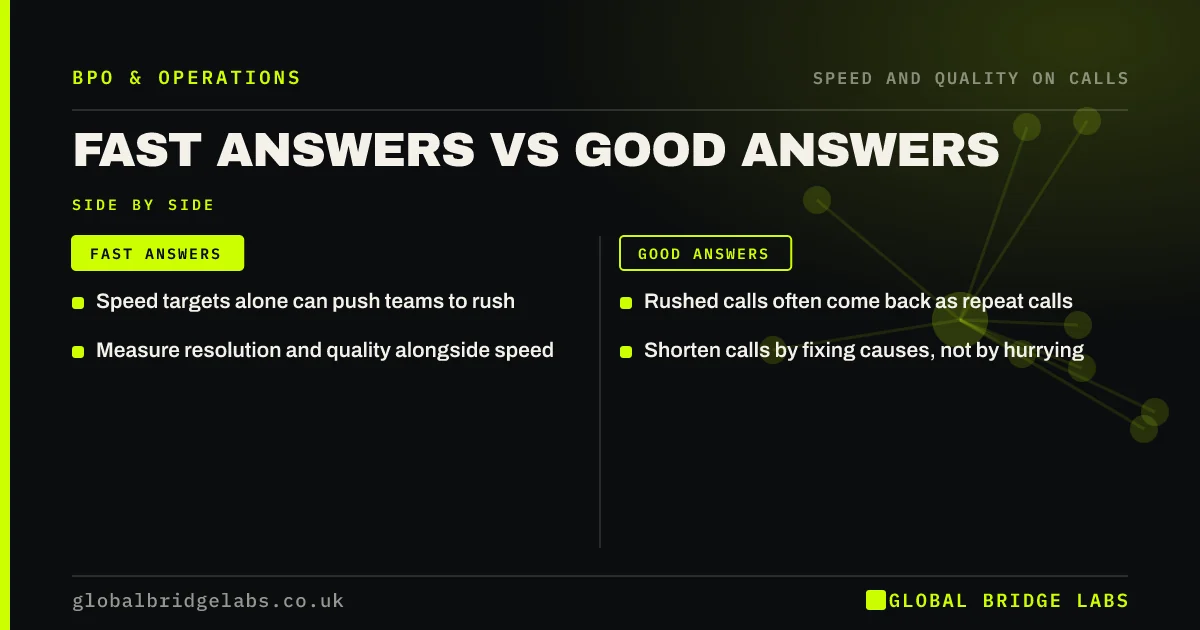
- Speed targets alone can push teams to rush.
- Rushed calls often come back as repeat calls.
- Measure resolution and quality alongside speed.
- Shorten calls by fixing causes, not by hurrying.
Want a balanced set of call targets? Message us on WhatsApp.
Chat on WhatsApp →How does speed pressure hurt quality?
When the queue is long and the target is visible, people naturally try to finish calls quickly. They may skip confirming details, avoid asking whether anything else is needed or transfer instead of solving. Each shortcut saves seconds now and costs a repeat call later, which lengthens tomorrow's queue.
How do you measure both?
Pair your service level with a measure of resolution, such as the share of callers who do not ring back about the same issue within seven days, and a quality check from listening to a sample of calls. Report them on the same page, so improving one at the expense of the other is visible straight away.
Where does time really go on calls?
Usually in searching for information, waiting for systems, putting callers on hold to ask a colleague and writing notes afterwards. Fixing these shortens calls without rushing the caller. A good answer library, faster system access and clear authority to act save more time than any instruction to hurry.
- Searching for answers.
- Slow or multiple systems.
- Holds to ask colleagues.
- Long after-call notes.
- A phone answer library for your top 20 questions
- After-call work: the hidden half of every customer contact
Want to know where time goes on your calls? Send us a sample on WhatsApp.
Chat on WhatsApp →What should you tell the team?
Say clearly that resolving the call is the priority, and that the speed target is the business's job to resource, not the individual's job to chase. When people know they will not be criticised for a long call that solved a problem, quality holds up even when the queue is busy.
What does this look like in practice?
A pattern we see: a team's service level improves after a push on speed, but repeat calls rise within weeks and the queue grows again. Adding a resolution measure and fixing two slow systems brings handling time down without the repeat calls.
Over a quarter, the balanced approach usually wins on both counts: fewer repeat calls mean fewer calls overall, which makes the speed target easier to hit.
Speed and quality checklist
- Report speed and resolution together.
- Listen to a sample of calls weekly.
- Find where time goes on calls.
- Fix systems and answers before asking for speed.
- Tell the team resolution comes first.
Next step
Add a repeat-call measure to your weekly report next to service level, and listen to ten calls to see where time is really spent.
Message us on WhatsApp to balance speed and quality, or book a 30-minute consultation.
Chat on WhatsApp →Sources and further reading
- Stop trying to delight your customers (Dixon, Freeman and Toman, 2010) · Harvard Business Review
- UK Customer Satisfaction Index · Institute of Customer Service
Frequently asked questions
Is speed or quality more important on calls?
Both matter, but quality usually has the bigger effect on satisfaction once calls are answered reasonably quickly. A fast answer that does not solve the problem leads to repeat calls and frustration. Set a sensible speed target, then focus improvement effort on resolving more calls fully the first time.
How do I stop staff rushing calls when the queue is long?
Make it clear that resolving the call matters more than the queue, measure resolution alongside speed and make queue pressure a staffing issue for managers. Showing the team the cost of repeat calls usually helps. Recognise good calls, not just fast ones, in team meetings.
Can I improve speed and quality at the same time?
Often yes. Removing avoidable calls, giving staff faster access to answers and shortening notes all improve speed without rushing anyone. Fewer repeat calls also reduce the queue. The improvements that work best usually fix causes rather than asking people to work faster.
Written by

Global Bridge Labs (GBL) is a UK–Sri Lanka partner for social media, websites and BPO. Everything here comes from client delivery, not theory.


