On this page
Key takeaways
Contact centre reports are full of jargon that makes simple ideas hard to follow. This glossary explains the service level terms you are most likely to meet, in plain English, with how each one is used. Use it to read reports, question providers and agree definitions that everyone in your business understands.
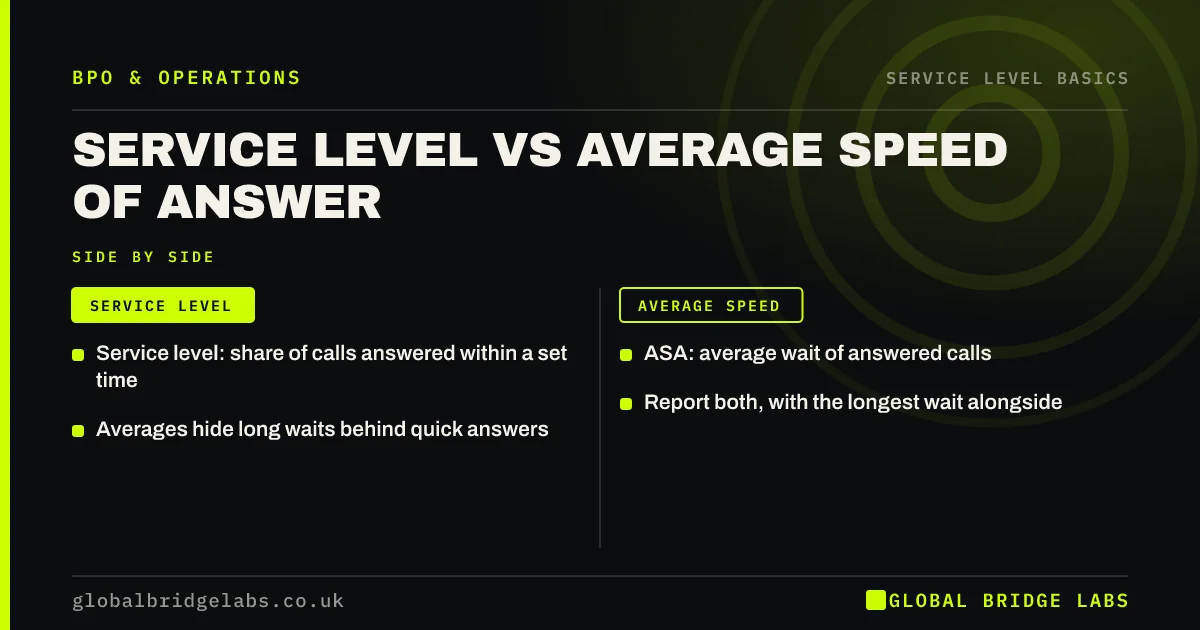
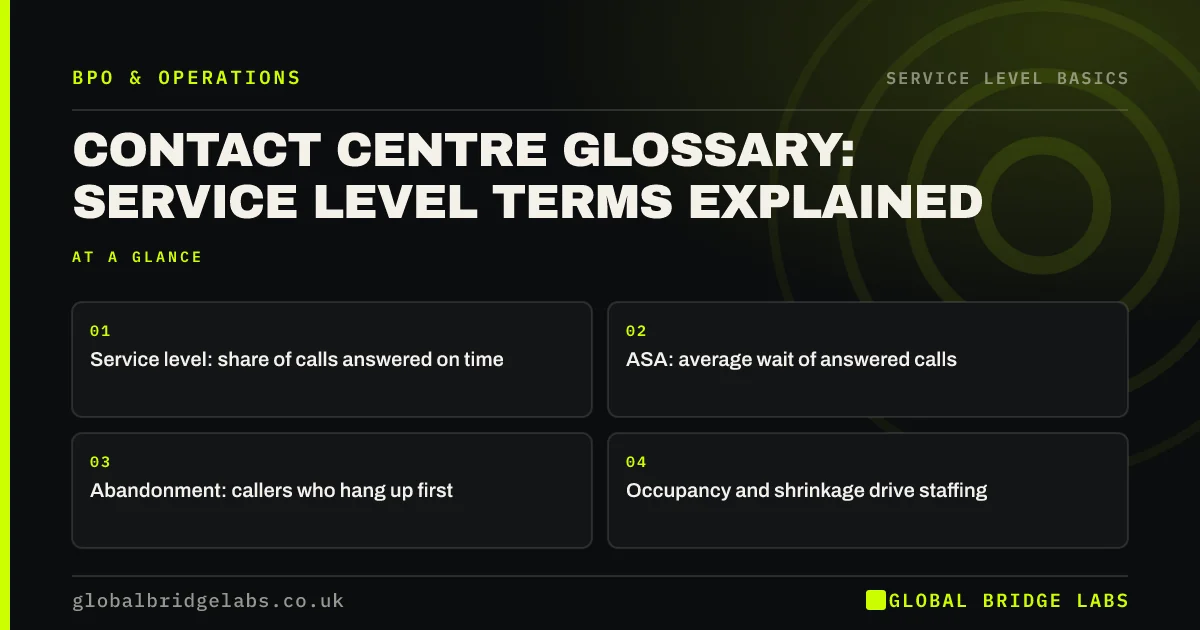
- Service level: share of calls answered on time.
- ASA: average wait of answered calls.
- Abandonment: callers who hang up first.
- Occupancy and shrinkage drive staffing.
Confused by a call report? Message us on WhatsApp.
Chat on WhatsApp →Speed terms
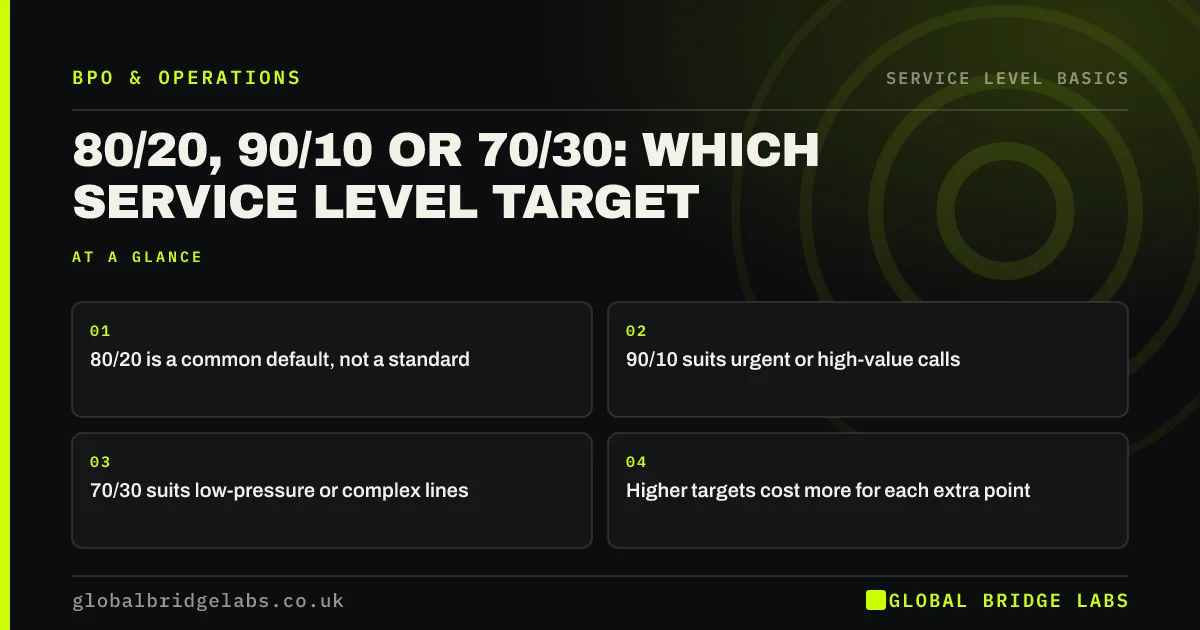
- Service level: the share of calls answered within a threshold, such as 80% in 20 seconds.
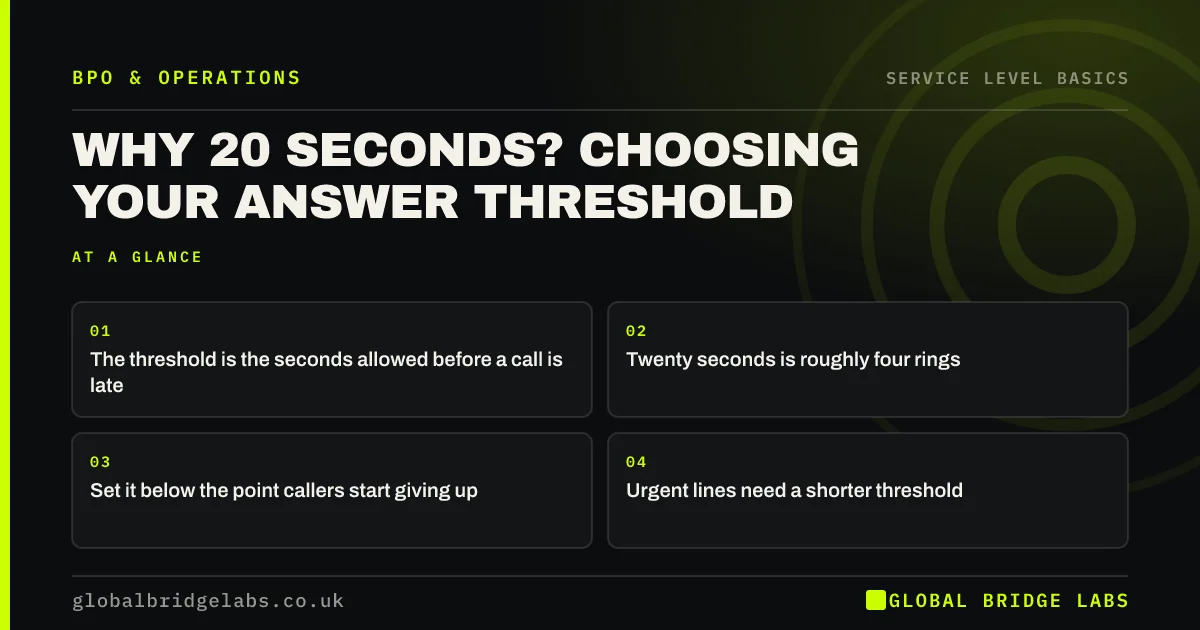
- Threshold: the seconds allowed before a call counts as late.
- ASA: average speed of answer, the mean wait of answered calls.
- Longest delay: the longest wait in a period.
Queue terms
- Calls offered: every call that reached the queue.
- Abandoned call: a caller who hung up before being answered.
- Short abandon: a caller who hung up within a few seconds.
- Overflow: sending calls to another team when the queue is full.
Staffing terms
- Handling time: talk time plus hold time plus after-call work.
- Occupancy: the share of logged-in time spent handling calls.
- Shrinkage: paid time when staff are not available, such as breaks and training.
- Adherence: being available when the rota says so.
- Erlang: a unit of phone traffic; one Erlang is one hour of calls per hour.
- Average handling time: what it is and when to lower it
- Shrinkage: why your rota keeps missing 80/20
- Schedule adherence: on the phones when planned
Want a glossary added to your own call reports? Ask us on WhatsApp.
Chat on WhatsApp →Quality terms
- First contact resolution: the share of issues solved on the first contact.
- Call reason code: a label for why the customer called.
- Repeat caller: someone who calls again about the same issue.
- Post-call survey: a short question asked after a call.
Why agree definitions?
Two reports can use the same word for different calculations. Agree definitions with anyone who reports on your calls, including providers, and print them on the report so the numbers mean the same thing every month.
What does this look like in practice?
A pattern we see: an owner and a provider argue about "missed calls" for weeks. One means abandoned calls, the other means calls answered late. A one-page glossary ends the argument and makes reports easier to act on.
Glossary checklist
- Agree a definition for each reported term.
- Note the formula next to each figure.
- Share the glossary with every provider.
- Use plain words in internal reports.
- Review definitions once a year.
Next step
Take your latest call report, list every term on it, and write a one-line definition for each that both your team and any provider agree with.
Message us on WhatsApp for help with call reporting, or book a 30-minute consultation.
Chat on WhatsApp →Sources and further reading
- Writing to GOV.UK standards: writing guidelines · GOV.UK
- Measuring success · GOV.UK Service Manual
Frequently asked questions
What is the difference between occupancy and utilisation?
Occupancy is the share of time staff are logged in that they spend handling calls. Utilisation usually means the share of paid time spent handling calls, so it also reflects breaks and training. Definitions vary between providers, so always ask how each term is calculated before comparing figures.
What does an Erlang mean?
An Erlang is a unit of phone traffic. One Erlang equals one hour of call time arriving per hour, enough to keep one person busy continuously. Erlang C is a formula that uses this traffic to estimate how many people you need to meet a service level target.
What is a calls offered figure?
Calls offered is the total number of calls that reached your queue in a period, whether answered or abandoned. It is the starting point for service level and abandonment rate. Check whether it includes calls that hung up in the phone menu, because systems count this differently.
Written by

Global Bridge Labs (GBL) is a UK–Sri Lanka partner for social media, websites and BPO. Everything here comes from client delivery, not theory.