On this page
- 01Key takeaways
- 02What is a scalable website?
- 03What breaks first as traffic grows?
- 04Where does manual work hide in a website?
- 05Can your team change the site themselves?
- 06What does making a site scalable cost?
- 07When is a simple site enough?
- 08What does this look like in practice?
- 09Scalable website checklist
- 10Next step
- 11Sources and further reading
- 12Frequently asked questions
Key takeaways
A scalable website is one that can handle more visitors, more orders and more content without slowing down or needing manual work for each transaction. As a business grows, websites usually break in four places: speed under load, manual order or enquiry handling, content that only a developer can change, and tracking that no longer adds up.
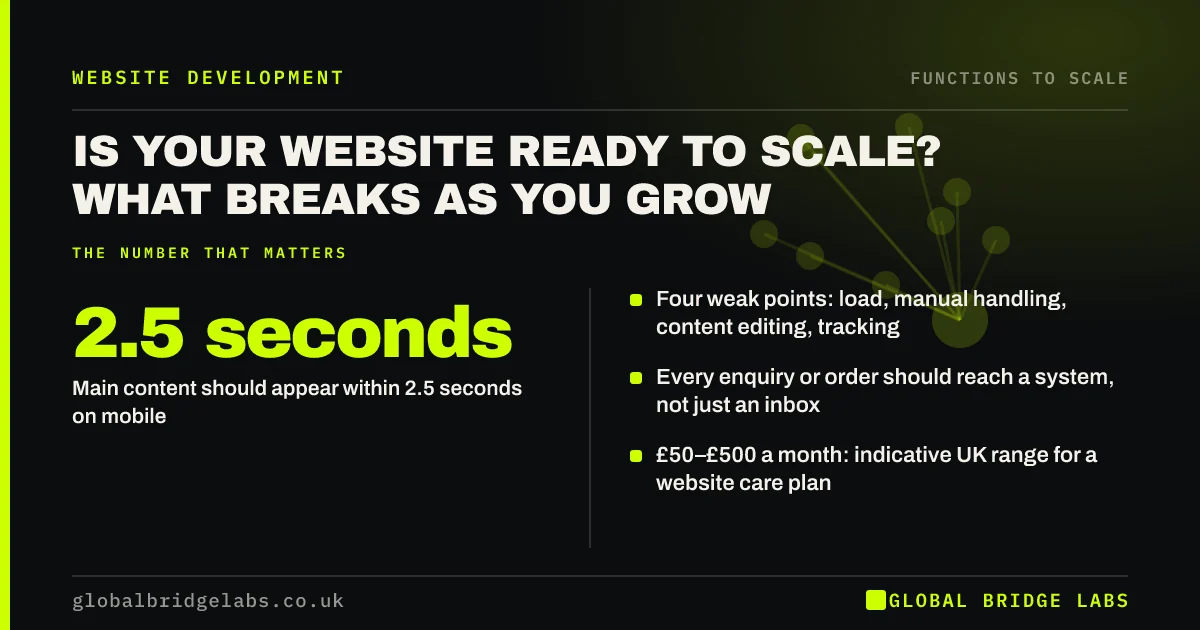
- Four weak points: load, manual handling, content editing, tracking.
- Main content should appear within 2.5 seconds on mobile.
- Every enquiry or order should reach a system, not just an inbox.
- £50–£500 a month: indicative UK range for a website care plan.
Planning growth and unsure the site will cope? Message us on WhatsApp with your URL.
Chat on WhatsApp →What is a scalable website?
A scalable website is a site built so that increases in traffic, transactions and content do not require proportionate increases in cost, manual effort or developer time. For a small business that means fast pages at peak times, forms and orders that flow into the right system, and pages staff can update themselves.
What breaks first as traffic grows?
Speed breaks first. A site on low-cost shared hosting can be fine with a few hundred visits a day and stall during a campaign. Google's Core Web Vitals guidance sets a target of 2.5 seconds for the largest content element to appear. Pages that miss it at busy times lose visitors exactly when you paid most to attract them.
Where does manual work hide in a website?
Manual work hides behind the form. An enquiry that arrives as an email and is retyped into a CRM, a booking confirmed by phone, an order copied into a spreadsheet: each takes minutes and each multiplies with growth. A scalable site passes the data straight into the system that needs it.
- Enquiries into the CRM automatically.
- Bookings into the diary with confirmations.
- Orders into stock and accounts.
- Customer questions answered on the page.
Can your team change the site themselves?
If every new service page, price change or team update needs a developer, the site will fall behind the business. A scalable website has a content management system with reusable page templates, so non-technical staff or a managed team can add pages safely while the design stays consistent.
What does making a site scalable cost?
Costs depend on the starting point. As indicative UK market ranges, managed hosting is £20–£100 a month, a care plan £50–£500 a month, speed work on an existing site £500–£3,000, and a rebuild on a better platform £5,000–£20,000 or more. Integrations with booking, CRM or accounts systems are scoped separately.
Want to discuss your requirements for a site that keeps up with growth? Send us your URL on WhatsApp.
Chat on WhatsApp →When is a simple site enough?
A simple site is enough when volume is low and each enquiry is high value and handled personally. A five-page site that loads quickly and sends enquiries to one inbox suits many local firms. Build for the growth you can reasonably see in the next two years, not for traffic you may never have.
What does this look like in practice?
A pattern we see in UK service and booking businesses: the site was built when there were ten enquiries a week, each handled by the owner. At fifty a week the same form still sends a plain email, bookings are confirmed by hand and double bookings appear. Connecting the form to the diary removes work that a new hire was about to be recruited for.
Scalable website checklist
Check these before a campaign or busy season.
- Test page speed on mobile at a busy time.
- Confirm hosting can handle a traffic spike.
- Trace an enquiry from form to CRM.
- Count manual steps per booking or order.
- Ask who can add a page without a developer.
- Check that enquiries and sales are tracked by source.
- Confirm backups, updates and security are someone's job.
Next step
Send us your website address and roughly how many enquiries or orders it handles a week. We will point out what is likely to break first as that number grows.
Message us on WhatsApp for a website scalability check, or book a 30-minute consultation.
Chat on WhatsApp →Sources and further reading
- Understanding Core Web Vitals and Google search results · Google Search Central
- PageSpeed Insights · Google
- Optimise Largest Contentful Paint · web.dev (Google)
Frequently asked questions
What makes a website scalable?
A website is scalable when it stays fast as traffic rises, passes enquiries and orders into business systems without retyping, and lets staff add or change content without a developer. Good hosting, a sound content management system and integrations with booking, CRM and accounts tools are the main ingredients.
How do I know if my website can handle more traffic?
Check how it performs at your busiest times, using field data in Google's PageSpeed Insights and your analytics. Ask your host what resources your plan includes and what happens at the limit. If pages slow or errors appear during campaigns, the site needs attention before you spend more on traffic.
Do I need a new website to scale my business?
Not always. Many sites can be made ready for growth with better hosting, speed fixes and integrations to booking or CRM systems. A rebuild is worth considering when the platform cannot be extended, staff cannot edit content, or fixes would cost more than starting again.
How can a website reduce admin as a business grows?
A website reduces admin by answering common questions clearly, taking bookings and payments online, and sending form data straight into your CRM, diary or order system. Each manual step removed per enquiry or order saves minutes that multiply as volume grows.
Written by

Global Bridge Labs (GBL) is a UK–Sri Lanka partner for social media, websites and BPO. Everything here comes from client delivery, not theory.