On this page
- 01Key takeaways
- 02Why do customers want more contact channels?
- 03What does each channel need in staffing terms?
- 04How do you decide which channel to add?
- 05When should you outsource a new channel?
- 06How do you keep answers consistent across channels?
- 07What are the risks of adding too many channels?
- 08What does adding a channel cost?
- 09Should you use chatbots to cover new channels?
- 10What does this look like in practice?
- 11New channel checklist
- 12Next step
- 13Sources and further reading
- 14Frequently asked questions
Key takeaways
Adding customer service channels, such as WhatsApp or live chat, only helps if each one is answered quickly. A channel that is slow is worse than no channel. Add one channel at a time, set a reply-time target for it, and staff it before launch. If the current team cannot meet the target, outsource that channel or its busiest hours.
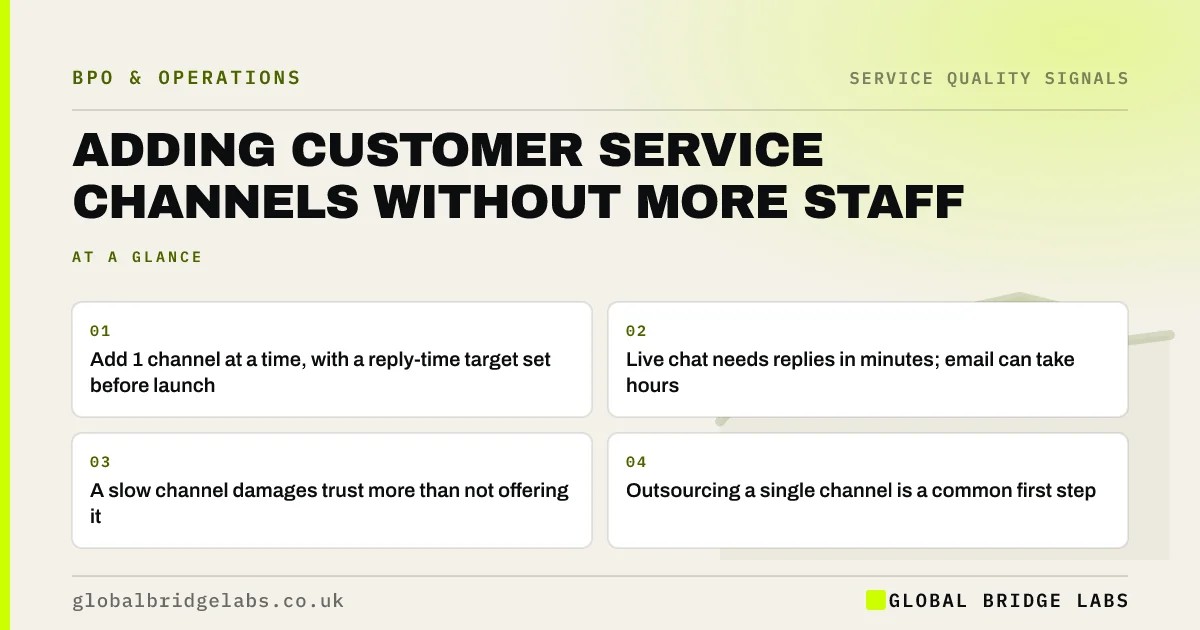
- Add 1 channel at a time, with a reply-time target set before launch.
- Live chat needs replies in minutes; email can take hours.
- A slow channel damages trust more than not offering it.
- Outsourcing a single channel is a common first step.
Thinking about adding WhatsApp or chat? Message us on WhatsApp and we will help you plan it.
Chat on WhatsApp →Why do customers want more contact channels?
Because different customers prefer different ways to get help, and many expect to message a business the way they message friends. WhatsApp, live chat and social messages feel quicker than email. The catch is that each channel creates its own expectations of speed, and small teams cannot watch them all at once.
What does each channel need in staffing terms?
Channels differ most in how quickly customers expect a reply. That decides how many people must be watching it and when.
- Phone: answered live, so needs someone available throughout opening hours.
- Live chat: replies within a minute or two while the customer is on the site.
- WhatsApp and social messages: replies within minutes to an hour.
- Email: replies within hours, up to one working day.
How do you decide which channel to add?
Add the channel your customers already try to use. Check where unprompted messages arrive: Facebook messages, WhatsApp texts to a mobile, chat requests on competitors' sites. Then add the one with the most demand and the best fit for your questions. Simple, quick questions suit chat and WhatsApp; complex cases suit phone and email.
Not sure which channel to add first? Ask us on WhatsApp.
Chat on WhatsApp →When should you outsource a new channel?
Outsource when the channel needs faster replies than the current team can give without dropping other work, or when it needs longer hours. Live chat is the most common example: it needs someone watching all the time, which a small team rarely has. Outsourcing one channel also lets you test demand before hiring.
How do you keep answers consistent across channels?
Use one written guide and one record of each customer. Every channel should give the same answers, and a customer who emails then messages on WhatsApp should not have to repeat themselves. A shared helpdesk that brings channels into one view makes this far easier, whoever is answering.
What are the risks of adding too many channels?
The main risk is spreading capacity too thinly, so every channel becomes slow. Another is fragmentation: customer history split across tools, and messages missed in apps nobody checks. Only add a channel you can staff to its reply-time target, and close ones you cannot.
What does adding a channel cost?
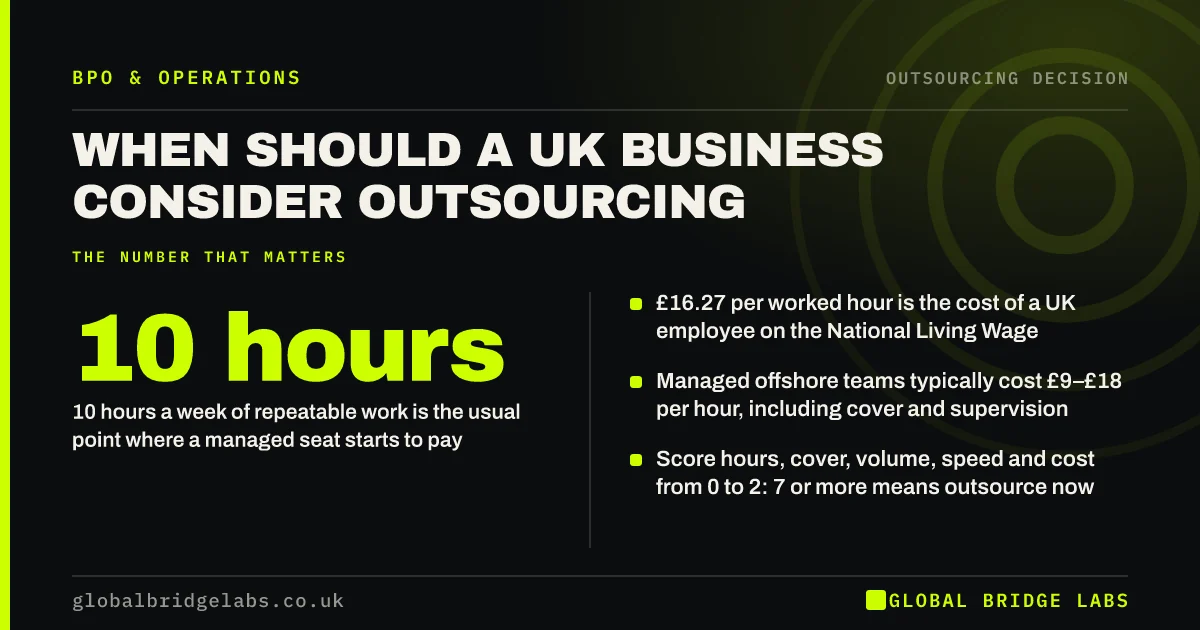
The cost is the hours needed to meet the reply-time target during the hours you offer it, plus any tool licences. Live chat covering 9am to 6pm needs someone available for nine hours a day, even if messages are light. As indicative ranges, managed offshore teams cost £9–£18 per hour, which is often less than dedicating an in-house person.
Should you use chatbots to cover new channels?
Chatbots and automated replies can handle simple, predictable questions such as opening hours or order tracking, and they can collect details before a person picks up. They are weaker on anything unusual or emotional. A common set-up is automation for the first step and a person, in-house or outsourced, for everything else, with an easy way to reach a human.
What does this look like in practice?
A pattern we see in UK hospitality and e-commerce businesses: WhatsApp is added because customers ask for it, but messages are answered only when staff are free, often hours later. Outsourcing WhatsApp during opening hours, with the same written guide as email, turns the channel into a quick way to book and buy.
New channel checklist
Use this before adding a channel.
- Check where customers already try to contact you.
- Pick one channel and set its reply-time target.
- Work out the hours needed to meet it.
- Decide in-house or outsourced before launch.
- Use one guide and one customer record across channels.
- Review volume and reply times after eight weeks.
Next step
Tell us which channel you want to add and your current volumes. We will tell you what it will take to staff it properly.
Message us on WhatsApp about new channels, or book a 30-minute consultation.
Chat on WhatsApp →Sources and further reading
- How to use click to chat · WhatsApp Help Center
- UK Customer Satisfaction Index · Institute of Customer Service
- Contracts and liabilities between controllers and processors · Information Commissioner's Office
Frequently asked questions
How many customer service channels should a small business offer?
As many as you can answer quickly, and no more. Most small businesses do well with phone or email plus one messaging channel, such as WhatsApp or live chat. Add another only when you can staff it to its reply-time target.
Is live chat worth it for a small business?
It can be, if someone can reply within a minute or two while customers are on the site. Unanswered chat feels worse than no chat. If you cannot staff it, outsource it for the busiest hours or use a clear contact form instead.
Can I outsource just one customer service channel?
Yes, and it is a common first step. Outsourcing live chat or WhatsApp while keeping phone and email in-house lets you test demand and speed. Use one written guide and a shared helpdesk so answers stay consistent across channels.
Written by

Global Bridge Labs (GBL) is a UK–Sri Lanka partner for social media, websites and BPO. Everything here comes from client delivery, not theory.