On this page
- 01Key takeaways
- 02What is the difference between the two?
- 03How do the costs compare?
- 04What duties come with remote employees?
- 05Which scales faster?
- 06How do control and culture compare?
- 07When is each the better choice?
- 08What does this look like in practice?
- 09Remote hire or outsource checklist
- 10Next step
- 11Sources and further reading
- 12Frequently asked questions
Key takeaways
Remote employees vs outsourcing is a choice between employing people who work away from your office and buying a managed service. Remote hiring widens the talent pool but keeps every employer duty and fixed cost. Outsourcing transfers recruitment, supervision and cover to a provider and scales faster, with less direct control over individuals.
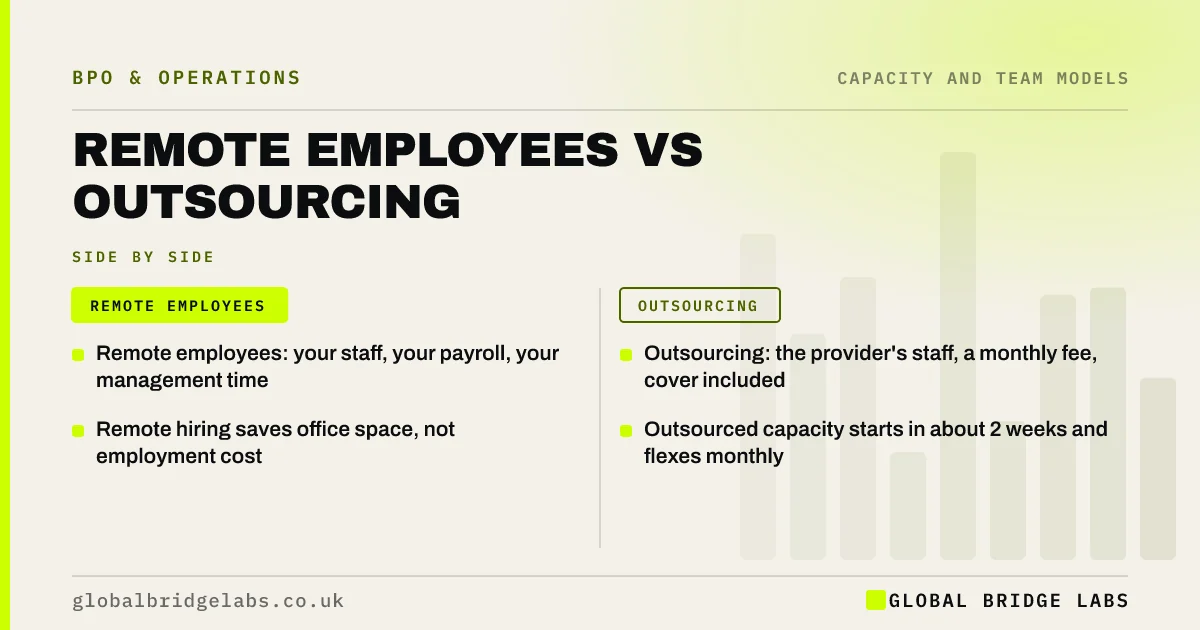
- Remote employees: your staff, your payroll, your management time.
- Outsourcing: the provider's staff, a monthly fee, cover included.
- Remote hiring saves office space, not employment cost.
- Outsourced capacity starts in about 2 weeks and flexes monthly.
Weighing a remote hire against a managed seat? Message us on WhatsApp with the role.
Chat on WhatsApp →What is the difference between the two?
A remote employee is on your payroll and works from home or another location. An outsourced team member is employed by a provider that delivers a service to you. The difference is who carries the employment relationship, with its costs, duties and risks, and who is responsible for the result.
How do the costs compare?
A UK remote employee costs the same to employ as an office-based one: salary, employer National Insurance at 15% above £5,000, at least 3% pension, paid holiday and equipment. That is about £16.27 per worked hour at the 2026/27 National Living Wage. The saving is in desk space. Indicative rates for managed offshore teams are £9–£18 per hour.
What duties come with remote employees?
Every employer duty applies to remote staff. You must check right to work, run payroll, provide a workplace pension, hold employers' liability insurance of at least £5 million and look after health and safety, including for home workers. Employing someone who lives abroad adds tax and employment law questions in their country.
- Right to work checks before employment starts.
- Payroll, pension and statutory pay.
- Employers' liability insurance.
- Health and safety for home working.
- Equipment, security and data protection.
Which scales faster?
Outsourcing scales faster. Recruiting a remote employee still takes 4 to 12 weeks from advert to a trained person, and each one adds to what you manage. A provider can usually add a trained seat in about two weeks and reduce hours with notice. For steady, core roles the slower route can still be the right one.
Need capacity this quarter, not next? Tell us the work on WhatsApp and we will discuss your requirements.
Chat on WhatsApp →How do control and culture compare?
Remote employees are part of your team: you choose them, direct them daily and build long-term knowledge. With outsourcing you direct the outcome and the provider manages the people. Both need written processes and regular contact. Remote work without those is as loosely controlled as badly run outsourcing.
When is each the better choice?
Choose a remote employee for a core, full-time role where you want the person for years and local talent is scarce. Choose outsourcing for repeatable work, variable volume, cover across hours, or when you need capacity quickly. Many firms use both: remote specialists in the core team and a managed team for volume.
- Remote employee: core, full-time, long-term, judgement-heavy.
- Outsourcing: repeatable, variable, needs cover, needed soon.
What does this look like in practice?
A pattern we see in UK firms after moving to home working: the business advertises a remote administrator nationally to save on salary, then discovers that managing, covering and equipping a lone remote employee takes more of the owner's time than expected. A managed seat with a team leader and backup removes that load.
Remote hire or outsource checklist
Answer these for the role in question.
- Is the role core to what customers pay for?
- Will it be fully used every week?
- How soon is the capacity needed?
- Who will manage and cover the person?
- Is the process written down?
- What is the loaded annual cost against a quoted service?
Next step
Send us the role description and weekly hours. We will set out the remote hire and managed team options side by side.
Message us on WhatsApp for a side-by-side comparison, or book a 30-minute consultation.
Chat on WhatsApp →Sources and further reading
Frequently asked questions
Is hiring remote staff the same as outsourcing?
No. Remote staff are your employees working away from the office, so you carry payroll, employer duties and management. Outsourcing means a provider employs and manages the people and delivers a service to you. Remote hiring changes where staff work. Outsourcing changes who is responsible for the work.
Is it cheaper to hire remote employees?
Remote employees based in the UK cost the same to employ as office staff, apart from savings on desk space. Salary, employer National Insurance, pension and paid holiday all still apply. Savings come mainly from lower office costs, not from the employment itself.
Can a UK company employ someone who lives overseas?
It can, but it is not simple. The employee's country of residence may require local payroll, tax and social security registration and apply its own employment law. Many small businesses use an employer of record or a managed outsourcing provider instead of employing overseas staff directly.
Which is easier to manage, remote staff or an outsourced team?
An outsourced team is usually easier for the owner, because the provider supplies team leaders, quality checks and cover. Remote employees need the same line management as office staff, with extra effort on communication. Both depend on written processes and regular reviews to work well.
Written by

Global Bridge Labs (GBL) is a UK–Sri Lanka partner for social media, websites and BPO. Everything here comes from client delivery, not theory.