On this page
- 01Key takeaways
- 02What do we mean by culture here?
- 03Does outsourcing damage culture?
- 04How do you pass culture to an outside team?
- 05How do you include people you do not employ?
- 06Why does fair treatment matter for service?
- 07Where are the limits?
- 08What does this look like in practice?
- 09Culture checklist
- 10Next step
- 11Sources and further reading
- 12Frequently asked questions
Key takeaways
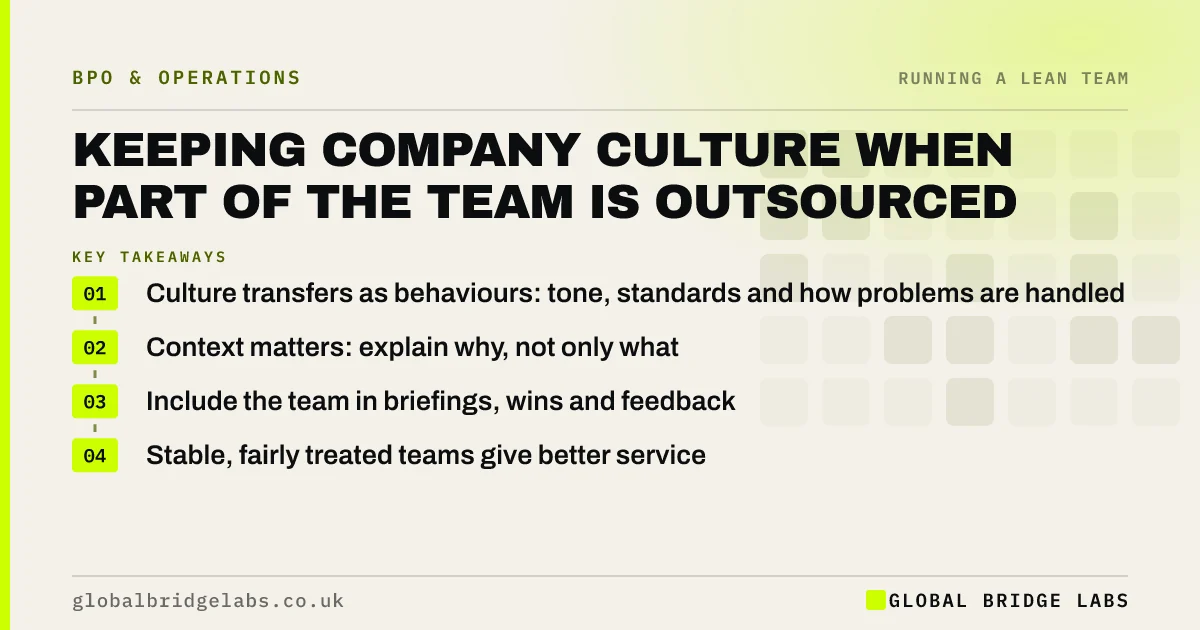
Company culture with an outsourced team is kept by treating culture as a set of behaviours you can describe and teach, not a feeling in the office. Write down how customers are spoken to and how problems are handled, give the outsourced team context and feedback, and treat them as colleagues. Customers feel the difference.
- Culture transfers as behaviours: tone, standards and how problems are handled.
- Context matters: explain why, not only what.
- Include the team in briefings, wins and feedback.
- Stable, fairly treated teams give better service.
Worried an outside team will not sound like you? Message us on WhatsApp with examples of your tone.
Chat on WhatsApp →What do we mean by culture here?
Company culture is the shared way people in a business behave, decide and treat customers and each other. For practical purposes it shows up as tone of voice, standards of work, how mistakes are handled and what gets praised. Those are the parts a team outside the building can learn.
Does outsourcing damage culture?
Outsourcing damages culture when it is done in a way that tells staff routine colleagues are disposable or when the outside team is treated as a faceless supplier. It does not damage culture when the purpose is explained, the in-house team gains better work and the outsourced team is included. The handling matters more than the structure.
How do you pass culture to an outside team?
Pass culture on by making it specific. Give examples of good and poor replies. Explain who your customers are and what they worry about. Share the stories behind your rules. People apply judgement well when they understand the reason for a standard, and poorly when they are only given a script.
- A tone guide with real examples.
- A short introduction to your customers and history.
- Reasons behind key rules.
- Feedback on real cases every week.
How do you include people you do not employ?
Include them in the parts of working life that relate to the work. Introduce them by name to the in-house team. Invite them to briefings about new products or changes. Share customer praise with the person who earned it. Small acts of inclusion cost nothing and noticeably improve care and accuracy.
- Names and faces shared on both sides.
- A place in relevant briefings.
- Praise passed on directly.
- Questions welcomed without blame.
Want an induction pack drafted for an outside team? Send us your tone examples on WhatsApp.
Chat on WhatsApp →Why does fair treatment matter for service?
Fair treatment matters because turnover in the team handling your customers costs you knowledge every time someone leaves. Ask a provider how it pays, schedules and develops its people, and how long they stay. A stable team that feels respected learns your business and represents it better.
Where are the limits?
There are limits. An outsourced team works for several interests and will not share every aspect of your culture, and you should not direct the provider's employees as though you employed them. Aim for shared standards on your work, mutual respect and good communication. That is enough for customers to experience one business.
What does this look like in practice?
A pattern we see in UK firms with a distinctive, friendly tone: the first outsourced replies are correct but stiff. A one-page guide with ten real examples, and a fortnight of specific feedback, usually brings the tone into line. Customers then cannot tell which team replied.
Culture checklist
Prepare these before the team starts.
- A one-page tone and values guide with examples.
- A short briefing on customers and history.
- Introductions between both teams.
- A channel for questions without blame.
- Weekly feedback on real cases.
- A way to share praise and results.
- Questions to the provider about staff retention.
Next step
Send us a few examples of how you like customers to be spoken to. We will show you how that becomes a guide an outside team can follow.
Message us on WhatsApp for a tone guide outline, or book a 30-minute consultation.
Chat on WhatsApp →Sources and further reading
- What are the Management Standards for work-related stress? · Health and Safety Executive
- Slavery and human trafficking in supply chains: guidance for businesses · Home Office
Frequently asked questions
Does outsourcing affect company culture?
It can, in either direction. Outsourcing handled openly, with a clear purpose and better work for in-house staff, usually leaves culture intact. Outsourcing introduced abruptly, or with the outside team kept at a distance, can create mistrust. Communication and inclusion decide the outcome.
How do you make an outsourced team feel part of the company?
Introduce them by name, explain the business and its customers, include them in relevant briefings, give regular feedback and share praise directly. Treat questions as welcome. These habits build commitment and context, which show up as better judgement in customer conversations.
Can an outsourced team represent my brand properly?
Yes, with a tone guide, real examples and feedback. Brand voice is a learnable set of choices about words, warmth and how problems are handled. Most teams match it within a few weeks when they are shown what good looks like and corrected specifically.
What should I ask a provider about how it treats staff?
Ask about pay relative to the local market, working hours and night shifts, training and progression, average length of service and annual staff turnover. Ask to meet the people who would work on your account. The answers indicate how stable and motivated your team will be.
Written by

Global Bridge Labs (GBL) is a UK–Sri Lanka partner for social media, websites and BPO. Everything here comes from client delivery, not theory.