On this page
- 01Key takeaways
- 02What is an employer of record?
- 03How does an EOR differ from outsourcing?
- 04What does each cost?
- 05When does an employer of record make sense?
- 06When does outsourcing make more sense?
- 07What compliance points apply?
- 08What should you check in an EOR contract?
- 09What does this look like in practice?
- 10EOR or outsourcing checklist
- 11Next step
- 12Sources and further reading
- 13Frequently asked questions
Key takeaways
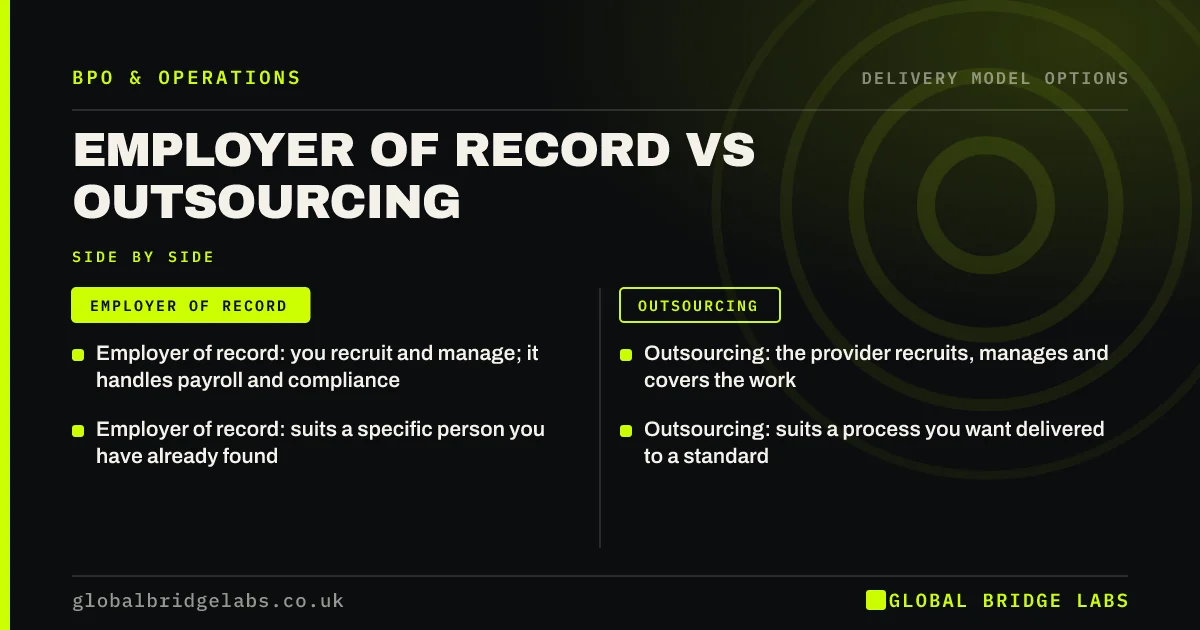
Employer of record vs outsourcing is about who manages the work. An employer of record (EOR) legally employs a person abroad for you, handling payroll and local compliance, while you recruit and manage them. Outsourcing buys a managed service, with recruitment, supervision and cover included. EOR suits individual hires; outsourcing suits processes.
- Employer of record: you recruit and manage; it handles payroll and compliance.
- Outsourcing: the provider recruits, manages and covers the work.
- Employer of record: suits a specific person you have already found.
- Outsourcing: suits a process you want delivered to a standard.
Hiring abroad or outsourcing? Message us on WhatsApp to compare the two.
Chat on WhatsApp →What is an employer of record?
An employer of record (EOR) is a company that becomes the legal employer of a worker in another country on your behalf. It issues the local employment contract, runs payroll, pays taxes and statutory contributions, and keeps you compliant with local law. You direct the person's work day to day, as if they were your employee.
How does an EOR differ from outsourcing?
With an EOR, you are still effectively running an in-house employee remotely: you recruit, train, manage and cover them. With managed outsourcing, the provider does all of that and delivers the work to agreed service levels. The EOR handles the paperwork; the outsourcing provider handles the operation.
- Recruitment: you (EOR) or the provider (outsourcing).
- Supervision and quality: you (EOR) or the provider (outsourcing).
- Holiday and sickness cover: you (EOR) or the provider (outsourcing).
- Pricing: salary plus an EOR fee, or an all-in service rate.
What does each cost?
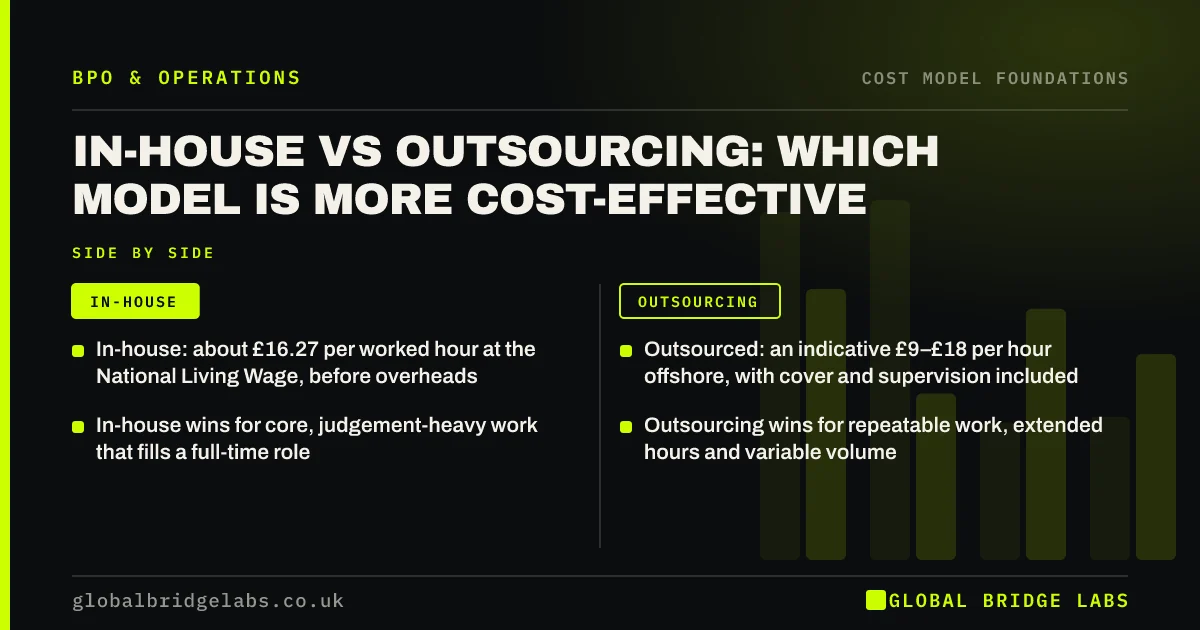
With an EOR, you pay the person's salary and local employer costs, plus the EOR's monthly fee per employee, plus your own recruitment, equipment and management time. With managed outsourcing, you pay an all-in rate, an indicative £9–£18 per hour offshore for support and admin, with those costs included.
For one skilled person you have already found, an EOR can be cheaper. For a process needing cover and supervision, outsourcing usually is.
Want both options priced for your role? Send us the details on WhatsApp.
Chat on WhatsApp →When does an employer of record make sense?
When you have found a specific person abroad you want to employ long term, when you have the management capacity to lead them remotely, and when setting up your own overseas entity is not justified. Common for senior specialists and remote hires in software.
When does outsourcing make more sense?
When you need a function run, not a person hired: customer support, admin, data work or bookkeeping that needs cover, supervision and quality checks. Outsourcing also scales more easily, because the provider can add or remove team members without new employment contracts on your side.
What compliance points apply?
Either way, personal data sent abroad is an international transfer under UK GDPR and needs a safeguard. Make sure the EOR contract assigns intellectual property to you. The worker's employment status is governed by the country where they work.
What should you check in an EOR contract?
Check what the monthly fee covers and what is charged on top: benefits administration, equipment, termination costs and currency conversion. Confirm that intellectual property created by the worker is assigned to you, how data is protected, and how quickly the EOR can end the arrangement if the role ends.
- Fee per employee and all extra charges.
- IP assignment to your business.
- Data protection and transfer terms.
- Termination process and local notice rules.
What does this look like in practice?
A pattern we see in UK SMEs: a founder uses an EOR to employ a senior developer they already know overseas, and separately outsources customer support to a managed team. The EOR suits the one known individual; outsourcing suits the process that needs cover.
EOR or outsourcing checklist
Answer these first.
- Are you hiring a known person or buying a function?
- Who will manage the work day to day?
- Who covers holidays and sickness?
- Have you costed salary, fees and management time?
- Is IP assigned to you in the contract?
Next step
Tell us whether you have a person or a process in mind. We will compare an EOR and managed outsourcing in a 30-minute call.
Message us on WhatsApp for an EOR vs outsourcing comparison, or book a 30-minute consultation.
Chat on WhatsApp →Sources and further reading
- International transfers of personal data · Information Commissioner's Office
- Employment status · GOV.UK
- The Sourcing and Consultancy Playbooks · Cabinet Office
Frequently asked questions
What is the difference between an EOR and outsourcing?
An employer of record legally employs a worker abroad for you and handles payroll, taxes and local compliance, while you recruit and manage them day to day. Outsourcing buys a managed service in which the provider recruits, supervises, covers and delivers the work to agreed service levels.
Is an employer of record cheaper than outsourcing?
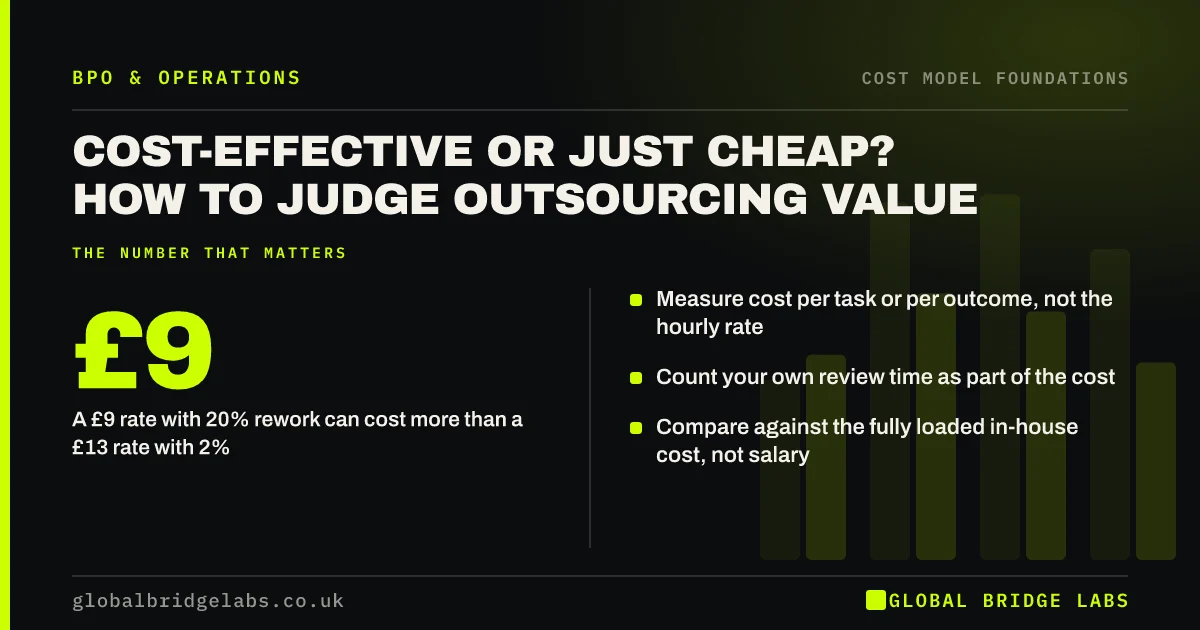
For one skilled person you have already found and can manage yourself, it can be. For a process that needs cover, supervision and quality checks, managed outsourcing is usually cheaper once your management time, recruitment and cover arrangements are counted properly.
Do I need my own overseas company to hire abroad?
Not with an employer of record or a managed provider. Setting up your own entity only makes sense at larger scale, when the fixed costs of the entity, office, compliance and local management are spread across many long-term roles rather than one or two people.
Who is responsible for an EOR worker's performance?
You are. The employer of record handles the legal employment and payroll, but you set the work, manage performance and give feedback, just as with an in-house employee. If performance problems arise, you work with the EOR to follow the local process.
Written by

Global Bridge Labs (GBL) is a UK–Sri Lanka partner for social media, websites and BPO. Everything here comes from client delivery, not theory.