On this page
- 01Key takeaways
- 02Why does speed matter for professional firms?
- 03What slows professional services websites?
- 04Which pages matter most?
- 05Does mobile matter for a desk-based audience?
- 06What should not be sacrificed for speed?
- 07What does this look like in practice?
- 08Professional services speed checklist
- 09Next step
- 10Sources and further reading
- 11Frequently asked questions
Key takeaways
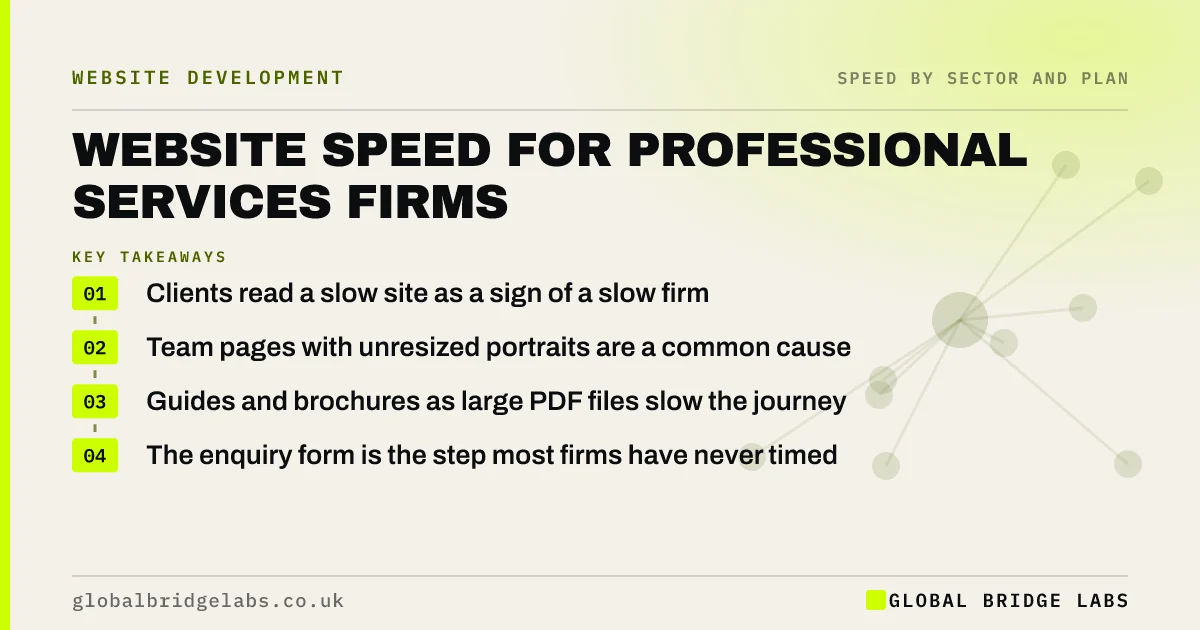
For a professional services firm, website speed is a credibility signal. Clients are buying judgement and responsiveness, and they cannot see either before they instruct you. They can see how your website behaves. Firm sites are usually slow because of carousels, team photographs, heavy themes and document downloads. Visitors arrive cautious and comparing, often on a phone between meetings.
- Clients read a slow site as a sign of a slow firm.
- Team pages with unresized portraits are a common cause.
- Guides and brochures as large PDF files slow the journey.
- The enquiry form is the step most firms have never timed.
Want to know what your site says about your firm on a phone? Send us the URL on WhatsApp.
Chat on WhatsApp →Why does speed matter for professional firms?
Speed matters because the purchase is high-trust and the evidence is thin. A prospective client choosing a solicitor, accountant or broker has little to compare beyond how each firm presents itself. A site that responds promptly supports the claim that the firm will. One that stalls contradicts it.
The Nielsen Norman Group's work on response times notes that delays make people feel less in control and less confident the system is working. On a firm's website, that unease transfers to the firm.
What slows professional services websites?
The causes reflect what firms like to show.
- Homepage carousels of practice areas or awards.
- Team pages with dozens of large portrait photographs.
- Stock imagery at full resolution on every page.
- Corporate themes with animation and mega-menus.
- Accreditation logos and review widgets loaded from other sites.
- Brochures, guides and terms supplied as large PDF files.
Which pages matter most?
Prospective clients land on service pages and individual profiles more than the homepage. A search for a specific need, such as a commercial lease or a self-assessment deadline, leads to the page about that service. A referral leads to the profile of the named person.
- Service pages: what you do, for whom, and what it costs or how it is priced.
- Profile pages: one portrait, sized correctly, with direct contact details.
- Contact page: a form that confirms immediately.
- Articles: often the first page a search visitor sees.
- Slow enquiry forms: the wait after a visitor clicks Send
- How to write a service page that wins enquiries
Want your service and profile pages tested on mobile? Ask us on WhatsApp.
Chat on WhatsApp →Does mobile matter for a desk-based audience?
Yes, more than firms assume. The first look often happens on a phone: after a recommendation, from a LinkedIn post or in the gap between meetings. The enquiry may come later from a desk, but the impression was formed on mobile, and Google indexes the mobile version regardless of your audience's habits.
Check your own device split before deciding priorities. Many firms find mobile is a third to a half of visits.
What should not be sacrificed for speed?
Do not strip out the content that builds confidence. Regulated firms have information they must publish, and clients want to see people, credentials and fees. Those belong on the site. The task is to deliver them efficiently: sized portraits, text instead of images of text, and web pages instead of PDF downloads where possible.
What does this look like in practice?
A pattern we see in firms of ten to fifty people: the team page loads every portrait at camera resolution, and it is the second most visited page on the site. A referred client looking for one named adviser waits while forty photographs download.
Resizing the portraits and loading them as the visitor scrolls makes that page quick and costs nothing in appearance. Global Bridge Labs (GBL) checks team and profile pages first on professional services sites.
Professional services speed checklist
- Check which pages receive most first visits.
- Test service, profile and team pages on a phone.
- Resize every portrait.
- Replace the homepage carousel with one clear statement.
- Convert key PDF guides to web pages.
- Submit the enquiry form and time the confirmation.
Next step
Your website is the first piece of work a prospective client sees from your firm. We will check how promptly it responds and what to tidy first.
Message us on WhatsApp for a speed review of your firm's website.
Chat on WhatsApp →Sources and further reading
- Website response times · Nielsen Norman Group
- Understanding Core Web Vitals and Google search results · Google Search Central
- PDF: still unfit for human consumption, 20 years later · Nielsen Norman Group
Frequently asked questions
Does website speed matter for a law firm or accountancy practice?
Yes. Prospective clients have little to judge a firm by before instructing it, and a slow site suggests a slow firm. Speed also affects how many search and referral visitors stay long enough to read a service page or make contact.
Why is my firm's team page so slow?
Team pages often load every portrait at full camera resolution. Resizing the photographs to the size displayed, using a modern format and loading those further down as the visitor scrolls usually fixes it.
Do professional services clients use mobile?
Often for the first visit, after a recommendation or from a social post, even when the enquiry is later sent from a desk. Check your analytics. Many firms find that a third to a half of visits are on phones.
Should a firm publish guides as PDFs?
Web pages are better for speed and for reading on a phone. They load with the site, can be found by search engines and need no separate viewer. Offer a PDF as an optional download where clients may want to print or save it.
Written by

Global Bridge Labs (GBL) is a UK–Sri Lanka partner for social media, websites and BPO. Everything here comes from client delivery, not theory.