On this page
- 01Key takeaways
- 02Why do stock photos hurt trust?
- 03Where are stock photos most damaging?
- 04When are stock photos acceptable?
- 05How do you replace them without a big budget?
- 06What about consent and copyright?
- 07When do stock photos point to a redesign?
- 08What photos should a small business take first?
- 09What does this look like in practice?
- 10Image replacement checklist
- 11Next step
- 12Sources and further reading
- 13Frequently asked questions
Key takeaways
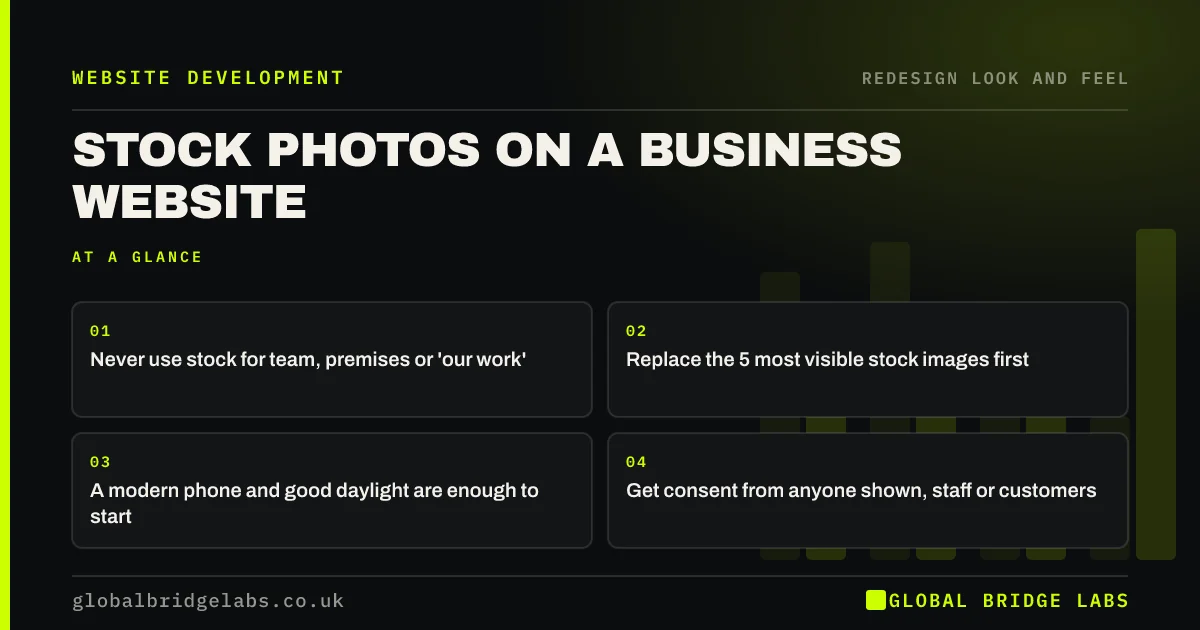
Stock photos hurt most where buyers expect to see you: team, premises, completed work and the homepage. They are acceptable for abstract ideas or backgrounds. Replacing the five most visible stock images with real photos taken on a modern phone usually does more for trust than a redesign.
- Never use stock for team, premises or 'our work'.
- Replace the 5 most visible stock images first.
- A modern phone and good daylight are enough to start.
- Get consent from anyone shown, staff or customers.
Want to know which images to replace first? Send us the URL on WhatsApp.
Chat on WhatsApp →Why do stock photos hurt trust?
Stock photos hurt trust because visitors recognise them. A handshake in a glass office or a smiling model in a headset tells buyers nothing about your business, and it suggests you have something to hide or nothing real to show. Real photographs prove you exist and show the quality of your work.
Where are stock photos most damaging?
Wherever buyers expect evidence. These are the places to replace first.
- The homepage hero, which sets the first impression.
- The team or About page.
- Case studies and 'our work' galleries.
- Service pages for hands-on trades.
- Contact pages showing premises.
When are stock photos acceptable?
For abstract concepts, textures and backgrounds, and on blog posts where the image illustrates an idea rather than claiming to show your business. Even there, a simple diagram or a photo from your own work usually does the job better.
Not sure which of your images read as stock? Ask us on WhatsApp.
Chat on WhatsApp →How do you replace them without a big budget?
Start with a modern phone, daylight and a plan. Photograph the team at work, the premises, vans or equipment, and finished jobs from three angles. A half-day professional shoot, often a few hundred pounds in the UK, is worth booking once the phone photos have shown you what you need.
- Shoot in natural light, facing a window.
- Photograph real work in progress and finished.
- Get written consent from anyone identifiable.
- Compress images before uploading to keep pages fast.
What about consent and copyright?
Photos of identifiable people are personal data, so tell staff and customers how the image will be used and get consent, which they can withdraw. Check the licence of any stock images you keep, and never use images from search results or competitor sites.
When do stock photos point to a redesign?
Rarely on their own. Swapping images is a content job. It becomes part of a redesign case only when the templates are built around large decorative images that real photos cannot fill well, or when the site has no structure for showing real work, such as case studies.
What photos should a small business take first?
Start with the images buyers look at before deciding: the people they will deal with, the work they will get and the place they will visit. A shot list of ten photos covers most small business sites and can be done in an afternoon.
Take several versions of each in good light, in both landscape and portrait, so they work on desktop and mobile layouts. Keep them in a shared folder with notes on who is shown and whether consent was given, so they can be reused on social profiles and Google Business Profile too.
- The owner or lead contact, at work.
- The team together, and each key person.
- Three to five examples of finished work.
- Work in progress or equipment in use.
- The premises, vans or shopfront.
What does this look like in practice?
A pattern in UK trades: a builder's site uses stock images of immaculate kitchens that are clearly not their work, while their phone is full of photos of real extensions. Replacing the gallery and homepage hero with their own projects, labelled by town, makes the site feel local and credible within a day.
Image replacement checklist
Work through these in an afternoon.
- List every stock image on the top 10 pages.
- Replace the homepage hero and team photos first.
- Photograph real work, premises and people.
- Get consent from anyone identifiable.
- Compress and add descriptive alt text.
- Label work photos with the job type and town.
Next step
If your site relies on stock images, we will review it with you in 30 minutes and plan which real photos to take first.
Message us on WhatsApp for an image review, or book a 30-minute consultation.
Chat on WhatsApp →Sources and further reading
- Google Images SEO best practices · Google Search Central
- Right to be informed (privacy information) · Information Commissioner's Office
- How copyright protects your work · GOV.UK
Frequently asked questions
Are stock photos bad for a business website?
They are bad where buyers expect evidence: team, premises, completed work and the homepage. Visitors recognise stock images and trust them less. They are acceptable for abstract concepts and backgrounds, but real photographs almost always build more trust. Replace the most visible ones first.
Can I use photos from my phone on my website?
Yes. Modern phones take good enough photos for most small business sites, especially in natural light. Compress them before uploading so pages stay fast, add descriptive alt text, and get consent from anyone identifiable in the image. Keep the originals in a shared folder for reuse.
Do I need permission to put staff photos on my website?
Photos of identifiable people are personal data under UK GDPR. Tell staff how the image will be used, get their agreement, and remove it if they withdraw consent or leave. Some staff may prefer not to appear; show work and premises instead.
How much does a professional photo shoot cost for a small business?
A half-day professional shoot in the UK often costs a few hundred pounds, depending on location and the number of images. Start with phone photos to learn what you need, then book a shoot for the hero images and team.
Written by

Global Bridge Labs (GBL) is a UK–Sri Lanka partner for social media, websites and BPO. Everything here comes from client delivery, not theory.