On this page
- 01Key takeaways
- 02What is a professional services website?
- 03Why do many firm websites fail to win clients?
- 04What should a professional services website include?
- 05What regulatory rules affect firm websites?
- 06How do firm websites win search and AI answers?
- 07When should a firm not publish fees?
- 08What does this look like in practice?
- 09Professional services website checklist
- 10Next step
- 11Sources and further reading
- 12Frequently asked questions
Key takeaways
A professional services website in the UK wins clients by making expertise visible and the first step easy: service pages written around client problems, named people with credentials, fee guidance, the regulatory information clients and regulators expect, and a simple route to a consultation. Clients are buying trust in people, so the site must show the people.
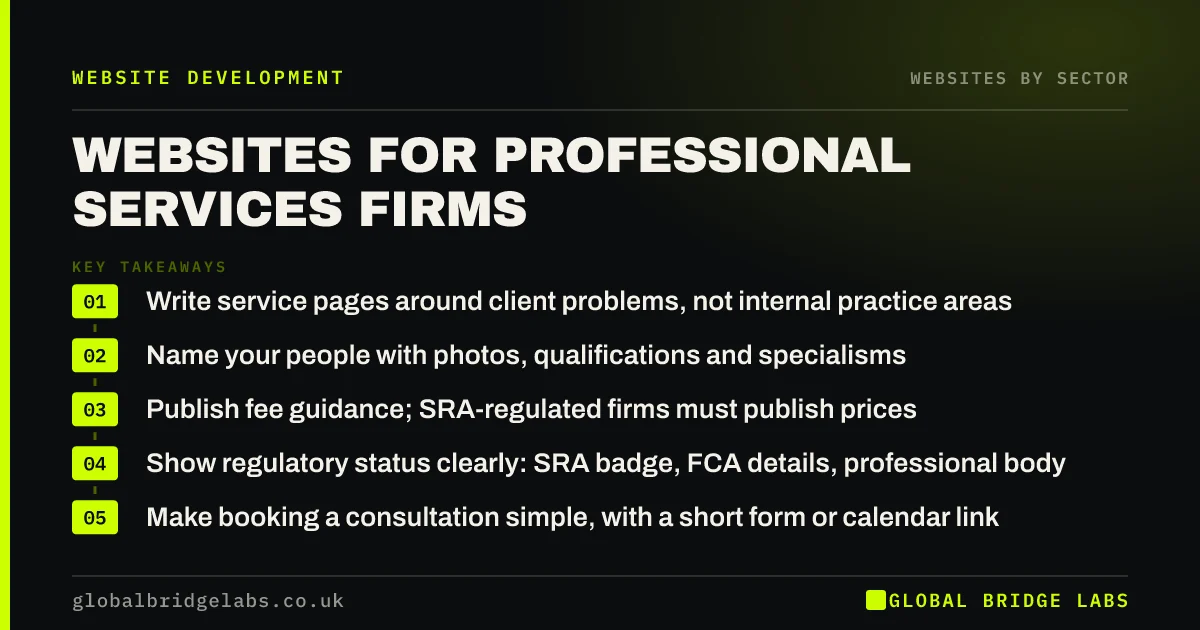
- Write service pages around client problems, not internal practice areas.
- Name your people with photos, qualifications and specialisms.
- Publish fee guidance; SRA-regulated firms must publish prices for some services.
- Show regulatory status clearly: SRA badge, FCA details, professional body.
- Make booking a consultation simple, with a short form or calendar link.
Want your firm's website reviewed against these? Send us the URL on WhatsApp.
Chat on WhatsApp →What is a professional services website?
A professional services website is a website for a firm that sells expertise, such as solicitors, accountants, financial advisers, mortgage brokers, consultants or architects, designed to demonstrate competence and trustworthiness and to generate consultation requests.
The buying process is considered and often personal. Clients may visit several times, read about the people who would handle their matter, check fees and regulatory status, and only then get in touch.
Why do many firm websites fail to win clients?
Many firm websites are organised around how the firm sees itself: practice areas, partner lists, news and awards. Clients arrive with a problem, such as buying a house, a tax investigation or selling a business, and have to translate it into the firm's categories.
The other common failure is anonymity: generic copy, stock photographs and no clear fee information, which leaves a cautious buyer with no basis to choose you over another firm.
- Practice area pages written in technical language.
- No fee guidance.
- People pages with names and nothing else.
- News sections instead of useful guidance.
- Contact routes that feel like a formal letter.
What should a professional services website include?
Structure the site around client situations and the people who help with them.
- Service pages named for client problems, with process and typical timescales.
- Fee guidance: fixed fees, ranges or how fees are calculated.
- People profiles: photo, qualifications, specialisms, a short personal note.
- Case summaries, anonymised where needed.
- Guides answering the questions clients ask before instructing a firm.
- Regulatory information and complaints procedure.
- A consultation booking route with what happens next.
What regulatory rules affect firm websites?
Solicitors regulated by the Solicitors Regulation Authority must follow the SRA Transparency Rules, which require publishing price and service information for specified services such as residential conveyancing, probate and certain employment claims, along with complaints information and the SRA digital badge.
Financial firms must ensure website content that promotes financial products complies with the FCA's financial promotions rules, being fair, clear and not misleading, with appropriate risk information. Other professions have their own body's rules. Build these in from the start rather than bolting them on.
Want your fee and regulatory pages checked for clarity? Message us on WhatsApp.
Chat on WhatsApp →How do firm websites win search and AI answers?
Clients ask Google and AI assistants questions such as how much does probate cost or do I need an accountant for a limited company. Firms that publish clear, specific answers, with fee ranges and named authors, are the ones cited.
Write guides answering those questions, each linked to the relevant service page, with a named author showing their qualifications. Google's helpful content guidance values exactly this kind of demonstrated expertise.
When should a firm not publish fees?
Some complex matters genuinely cannot be priced in advance, and regulated firms must not publish figures that mislead. In those cases, explain how fees are calculated, typical ranges for common scenarios and what affects cost, and offer a fixed-fee initial consultation.
The trade-off is transparency against flexibility. Clients increasingly expect some price information, and firms that provide it tend to receive better-qualified enquiries.
What does this look like in practice?
A pattern in professional services: a firm website organised by practice area, a partners page with names and email addresses only, and no fee information despite the SRA Transparency Rules applying to two of its services.
Rebuilding service pages around client situations, adding fee guidance and people profiles, and publishing the required transparency information makes the site both compliant and more persuasive. The two goals turn out to be the same.
Professional services website checklist
Review your site against these.
- Name services after client problems.
- Publish fee guidance where you can.
- Build full people profiles.
- Add anonymised case summaries.
- Publish guides answering pre-instruction questions.
- Show regulatory status and complaints information.
- Make consultation booking simple.
- Check promotions against your regulator's rules.
Next step
If your firm's website describes practice areas rather than client problems, we will outline a better structure with you in 30 minutes.
Message us on WhatsApp for a professional services website review, or book a 30-minute consultation.
Chat on WhatsApp →Sources and further reading
- Transparency rules · Solicitors Regulation Authority
- Financial promotions and adverts · Financial Conduct Authority
- Creating helpful, reliable, people-first content · Google Search Central
Frequently asked questions
What should a professional services website include?
Service pages written around client problems, fee guidance, detailed profiles of your people with qualifications, case summaries, guides answering common questions, regulatory information and complaints procedure, and a simple way to book a consultation with a clear explanation of what happens next.
Do solicitors have to publish prices on their website?
SRA-regulated firms must publish price and service information for specified services, including residential conveyancing, probate and certain employment claims, under the SRA Transparency Rules. They must also publish their complaints procedure and display the SRA digital badge prominently on their website.
How can an accountancy firm get more clients from its website?
Write service pages around client situations such as starting a limited company or a tax investigation, publish fee guidance or packages, show named accountants with qualifications, answer common questions in guides, and make booking a first call quick. Track enquiries by source to see what works.
Are financial promotions rules relevant to my website?
Yes, if you are an FCA-regulated firm promoting financial products or services. Website content that invites or induces people to engage in financial activity is a financial promotion and must be fair, clear and not misleading, with appropriate risk information.
Written by

Global Bridge Labs (GBL) is a UK–Sri Lanka partner for social media, websites and BPO. Everything here comes from client delivery, not theory.