On this page
- 01Key takeaways
- 02What is key person dependency?
- 03How do you spot key person dependency?
- 04What does key person dependency risk?
- 05How do you reduce key person dependency?
- 06How does outsourcing reduce the risk?
- 07Does outsourcing just move the dependency to a provider?
- 08How do you raise the subject with the key person?
- 09Which dependencies should you fix first?
- 10What does this look like in practice?
- 11Key person checklist
- 12Next step
- 13Sources and further reading
- 14Frequently asked questions
Key takeaways
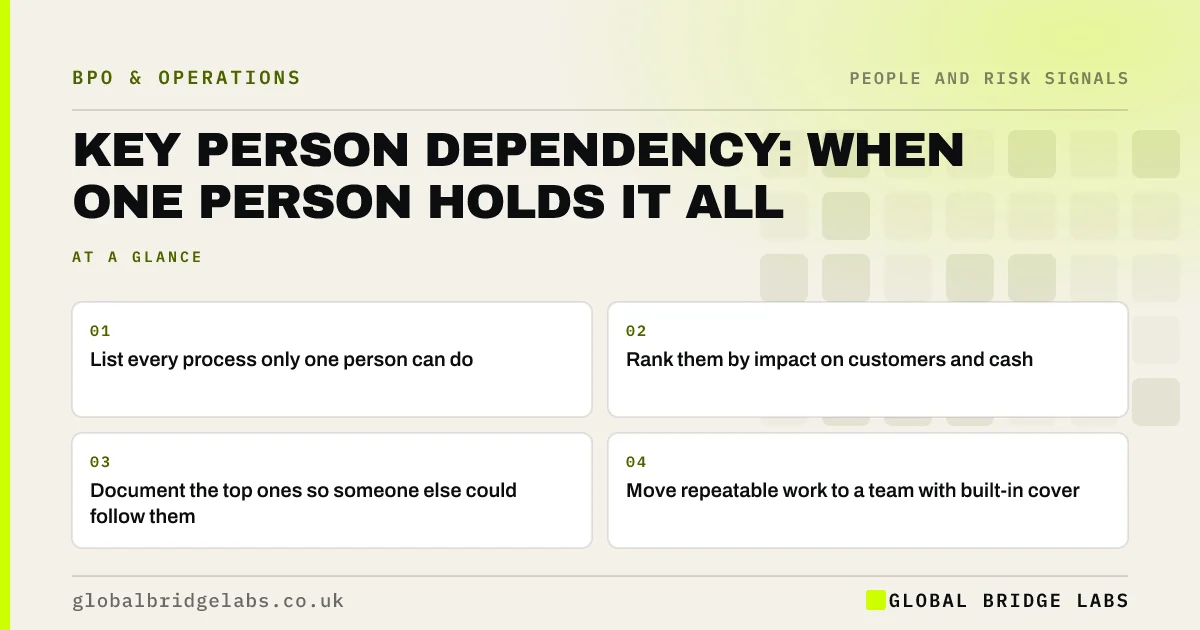
Key person dependency in a small business means a process, customer relationship or piece of knowledge relies on one person. If they are ill, on holiday or leave, it stops. Reduce it by writing processes down, cross-training, and moving repeatable work to a team where cover is built in. Start with the dependencies that would hurt customers or cash first.
- List every process only one person can do.
- Rank them by impact on customers and cash.
- Document the top ones so someone else could follow them.
- Move repeatable work to a team with built-in cover.
Worried about what happens if one person leaves? Message us on WhatsApp.
Chat on WhatsApp →What is key person dependency?
Key person dependency is the risk that a business cannot function properly without a particular person, because they alone know how a process works, hold a key relationship or have access to a critical system. It is common in small businesses, where one office manager or bookkeeper often runs several essential processes.
How do you spot key person dependency?
Ask what would stop if each person were away for a month. The answers reveal the dependencies. Look also at who holds passwords, who is copied into every customer email, and whose absence causes problems every holiday.
- Processes that stop when one person is on holiday.
- Passwords or system access held by one person.
- Customers who only deal with one person.
- Knowledge that is not written down anywhere.
Want a quick way to map your dependencies? Ask us on WhatsApp for the template.
Chat on WhatsApp →What does key person dependency risk?
It risks service stopping, cash being delayed and knowledge being lost. If the only person who knows the invoicing process leaves, invoices go out late. If the only person who answers the phones is ill, enquiries go elsewhere. It also lowers business value, because buyers and lenders see it as a risk.
How do you reduce key person dependency?
Document, share and spread. Write down how each critical process works, share passwords through a business password manager, cross-train a second person, and move repeatable processes to a team rather than an individual. Start with the processes that would hurt customers or cash most if they stopped.
How does outsourcing reduce the risk?
A managed provider runs a process with a team, not a single person, and covers holidays, sickness and leavers itself. Handing a process over also forces it to be written down. That turns knowledge held by one person into a documented procedure the business owns, which reduces the risk whoever runs it in future.
Does outsourcing just move the dependency to a provider?
It can, if you do not keep control of the documentation and access. Keep the written process, own the system accounts, and use contracts with reasonable notice periods and exit support. Then, if the provider changed, a new team could pick up the process. The aim is a business that owns its processes, whoever runs them.
How do you raise the subject with the key person?
Frame it as protecting them and the business, not replacing them. Key people often carry too much and cannot take proper holidays. Documenting and sharing their processes gives them cover and frees them for higher-value work. Involve them in writing the procedures; they know the details.
Which dependencies should you fix first?
Rank each dependency by how quickly its absence would hurt and how badly. Processes that face customers or bring in cash come first, because a gap there is felt within days. Knowledge that is used once a year, such as a renewal, matters too, but can be documented later.
- Daily customer contact: phones, inbox, bookings.
- Cash: invoicing, payments and credit control.
- System access: passwords, domains and admin accounts.
- Periodic tasks: renewals, returns and annual filings.
What does this look like in practice?
A pattern we see in UK family businesses: one long-serving office manager runs invoicing, payroll preparation, supplier orders and the phones. When they are off sick for three weeks, invoices stop. Documenting each process with them and moving phones and invoicing to a managed team gives them cover and removes the business's biggest single risk.
Key person checklist
Use this to reduce dependency.
- Ask what would stop if each person were away for a month.
- Rank dependencies by impact on customers and cash.
- Move passwords into a business password manager.
- Document the top three processes with the key person.
- Cross-train or outsource each one.
- Test by covering a holiday without calls to the key person.
Next step
Tell us which processes rely on one person. We will suggest which to document first and whether outsourcing would give you cover.
Message us on WhatsApp about key person risk, or book a 30-minute consultation.
Chat on WhatsApp →Sources and further reading
- Small Business Guide: cyber security · National Cyber Security Centre
- Contracts and liabilities between controllers and processors · Information Commissioner's Office
- Holiday entitlement · GOV.UK
Frequently asked questions
What is key person risk in a small business?
It is the risk that the business cannot function properly without a particular person, because they alone know a process, hold a key relationship or control system access. If they are ill, on holiday or leave, service, cash flow or customer relationships suffer.
How do you reduce reliance on one employee?
Document their critical processes with them, share system access through a business password manager, cross-train a second person, and move repeatable processes to a team with built-in cover, such as a managed provider. Start with the processes that affect customers and cash most.
Does outsourcing create dependency on the provider?
It can if you do not own the documentation and system access. Keep the written process, own the accounts, and agree reasonable notice and exit support in the contract. Then another team could take over if needed.
Written by

Global Bridge Labs (GBL) is a UK–Sri Lanka partner for social media, websites and BPO. Everything here comes from client delivery, not theory.