On this page
- 01Key takeaways
- 02What is co-sourcing?
- 03How is co-sourcing different from a hybrid model?
- 04What does co-sourcing cost?
- 05When does co-sourcing work best?
- 06When is full outsourcing better?
- 07How do you make co-sourcing work?
- 08Who is accountable in a co-sourced model?
- 09What does this look like in practice?
- 10Co-sourcing checklist
- 11Next step
- 12Sources and further reading
- 13Frequently asked questions
Key takeaways
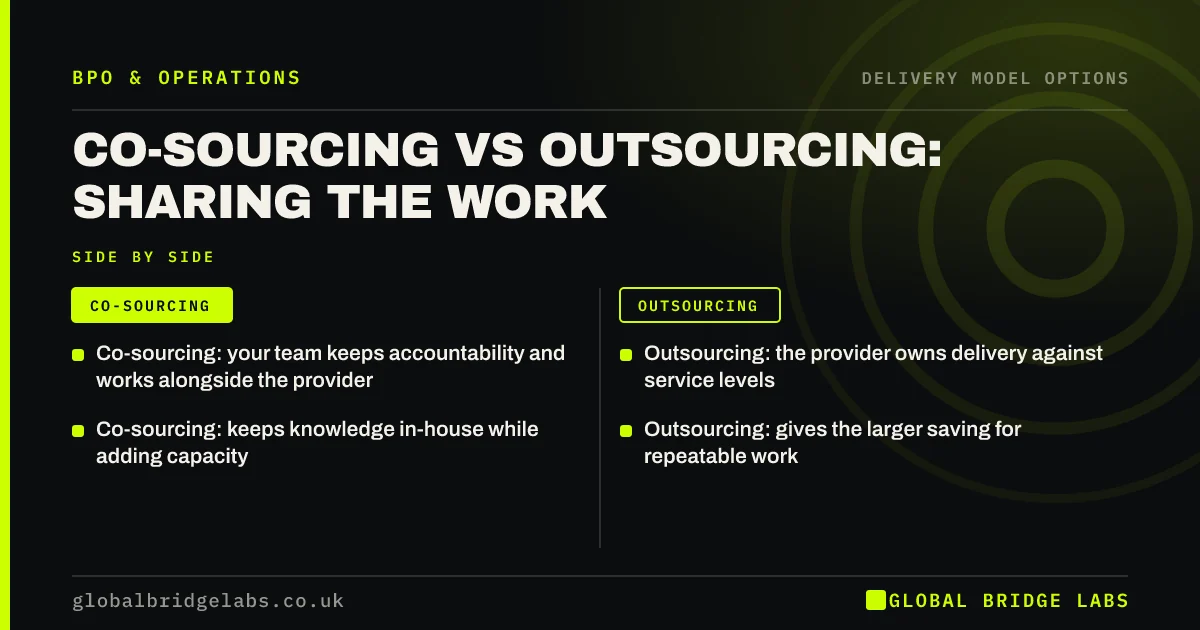
Co-sourcing vs outsourcing is about shared ownership. In co-sourcing, your in-house team and a provider deliver the same function together, with your team keeping accountability and the provider adding capacity or expertise. In outsourcing, the provider owns delivery. Co-sourcing keeps more control and knowledge in-house at a moderate saving.
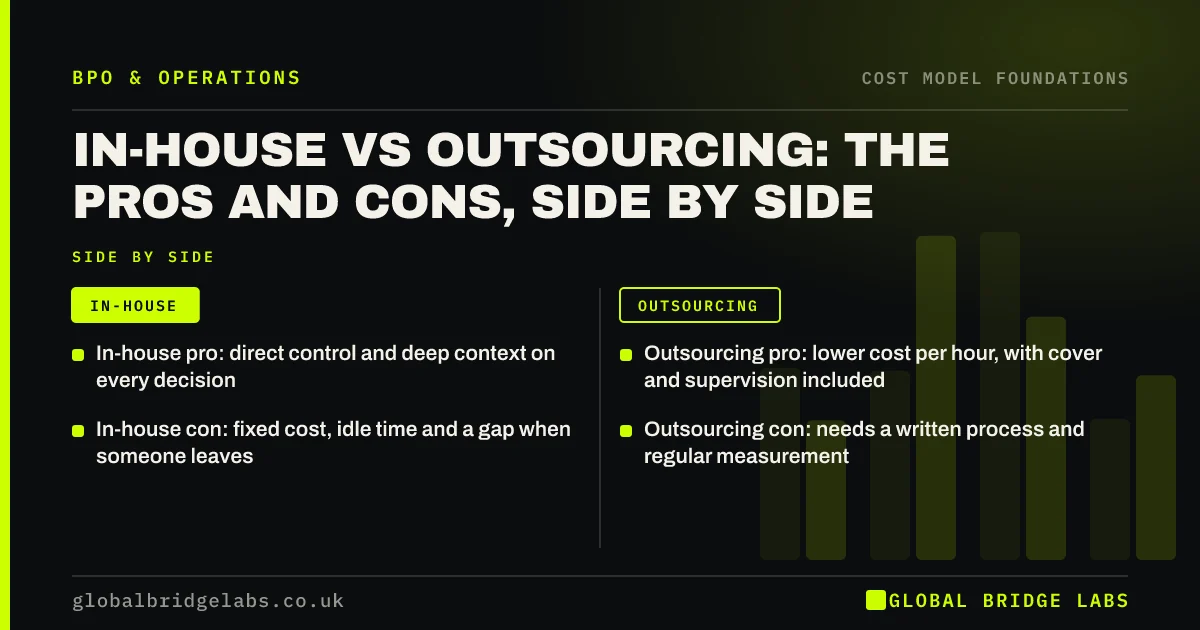
- Co-sourcing: your team keeps accountability and works alongside the provider.
- Outsourcing: the provider owns delivery against service levels.
- Co-sourcing: keeps knowledge in-house while adding capacity.
- Outsourcing: gives the larger saving for repeatable work.
Want to see whether co-sourcing fits a function? Message us on WhatsApp.
Chat on WhatsApp →What is co-sourcing?
Co-sourcing is a delivery model in which an in-house team and an external provider share responsibility for one function. The in-house lead sets direction and owns results; the provider supplies extra capacity, specialist skills or extended hours, working inside the same process and systems. It is common in audit, finance and IT, and works for operations too.
How is co-sourcing different from a hybrid model?
In a hybrid model, work is split: the provider handles defined tiers or hours and the in-house team handles the rest. In co-sourcing, both teams work on the same processes side by side, often on the same cases, under an in-house lead. Co-sourcing is closer collaboration; hybrid is a cleaner division.
What does co-sourcing cost?
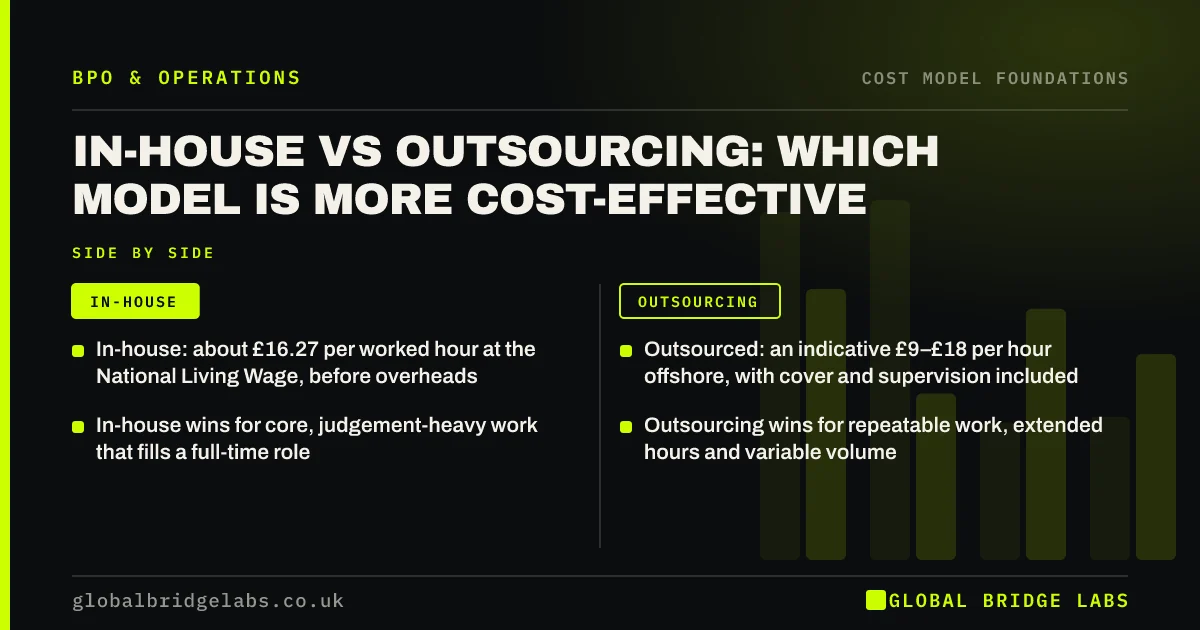
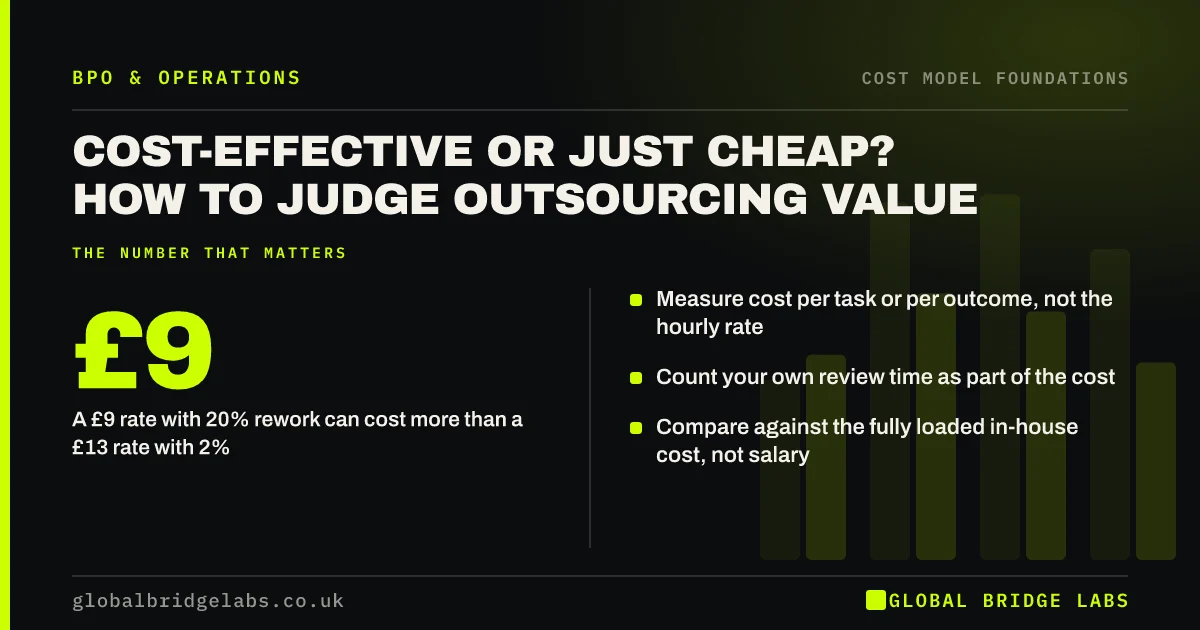
You keep the in-house lead and core team, and pay the provider for the capacity or skills added, an indicative £9–£18 per hour offshore for support and admin. The saving comes from not hiring for peaks or niche skills. Management time stays higher than full outsourcing, because your lead coordinates both teams.
Want a co-sourced set-up costed for your team? Send us the details on WhatsApp.
Chat on WhatsApp →When does co-sourcing work best?
When the function needs in-house judgement and knowledge, but also more capacity or a skill you lack, such as a finance team adding month-end support, or a customer team adding weekend cover with shared case handling. It also suits businesses that want to learn how a provider works before outsourcing more.
When is full outsourcing better?
When the process is repeatable, well documented and not core, and you want the largest saving with the least management. Co-sourcing a simple process adds coordination cost without much benefit.
How do you make co-sourcing work?
Use one set of processes, one system and one scorecard for both teams. Name the in-house lead as accountable, agree how work is allocated each day, and meet briefly each week. Treat the provider's team as colleagues, not overflow.
Who is accountable in a co-sourced model?
Your in-house lead is accountable for results, and the provider is accountable for the quality and timeliness of the work its people deliver. Write both down. Without a clear split, problems bounce between teams, which is the most common reason co-sourcing disappoints.
What does this look like in practice?
A pattern we see in UK accountancy and brokerage firms: an in-house team keeps client relationships and reviews, while a co-sourced offshore team prepares documents and data inside the same case system. Both work to one checklist, and the in-house team handles more clients without new hires.
Co-sourcing checklist
Use these steps to set it up.
- Name the accountable in-house lead.
- Use one process, one system and one scorecard.
- Agree how work is allocated daily.
- Hold a short weekly joint review.
- Review whether to move to hybrid or full outsourcing after 6 months.
Next step
Tell us which function you want to share. We will compare co-sourcing, hybrid and full outsourcing in a 30-minute call.
Message us on WhatsApp to discuss co-sourcing, or book a 30-minute consultation.
Chat on WhatsApp →Sources and further reading
- The Sourcing and Consultancy Playbooks · Cabinet Office
- Contracts and liabilities between controllers and processors · Information Commissioner's Office
Frequently asked questions
What is co-sourcing?
A model where an in-house team and an external provider deliver the same function together. The in-house lead keeps accountability and direction; the provider adds capacity, specialist skills or extended hours, working inside the same processes, systems and scorecard as the in-house team.
Is co-sourcing cheaper than outsourcing?
Usually not. Co-sourcing keeps your in-house lead and core team and adds coordination time between the two teams, so the saving is smaller than full outsourcing. It is chosen for control, knowledge retention and flexibility rather than for the maximum possible saving.
What is the difference between co-sourcing and a hybrid model?
In a hybrid model, work is divided between the two teams by tier or hours, with a clear routing rule. In co-sourcing, both teams work side by side on the same processes, often on the same cases, under one in-house lead who allocates the work daily.
Which functions suit co-sourcing?
Functions that need in-house judgement but also more capacity or a specialist skill: finance teams at month end, internal audit, IT projects, and case-based admin in brokerages or professional services. Simple, repeatable processes usually suit full outsourcing better. Start with one function and review after six months.
Written by

Global Bridge Labs (GBL) is a UK–Sri Lanka partner for social media, websites and BPO. Everything here comes from client delivery, not theory.