On this page
- 01Key takeaways
- 02What is business continuity in BPO?
- 03What disruptions should the plan cover?
- 04What should a provider have in place?
- 05How does staff cover work?
- 06What should you control on your side?
- 07What does continuity cost?
- 08How do you test continuity?
- 09What does this look like in practice?
- 10Checklist: continuity for outsourcing
- 11Next step
- 12Sources and further reading
- 13Frequently asked questions
Key takeaways
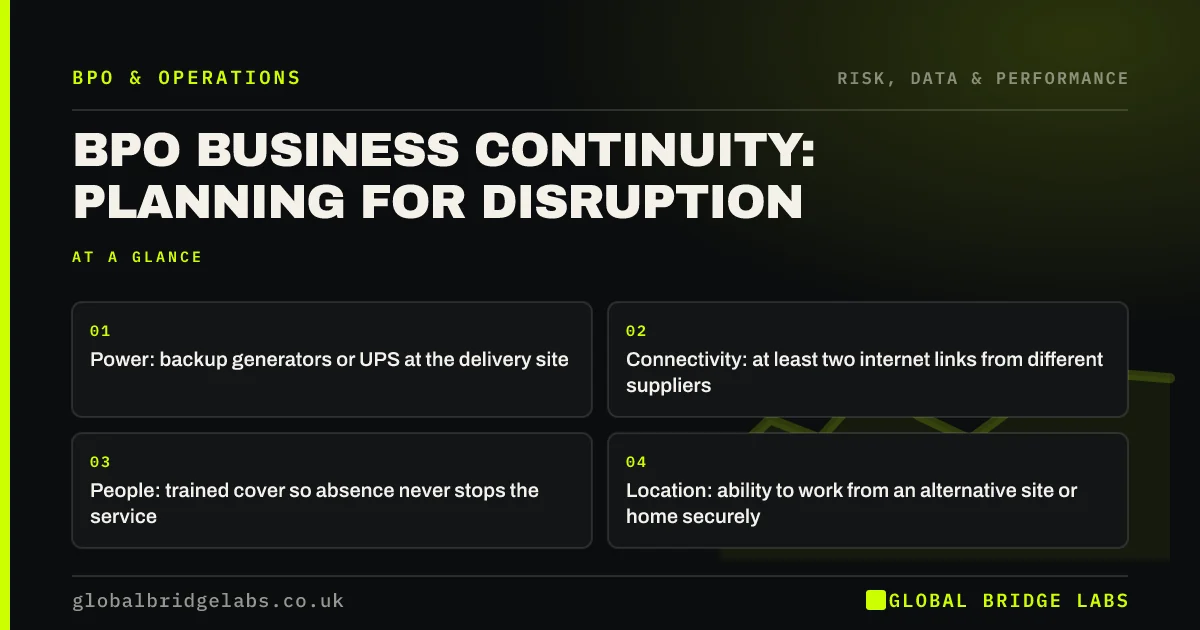
BPO business continuity is how your outsourced service keeps running when something goes wrong: a power cut, an internet outage, staff illness, a cyber incident or the provider itself failing. A good provider has a written plan with backups for each; you should see it before signing and test it once a year.
- Power: backup generators or UPS at the delivery site.
- Connectivity: at least two internet links from different suppliers.
- People: trained cover so absence never stops the service.
- Location: ability to work from an alternative site or home securely.
- Your side: procedures and data in your systems, so you can move if needed.
Want to see what a continuity plan should cover for your outsourced team? Message us on WhatsApp and ask for the checklist.
Chat on WhatsApp →What is business continuity in BPO?
Business continuity in business process outsourcing (BPO) is the set of plans and resources that allow an outsourced process to keep running, or recover quickly, during disruption. It covers infrastructure, people, systems and the relationship itself.
Continuity is a shared responsibility. The provider protects its site, staff and devices. You protect your systems, procedures and the ability to move the work if the provider cannot recover.
What disruptions should the plan cover?
Plan for the common disruptions first. Most are ordinary and short, but without a plan even a short outage means missed calls and a backlog.
- Power cuts at the delivery site.
- Internet or telephony outages.
- Staff illness, resignations or local public holidays.
- Cyber incidents affecting the provider or your systems.
- Local disruption such as severe weather or transport problems.
- Failure of a key tool, such as your helpdesk or phone platform.
- The provider going out of business or withdrawing.
What should a provider have in place?
Ask to see the provider's continuity plan and ask specific questions about each element. Good providers answer with specifics.
- Backup power, such as generators and uninterruptible power supplies.
- At least two internet connections from different suppliers.
- Cloud phone and helpdesk access so staff can work from any secure location.
- Secure work-from-home capability with managed devices.
- Trained cover for each client's work.
- A tested incident response procedure with named contacts.
How does staff cover work?
Staff cover is the most frequently used continuity measure. The provider should train at least one backup person on your process, keep them current, and step them in when needed. Documented procedures make this possible: cover depends on the process being written down, not in one person's head.
What should you control on your side?
Keep your procedures, data and history in systems you control. Use cloud tools that the team, your own staff or another provider can access from anywhere. Keep a short fallback plan: if the outsourced service is down for an hour, who picks up calls? If it is down for a week, how would you move the work?
The NCSC's Small Business Guide covers backing up data and preparing for incidents; it applies to your side of the arrangement as much as the provider's.
What does continuity cost?
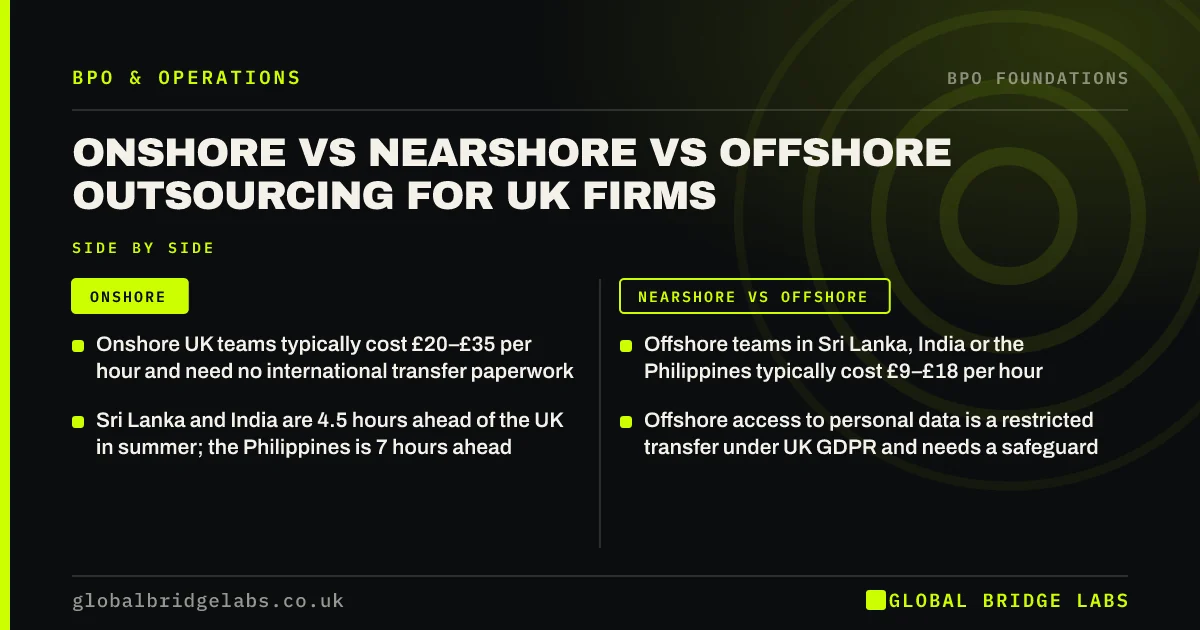
For a managed service, continuity should be included in the rate: backup power, redundant connectivity and cover are part of running a professional operation. As indicative market ranges, managed offshore BPO costs around £9–£18 per hour and onshore UK around £20–£35. A very low quote may be missing these, which you would discover only during an outage.
Want a managed team with continuity built in? Tell us your hours and channels on WhatsApp and we will discuss your requirements.
Chat on WhatsApp →How do you test continuity?
Ask the provider to walk you through a scenario once a year: power out at the site for four hours, or the team lead off sick for two weeks. What happens, minute by minute? Check that backup staff can actually log into your systems. Review the plan whenever scope changes.
Keep the test proportionate. For a single seat, a 30-minute walkthrough and one check that the backup person can log in is enough. For a larger team covering several channels, a short annual exercise with both sides present is worth the time. Record what you found and what changed.
What does this look like in practice?
At Global Bridge Labs (GBL), because processes are documented and we keep trained cover, we replace people without a gap in service. Teams work inside clients' cloud systems, so work can continue from an alternative location if the Colombo hub is disrupted, and there is no key-person risk on the client's side.
Checklist: continuity for outsourcing
Confirm each point.
- Provider has backup power and redundant internet.
- Provider can work securely from an alternative location.
- At least one trained backup person for your process.
- Incident contacts and response times are agreed.
- Procedures and data live in your systems.
- You have a short fallback plan for an outage.
- The plan is walked through once a year.
Next step
Ask us how our continuity plan would work for your process. We will walk through the scenarios with you. 30 minutes, no pitch.
Message us on WhatsApp for the continuity checklist, or book a 30-minute consultation.
Chat on WhatsApp →Sources and further reading
- Small Business Guide: cyber security · National Cyber Security Centre
- Cyber security breaches survey 2025/2026 · DSIT and Home Office
- The Sourcing and Consultancy Playbooks · Cabinet Office
Frequently asked questions
What happens if my outsourcing provider has a power cut?
A professional provider should have backup generators or uninterruptible power supplies, redundant internet connections and the ability to work from an alternative location, so service continues. Ask to see the provider's continuity plan and how quickly service recovers in each scenario.
What if my outsourced team member is ill?
A managed provider should have at least one trained backup person on your process who steps in without a gap. That depends on documented procedures. With a single freelancer, illness usually means the work stops until they return.
What if my BPO provider goes out of business?
Protect yourself by keeping procedures, data and history in your own systems, and by having exit clauses that require return of materials. Then moving to another provider or bringing work in-house is a planned transition rather than starting from scratch.
Should an outsourcing contract include business continuity?
Yes. The contract or its schedules should describe the provider's continuity arrangements, incident notification duties and recovery expectations. For an SME, a clear written plan and an annual walkthrough are more useful than complex contractual recovery targets.
Written by

Global Bridge Labs (GBL) is a UK–Sri Lanka partner for social media, websites and BPO. Everything here comes from client delivery, not theory.