On this page
- 01Key takeaways
- 02What does BPO data security involve?
- 03How real is the risk?
- 04Which access controls matter most?
- 05Why should the team work inside your systems?
- 06What should you ask the provider about its controls?
- 07How should payments be handled?
- 08What happens if there is a breach?
- 09Is offshore less secure than onshore?
- 10What does this look like in practice?
- 11Checklist: secure an outsourced team
- 12Next step
- 13Sources and further reading
- 14Frequently asked questions
Key takeaways
BPO data security depends more on how access is set up than on where the team sits. Keep the work inside your systems, give each person an individual login with multi-factor authentication and only the permissions they need, block bulk exports, log activity, and train the team to spot phishing. Then check the provider's own controls.
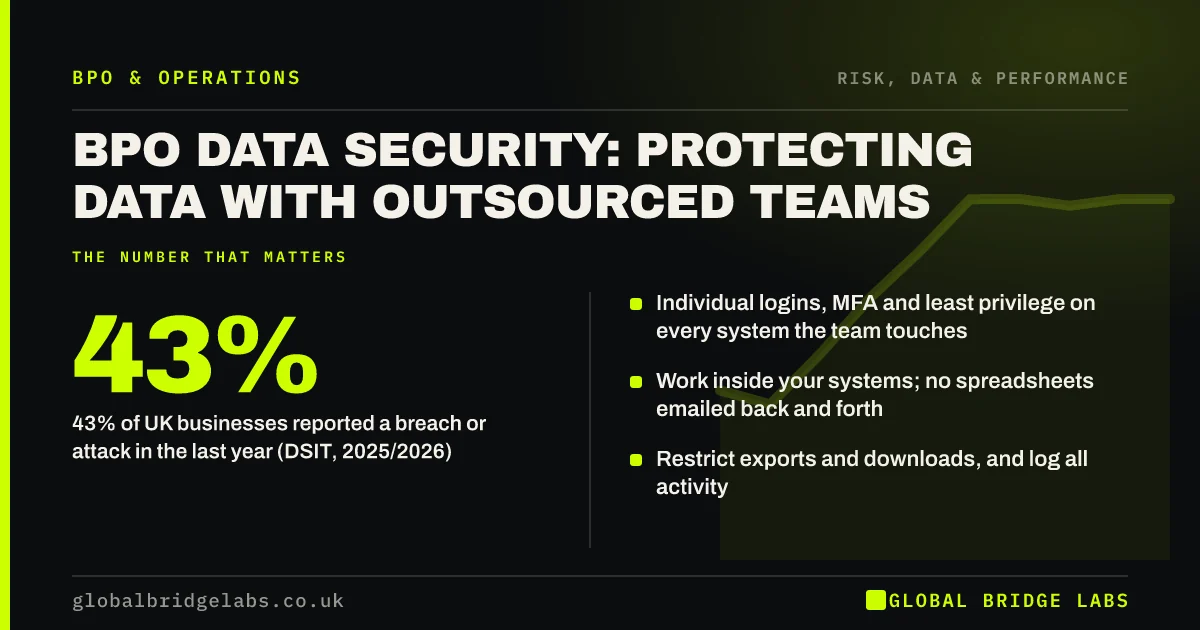
- 43% of UK businesses reported a breach or attack in the last year (DSIT, 2025/2026).
- Individual logins, MFA and least privilege on every system the team touches.
- Work inside your systems; no spreadsheets emailed back and forth.
- Restrict exports and downloads, and log all activity.
- Agree breach notification: the provider tells you without undue delay.
Want a security checklist for an outsourced team? Message us on WhatsApp and ask for the BPO security checklist.
Chat on WhatsApp →What does BPO data security involve?
BPO data security is the set of technical and organisational controls that protect personal and business data when a business process outsourcing provider's team works on it. It covers access, devices, networks, people and incident response, and it is shared between you and the provider.
UK GDPR requires both controller and processor to implement appropriate security measures. In practice, you control access to your systems, and the provider controls its people, devices and premises.
How real is the risk?
The risk is real and mostly ordinary. The DSIT Cyber Security Breaches Survey 2025/2026 found 43% of UK businesses reported a cyber breach or attack in the previous 12 months, with phishing the most common type. Outsourced teams handle email, customer data and payment queries, so they are targets like any other staff.
Most incidents come from weak passwords, shared accounts, phishing and excessive access, not sophisticated attacks. That means basic controls prevent most of them.
Which access controls matter most?
Access controls are the controls you own, and they matter most. Set them up before go-live.
- Individual accounts for every team member; never shared logins.
- Multi-factor authentication on email, helpdesk, CRM and finance tools.
- Least privilege: only the permissions each role needs.
- Restrict bulk export, download and deletion rights.
- Activity logging switched on and reviewed.
- Access removed the same day someone leaves.
Why should the team work inside your systems?
Working inside your systems keeps the data in one controlled place. Every copy of data, a downloaded spreadsheet, a forwarded email, a screenshot, is another thing that can leak. When the team uses your helpdesk and CRM directly, you can see and revoke access at any time and there is nothing to retrieve at exit.
What should you ask the provider about its controls?
The provider controls its people, devices and premises. Ask specific questions and expect specific answers.
- Are staff background-checked and bound by confidentiality agreements?
- Are devices company-managed, encrypted and patched?
- Are USB storage and personal devices restricted?
- How are staff trained on phishing and data handling, and how often?
- Do you hold Cyber Essentials, ISO 27001 or equivalent?
- How fast will you tell us about an incident, and who will call?
How should payments be handled?
Keep card details out of conversations. Outsourced teams should never take card numbers by email, chat or WhatsApp, and should only take them by phone if your process meets the PCI Data Security Standard. Secure payment links sent to the customer are simpler and safer for most SMEs.
Guard against payment diversion fraud: never change supplier or customer bank details on an email request without calling a known contact.
What happens if there is a breach?
The processor contract should require the provider to tell you without undue delay. As controller, you must report notifiable breaches to the ICO within 72 hours of becoming aware. Agree named contacts and a practical timescale, such as within 24 hours of discovery, and rehearse what happens: contain, assess, notify, fix.
Want an outsourced team set up with these controls from day one? Tell us about your systems on WhatsApp and we will discuss your requirements.
Chat on WhatsApp →Is offshore less secure than onshore?
Not inherently. Security depends on controls, not geography. A well-run offshore team working inside your systems with MFA and least privilege can be more secure than an in-house team sharing one password. Offshore does add a legal step, the transfer safeguard, and it is worth checking local continuity arrangements for power and connectivity.
What does this look like in practice?
At Global Bridge Labs (GBL), access is role-based and logged, work runs inside the client's systems rather than copies of their data, and every process is written down. We work to UK GDPR requirements and sign a data processing agreement. The client can revoke any access at any time.
Checklist: secure an outsourced team
Complete these before go-live.
- Create individual accounts with MFA in every system.
- Apply least privilege and restrict exports.
- Switch on activity logging.
- Confirm the provider's device, network and training controls.
- Keep card details out of conversations; use payment links.
- Agree breach notification contacts and timescales.
- Remove access the same day anyone leaves.
Next step
Send us your list of systems and we will tell you how we would set up access for an outsourced team securely. 30 minutes, no pitch.
Message us on WhatsApp for the BPO security checklist, or book a 30-minute consultation.
Chat on WhatsApp →Sources and further reading
- Cyber security breaches survey 2025/2026 · DSIT and Home Office
- Cyber Essentials overview · National Cyber Security Centre
- Small Business Guide: cyber security · National Cyber Security Centre
- Payment Card Industry Data Security Standard · PCI Security Standards Council
Frequently asked questions
Is outsourcing a data security risk?
It adds risk if access is poorly controlled, and reduces it if outsourcing forces you to replace shared passwords and informal processes with individual accounts, MFA, least privilege and logging. Most incidents come from basic failures, which the right set-up prevents regardless of location.
What security certifications should a BPO provider have?
Cyber Essentials is a useful UK baseline, and ISO/IEC 27001 shows a formal information security management system. Neither is legally required. Providers without them should still demonstrate equivalent controls: managed devices, staff training, access management, logging and incident response.
How do I stop an outsourced team downloading our data?
Use your systems' permission settings to restrict export, download and bulk actions, keep the team working inside your tools, and switch on activity logs. Ask the provider to use managed devices with USB storage disabled. Combine technical controls with confidentiality obligations in the contract.
Who is responsible if an outsourced team causes a breach?
As controller, you remain responsible for protecting personal data and for reporting notifiable breaches to the ICO. The processor also has direct obligations under UK GDPR and contractual duties to you. The contract should set out liability and require prompt notification and cooperation.
Written by

Global Bridge Labs (GBL) is a UK–Sri Lanka partner for social media, websites and BPO. Everything here comes from client delivery, not theory.