On this page
- 01Key takeaways
- 02What does an in-house development team cost?
- 03What does outsourced development cost?
- 04When should software development stay in-house?
- 05When is outsourcing development better?
- 06How do you keep control of outsourced development?
- 07What are the hidden costs on each side?
- 08How should an outsourced build be scoped?
- 09What does this look like in practice?
- 10Software development checklist
- 11Next step
- 12Sources and further reading
- 13Frequently asked questions
Key takeaways
In-house vs outsourced software development depends on how long you need the team. Three UK developers on £50,000 cost about £183,000 a year with tools, before recruitment. A managed offshore team of similar size costs an indicative £20–£40 per developer hour. Keep product ownership in-house whichever route you choose.
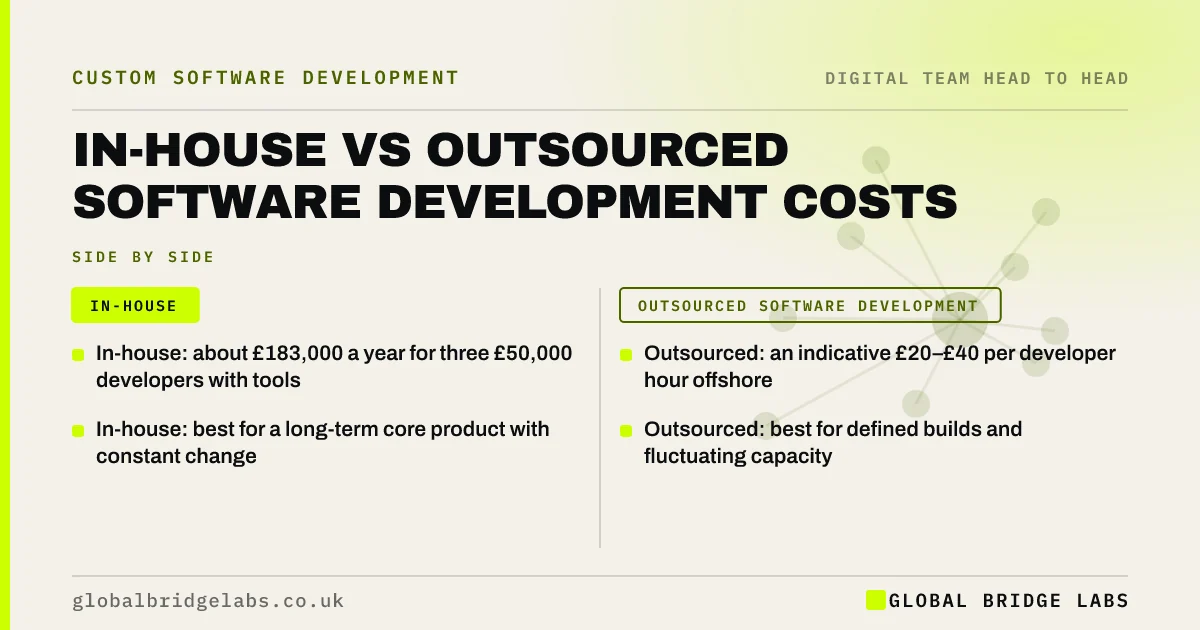
- In-house: about £183,000 a year for three £50,000 developers with tools.
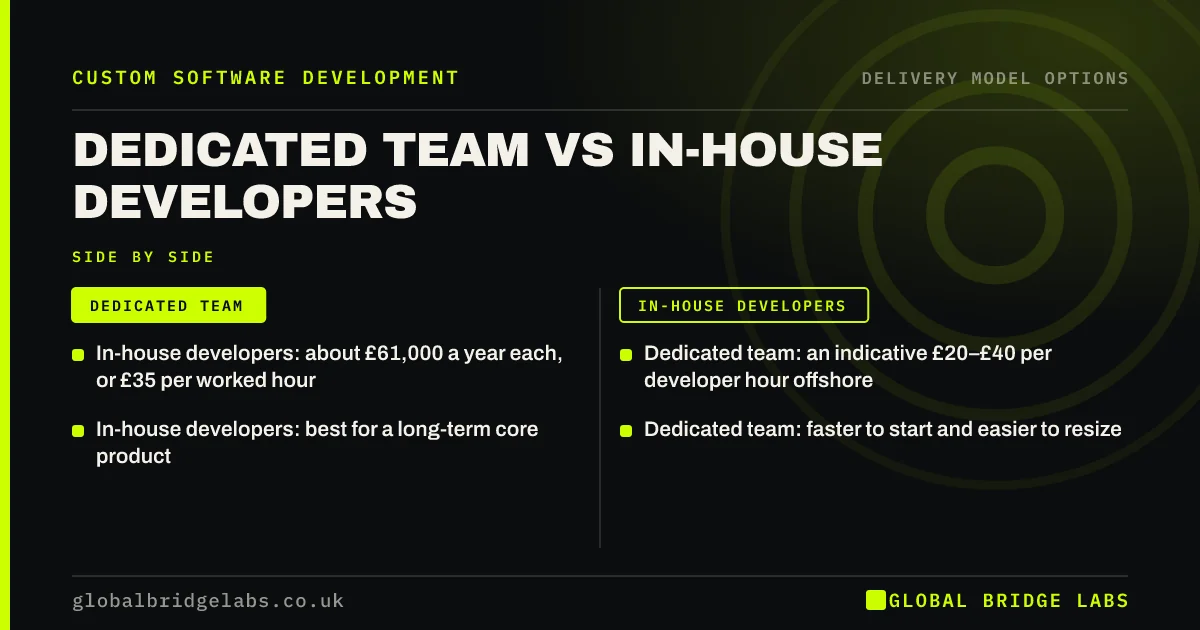
- Outsourced: an indicative £20–£40 per developer hour offshore.
- In-house: best for a long-term core product with constant change.
- Outsourced: best for defined builds and fluctuating capacity.
Want a software build costed both ways? Message us on WhatsApp with your scope.
Chat on WhatsApp →What does an in-house development team cost?
A developer on £50,000 costs about £58,063 a year in employment costs using 2026/27 rates. Add about £3,000 for equipment, software and cloud tools, and three developers cost about £183,000 a year. Recruitment is significant for technical roles, and you still need product management, testing and hosting.
What does outsourced development cost?
As indicative ranges, UK development agencies often charge day rates in the hundreds of pounds per developer, while managed offshore teams commonly charge about £20–£40 per developer hour depending on seniority. A three-person offshore team working full time costs roughly £104,000–£209,000 a year at those rates, so at the senior end it can cost as much as in-house. The bigger gains are no recruitment and the ability to scale down after a build. Always compare quotes on the same scope.
Want an offshore team option priced for your roadmap? Send us your scope on WhatsApp.
Chat on WhatsApp →When should software development stay in-house?
When the software is your product, changes every week, and depends on deep knowledge of your customers and data. A long-term in-house team builds that knowledge and moves fastest on it. Many software businesses keep a core team in-house and add outsourced capacity.
When is outsourcing development better?
When you need a defined build, such as an internal tool, a customer portal or an integration, rather than a permanent team. Outsourcing also suits variable capacity: adding developers for a phase and scaling down after launch, without recruitment or redundancy.
How do you keep control of outsourced development?
Keep product ownership in-house: someone who decides priorities, accepts work and talks to users. Own the code repository, cloud accounts and domain, and write intellectual property transfer into the contract. Agree how work is estimated, reviewed and tested before it starts.
- A named product owner in your business.
- Code, cloud and domain accounts in your name.
- IP assigned to you in the contract.
- Regular demos of working software.
- Testing and code review built into the process.
What are the hidden costs on each side?
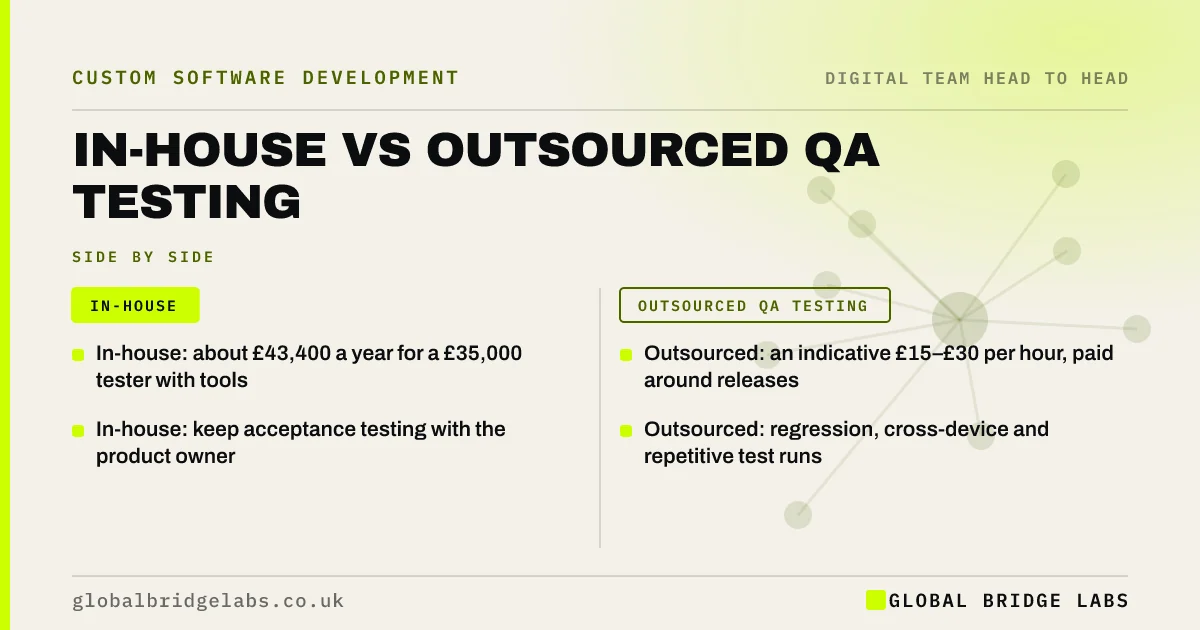
In-house, the hidden costs are recruitment, idle time between projects and the risk of one developer holding all the knowledge. Outsourced, they are your product owner's time, communication overhead across time zones, and rework if requirements are vague. Clear, written requirements reduce both.
How should an outsourced build be scoped?
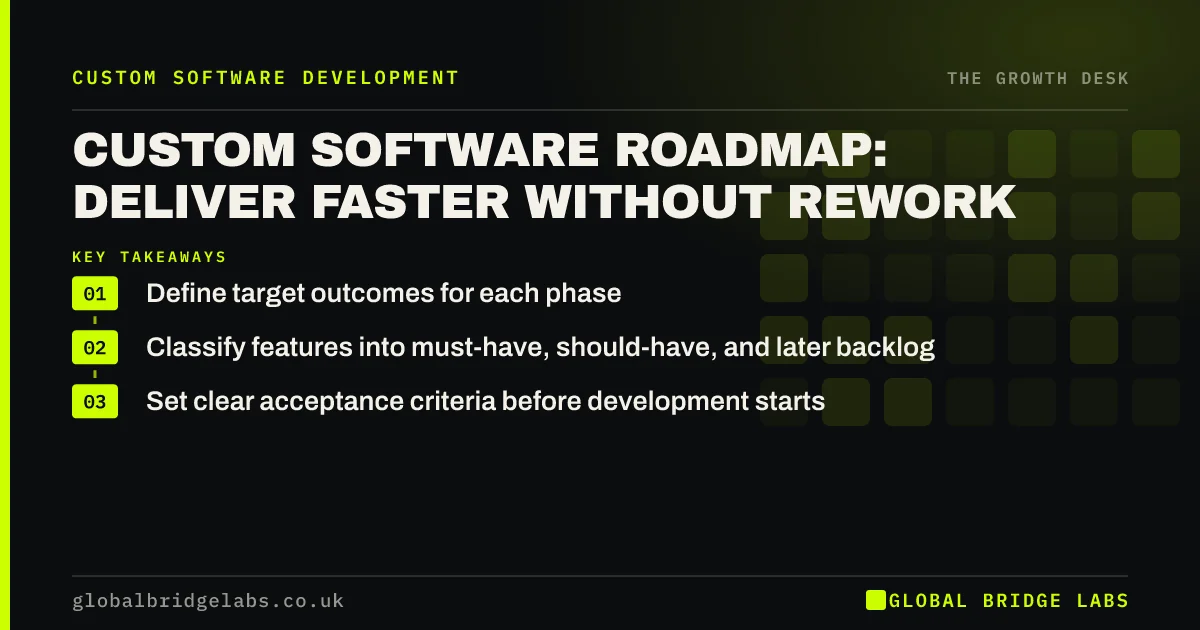
Start with the problem and the users, not a feature list. Describe the processes the software must support, the systems it must connect to, and what a successful first release looks like. Ask providers to propose a first phase that delivers something usable in weeks, then plan later phases once it is in use.
What does this look like in practice?
A pattern we see in UK brokerages and professional services firms: a custom CRM integration is needed, but hiring a developer for one project makes little sense. A defined outsourced build with an in-house product owner delivers it, and a small support retainer covers changes afterwards.
Software development checklist
Use these steps to decide.
- Decide whether the software is your core product.
- Estimate developer months for the next 12 months.
- Cost an in-house team fully loaded.
- Get outsourced quotes on the same scope.
- Name an in-house product owner.
- Put code, accounts and IP in your name.
Next step
Tell us what you need built and how long you will need the team. We will cost in-house and outsourced development in a 30-minute call.
Message us on WhatsApp for a development cost comparison, or book a 30-minute consultation.
Chat on WhatsApp →Sources and further reading
- Rates and thresholds for employers 2026 to 2027 · HM Revenue & Customs
- How copyright protects your work · GOV.UK
- The Sourcing and Consultancy Playbooks · Cabinet Office
- Contracts and liabilities between controllers and processors · Information Commissioner's Office
Frequently asked questions
Is outsourcing software development cheaper than hiring?
For defined builds and variable capacity, usually. Three UK developers on £50,000 cost about £183,000 a year with tools, while a managed offshore team at an indicative £20–£40 per developer hour costs about £104,000–£209,000 for the same capacity and can scale down after a build.
How do I protect my IP when outsourcing development?
Assign intellectual property to your business in the contract, keep the code repository and cloud accounts in your name, and make sure you can access all source code and documentation at any time. Check that open-source components are used under licences you can accept.
What should stay in-house when outsourcing development?
Product ownership: deciding priorities, accepting work and speaking to users. Keep ownership of code, cloud accounts and domains too. The outsourced team provides design, development and testing capacity, working to priorities set by someone who understands the business. Keep documentation in your name as well.
How do I choose a software development partner?
Look for examples of similar work, speak to at least two references, check how they estimate, test and review code, and ask who exactly will work on your project. A short paid discovery phase is a low-risk way to judge how well you work together.
Written by

Global Bridge Labs (GBL) is a UK–Sri Lanka partner for social media, websites and BPO. Everything here comes from client delivery, not theory.