On this page
- 01Key takeaways
- 02Why do law firm menus confuse clients?
- 03How should services be organised?
- 04What do the SRA transparency rules mean for navigation?
- 05Why should people be easy to find?
- 06What does this look like in practice?
- 07Law firm navigation checklist
- 08Next step
- 09Sources and further reading
- 10Frequently asked questions
Key takeaways
Law firm website navigation works when it follows clients' problems, such as 'Buying a home' or 'Divorce', rather than department names such as 'Private client'. Split by individuals and businesses if both are served, make fees and the people who will help easy to find, and make sure price information required by the SRA transparency rules is clearly linked.
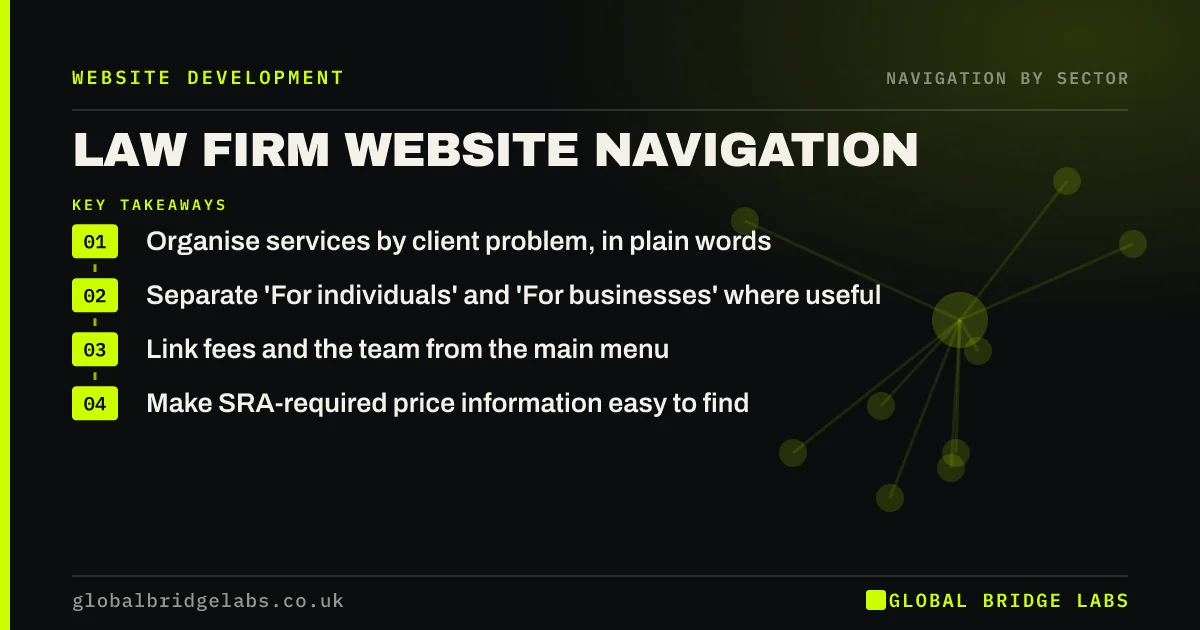
- Organise services by client problem, in plain words.
- Separate 'For individuals' and 'For businesses' where useful.
- Link fees and the team from the main menu.
- Make SRA-required price information easy to find.
Want your firm's navigation reviewed against client language? Message us on WhatsApp.
Chat on WhatsApp →Why do law firm menus confuse clients?
Law firm menus often mirror the firm's departments: 'Private client', 'Dispute resolution', 'Corporate and commercial'. Clients do not use those words; they search for 'making a will', 'neighbour dispute' or 'selling my business'. When labels do not match, clients guess or leave to search elsewhere.
How should services be organised?
Group services by client type and problem. Many firms use 'For individuals' and 'For businesses' as the top split, then name the problems beneath in plain words. Keep legal terms for the page content, where they can be explained.
- For individuals: buying or selling a home, wills, divorce, disputes.
- For businesses: contracts, employment, property, disputes.
- Plain names first; legal terms explained on the page.
- A section menu within each area.
What do the SRA transparency rules mean for navigation?
The Solicitors Regulation Authority's transparency rules require firms to publish price and service information for certain services, such as residential conveyancing, probate and some employment claims, and to display it prominently. They also require information on complaints handling. Linking fees clearly from the menu and service pages helps meet them. Check the current SRA rules for your services.
Want your fees and complaints information linked properly? Message us on WhatsApp and we will discuss your requirements.
Chat on WhatsApp →Why should people be easy to find?
Clients choosing a solicitor want to know who will handle their matter. A 'Team' or 'Our people' link in the menu, with profiles linked from each service page, builds confidence. Profiles should name the services each person handles, so clients can move from a person to the service and back.
What does this look like in practice?
A pattern we see: a high-street firm's menu has 'Private client', 'Litigation' and 'Commercial', and fees are linked only from the footer. A client looking to sell a house cannot see where conveyancing sits. Renaming to plain problems under 'For individuals' and adding 'Fees' to the main menu fixes both.
Law firm navigation checklist
- Services named by client problem.
- Individuals and businesses separated where useful.
- Fees linked from the main menu.
- SRA price and complaints information easy to find.
- Team profiles linked from services.
- Contact and enquiry action in the header.
Next step
List the words clients used in your last ten enquiries and compare them with your menu.
Message us on WhatsApp for a law firm website review, or book a 30-minute consultation.
Chat on WhatsApp →Sources and further reading
- Transparency rules · Solicitors Regulation Authority
- Mental models and user experience design · Nielsen Norman Group
- Local navigation is a valuable orientation and wayfinding aid · Nielsen Norman Group
Frequently asked questions
How should a law firm website be structured?
Around client problems, often split into individuals and businesses, with each service named in plain words. Link fees, the team and contact from the main menu, and use section menus within larger practice areas.
Do solicitors have to publish prices on their website?
The SRA transparency rules require firms to publish price and service information for certain services, such as residential conveyancing and probate, and to display it prominently. Check the current rules for the services you offer.
Should legal terms be used in the menu?
Use the words clients search for in the menu, such as 'Buying a home' rather than 'Residential conveyancing'. The page can then explain the legal term, which also helps clients and search engines connect the two.
Written by

Global Bridge Labs (GBL) is a UK–Sri Lanka partner for social media, websites and BPO. Everything here comes from client delivery, not theory.