On this page
Key takeaways
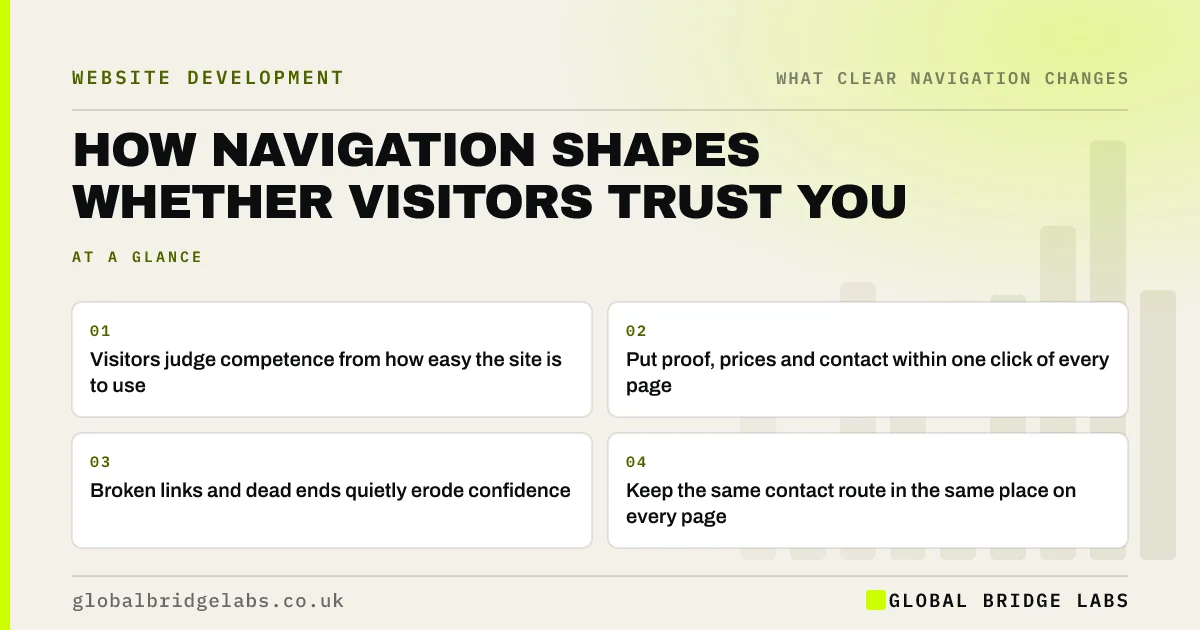
Navigation shapes trust because visitors read it as evidence of how the business works. A clear menu with services, prices, proof and contact in view says 'we are organised and open'. Vague labels, hidden contact details and broken links say the opposite, before a visitor reads a word of your copy.
- Visitors judge competence from how easy the site is to use.
- Put proof, prices and contact within one click of every page.
- Broken links and dead ends quietly erode confidence.
- Keep the same contact route in the same place on every page.
Want to know what your menu says about your business? Message us on WhatsApp.
Chat on WhatsApp →Why does navigation affect trust?
Visitors cannot inspect your business, so they judge it by the signals they can see. A site that is easy to move through feels competent; one that confuses feels careless. Nielsen Norman Group's research on the aesthetic-usability effect found people perceive more usable-looking designs as working better, which colours how they judge the business behind them.
Which navigation gaps raise doubts?
The gaps that raise doubts are the ones that look like hiding. Buyers notice when they cannot find prices, a phone number, an address or evidence of past work.
- No contact details visible without scrolling to the footer.
- No route to prices or fees, even indicative ones.
- No case studies, reviews or projects in the menu.
- Broken links, empty pages and default 404 pages.
- A menu that changes between pages.
What should be within easy reach?
Put the items buyers use to decide within one click of every page: services, prices or fees, proof such as projects or reviews, the team or About page, and contact. WCAG 2.2 success criterion 3.2.6, Consistent Help, asks that help mechanisms such as contact details appear in the same relative order across pages.
Can navigation look too salesy?
Yes. A header crowded with 'Get a quote', 'Book now', 'Call us' and 'Free audit' buttons can feel pushy. One primary action, styled distinctly, is enough. Let the menu carry information and the single button carry the action.
What does this look like in practice?
A pattern we see with professional firms: the site looks polished, but the menu offers 'About', 'Insights' and 'Contact', and nothing on services, fees or people. Buyers comparing firms cannot see what they would get. Adding services, fees and team to the menu makes the firm feel more open without changing the design.
Trust navigation checklist
- Contact details in the header and footer.
- Services named specifically in the menu.
- Prices or fees reachable in one click.
- Projects, case studies or reviews linked.
- No broken links or default 404 page.
- One distinct primary action.
Next step
Ask someone outside the business to find your prices, proof and phone number, and time it.
Message us on WhatsApp for a navigation review, or book a 30-minute consultation.
Chat on WhatsApp →Sources and further reading
- The aesthetic-usability effect · Nielsen Norman Group
- Understanding WCAG 2.2 success criterion 3.2.6: Consistent Help · W3C
- Information scent: how users decide where to go next · Nielsen Norman Group
Frequently asked questions
Does website design affect trust?
Yes. Visitors form judgements about a business from how its website looks and works, often within seconds. Navigation is a large part of that: easy, consistent menus and visible contact details signal an organised business, while confusion and broken links raise doubts.
Should my phone number be in the navigation?
For businesses that take phone enquiries, yes, in the header on every page, and as a tap-to-call link on phones. It is one of the clearest signals that a real business is behind the site and ready to talk.
Do I need an About page in the menu?
Usually, yes. Many buyers check who they would be dealing with before enquiring, especially for professional and home services. Group company pages under one About item rather than listing several separately.
Written by

Global Bridge Labs (GBL) is a UK–Sri Lanka partner for social media, websites and BPO. Everything here comes from client delivery, not theory.