On this page
- 01Key takeaways
- 02What is cross-training?
- 03Why does a small team need it?
- 04How do you build a skills matrix?
- 05How do you train without losing output?
- 06Where does cross-training run out?
- 07How does it combine with outsourcing?
- 08When is cross-training not worth it?
- 09What does this look like in practice?
- 10Cross-training checklist
- 11Next step
- 12Sources and further reading
- 13Frequently asked questions
Key takeaways
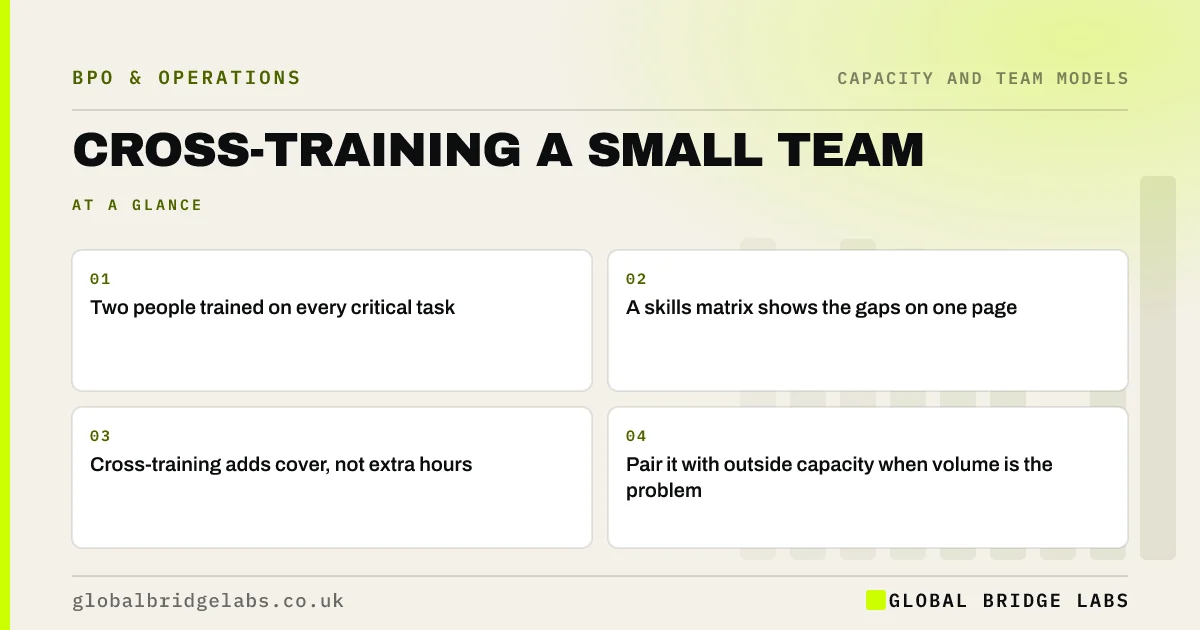
Cross-training employees in a small business means teaching each critical task to at least two people, so work continues when someone is away. It adds cover and some flexibility without hiring. It does not add hours: when a cross-trained colleague covers, their own work waits. Use it for resilience and use outside capacity for volume.
- Two people trained on every critical task.
- A skills matrix shows the gaps on one page.
- Cross-training adds cover, not extra hours.
- Pair it with outside capacity when volume is the problem.
Want a skills matrix template for your team? Message us on WhatsApp.
Chat on WhatsApp →What is cross-training?
Cross-training is teaching employees to carry out tasks outside their main role so that more than one person can do each important job. In a small business it is the main defence against a process stopping when one person is on holiday, off sick or leaves.
Why does a small team need it?
A small team needs cross-training because absence is certain. Full-time staff are entitled to 28 days of paid holiday, and the Office for National Statistics reported an average of 4.4 sickness days per worker in 2024. A task only one person can do is therefore uncovered for around six weeks every year.
How do you build a skills matrix?
Build a skills matrix by listing critical tasks down the side of a sheet and people across the top. Mark each cell as can do unaided, can do with help, or cannot do. Any row with only one unaided mark is a risk. Start training there.
- 1. List the 10 to 15 tasks the business cannot go a week without.
- 2. List the team across the top.
- 3. Mark each person's level for each task.
- 4. Highlight rows with a single capable person.
- 5. Assign a second person to learn each one.
How do you train without losing output?
Train in short, scheduled sessions using a written guide. The person who knows the task documents it, the learner follows the guide while being watched, then does it alone and is checked. Thirty minutes twice a week is more sustainable than a full day. Rotate the task monthly so the skill stays fresh.
Where does cross-training run out?
Cross-training runs out when the team is already full. A colleague covering someone else's task is not doing their own, so the queue simply moves. It also has a cost: switching between kinds of work reduces productivity, and the American Psychological Association notes that task switching can cost as much as 40% of productive time.
- Team at full capacity: outsource, hire or wait?
- How much spare capacity should a small business carry?
Team cross-trained but still stretched? Tell us the volumes on WhatsApp and we will look at capacity.
Chat on WhatsApp →How does it combine with outsourcing?
The two work together. Cross-train in-house on the judgement-heavy and client-facing tasks, where internal knowledge matters. Use a managed team for routine volume, where the provider supplies trained backups as part of the service. The written guides you create for cross-training are the same ones a provider needs.
When is cross-training not worth it?
Cross-training is not worth it for tasks that are rare, low-risk or need a licence or qualification the second person lacks. It is also a poor use of specialists: teaching a senior engineer to run payroll gives cover at a high hourly cost. For those tasks, outside cover is usually cheaper.
What does this look like in practice?
A pattern we see in UK offices of six to ten people: one administrator has run invoicing for years and nobody else has the login. Their fortnight's holiday delays every invoice in the month. A skills matrix exposes four or five tasks like it in an hour, and written guides for each make both internal cover and outside support possible.
Cross-training checklist
Review this twice a year.
- Critical tasks listed and current.
- Skills matrix completed for the whole team.
- Single-person tasks identified.
- A written guide for each of those tasks.
- A named second person trained and tested.
- Tasks rotated at least quarterly.
- Outside cover arranged where a second person is impractical.
Next step
Send us your list of critical tasks and who can do each. We will point out the cover gaps and where outside capacity would be more efficient than training.
Message us on WhatsApp for a cover review, or book a 30-minute consultation.
Chat on WhatsApp →Sources and further reading
- Holiday entitlement · GOV.UK
- Sickness absence in the UK labour market · Office for National Statistics
- Multitasking: switching costs · American Psychological Association
Frequently asked questions
What is cross-training in the workplace?
Cross-training in the workplace is teaching employees to perform tasks beyond their own role, so that more than one person can do each important job. It provides cover for absence, reduces dependence on individuals and gives the team flexibility to move people to where work is building up.
What are the disadvantages of cross-training?
Cross-training takes time away from normal work while people learn, and skills fade if they are not used. It can spread people thin, lower productivity through task switching, and frustrate specialists asked to do routine work. It adds cover but not total capacity.
What is a skills matrix?
A skills matrix is a simple grid listing tasks on one axis and team members on the other, with each cell showing whether the person can do the task alone, with help or not at all. It shows at a glance which tasks depend on one person.
Is cross-training a substitute for hiring?
Only for cover. Cross-training lets existing staff step in when someone is absent, but it does not create extra hours. If the team's total workload exceeds its capacity, you need more capacity, whether from recovered time, automation, a managed outsourced team or a new hire.
Written by

Global Bridge Labs (GBL) is a UK–Sri Lanka partner for social media, websites and BPO. Everything here comes from client delivery, not theory.