On this page
- 01Key takeaways
- 02What is a customer focused homepage?
- 03How do you tell if your homepage is too much about you?
- 04How do you rewrite 'we' copy?
- 05When does copy about the business help?
- 06Can a homepage be too customer focused?
- 07What does this look like in practice?
- 08Customer focus checklist
- 09Next step
- 10Sources and further reading
- 11Frequently asked questions
Key takeaways
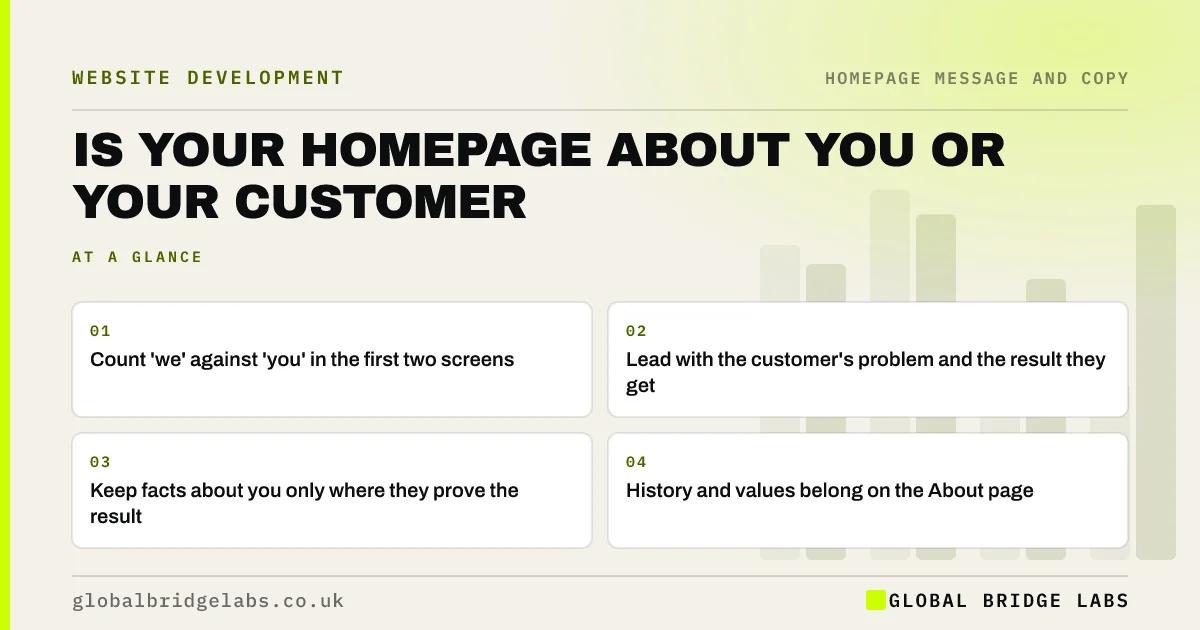
A customer focused homepage talks about the visitor's problem and outcome before it talks about the business. Count 'we', 'our' and 'us' against 'you' and 'your' in the first two screens; if the business wins by a wide margin, rewrite the sentences around what the customer gets, and keep facts about you only where they prove it.
- Count 'we' against 'you' in the first two screens.
- Lead with the customer's problem and the result they get.
- Keep facts about you only where they prove the result.
- History and values belong on the About page.
Want your homepage turned round to face the customer? Message us on WhatsApp.
Chat on WhatsApp →What is a customer focused homepage?
A customer focused homepage is written from the buyer's side: it names their situation, the result they want and how you get them there. Facts about the business still appear, but as evidence. A business-focused homepage leads with the company: its history, values, team and pride.
How do you tell if your homepage is too much about you?
Run the 'we' count. Copy the text of the first two screens and count 'we', 'our' and 'us' against 'you' and 'your'. As a GBL rule of thumb, if 'we' outnumbers 'you' by more than two to one, the page is facing inwards. Also check where the first mention of a customer problem appears; it should be in the first screen.
How do you rewrite 'we' copy?
Turn each claim round to the result it gives the customer, then add proof.
- 'We have 20 years' experience' becomes 'Your extension planned by a team that has built 600 of them'.
- 'We offer a wide range of services' becomes 'Everything from a leaking tap to a new bathroom, from one firm'.
- 'We pride ourselves on customer service' becomes 'You get a named contact and a reply within 2 working hours'.
When does copy about the business help?
Copy about the business helps when it answers a buyer's worry: being local, qualified, insured, long-established or small enough to care. Then say it plainly and link it to the worry it answers. Founder stories help for personal services and new brands, usually lower on the page.
Can a homepage be too customer focused?
Yes, if it becomes a list of 'you' sentences with no evidence. 'You deserve the best' is customer-focused and empty. Balance every promise to the customer with a specific fact about how you deliver it.
What does this look like in practice?
A pattern we see: a professional firm's homepage opens with its founding partners, its values and its office. Rewriting the first screen around the three problems clients bring, with the partners' experience as proof underneath, keeps every fact and changes what visitors see first.
Customer focus checklist
- Count 'we' against 'you' in the first two screens.
- Name a customer problem in the first screen.
- Turn each 'we' claim into a customer result.
- Back every promise with one fact.
- Move history and values to the About page.
Next step
Run the 'we' count on your first two screens today and rewrite the three sentences with the most 'we' in them.
Message us on WhatsApp and we will rewrite them with you, or book a 30-minute consultation.
Chat on WhatsApp →Sources and further reading
- The impact of tone of voice on users' brand perception · Nielsen Norman Group
- Plain language is for everyone, even experts · Nielsen Norman Group
Frequently asked questions
How do I make my homepage more customer focused?
Lead with the customer's situation and the result they want, then show how you deliver it. Turn statements about your business into outcomes for the buyer, back each with a fact, and move history and values to the About page.
Is it wrong to use 'we' on a website?
No. 'We' is natural and honest. The problem is when almost every sentence is about the business and none is about the customer's problem or result. Aim for a balance where each 'we' sentence explains what the customer gets.
Should my homepage talk about our history?
Briefly, and only where it answers a buyer's worry, such as reliability or local roots. A line like 'Fitting kitchens in Sheffield since 1998' can help. Longer history belongs on the About page, linked from the homepage.
Written by

Global Bridge Labs (GBL) is a UK–Sri Lanka partner for social media, websites and BPO. Everything here comes from client delivery, not theory.