On this page
- 01Key takeaways
- 02What is jobs to be done?
- 03How does jobs to be done change a website?
- 04How do you find your buyers' jobs?
- 05How do you write a job statement?
- 06When does jobs to be done not fit?
- 07What does this look like in practice?
- 08Jobs to be done checklist
- 09Next step
- 10Sources and further reading
- 11Frequently asked questions
Key takeaways
Jobs to be done is a way of understanding buyers by the progress they are trying to make, rather than by who they are. For a website, it means writing each service page around the job the buyer is hiring you for, such as 'get my accounts filed without a fine', and answering what stands between them and that progress. It produces clearer pages than feature lists.
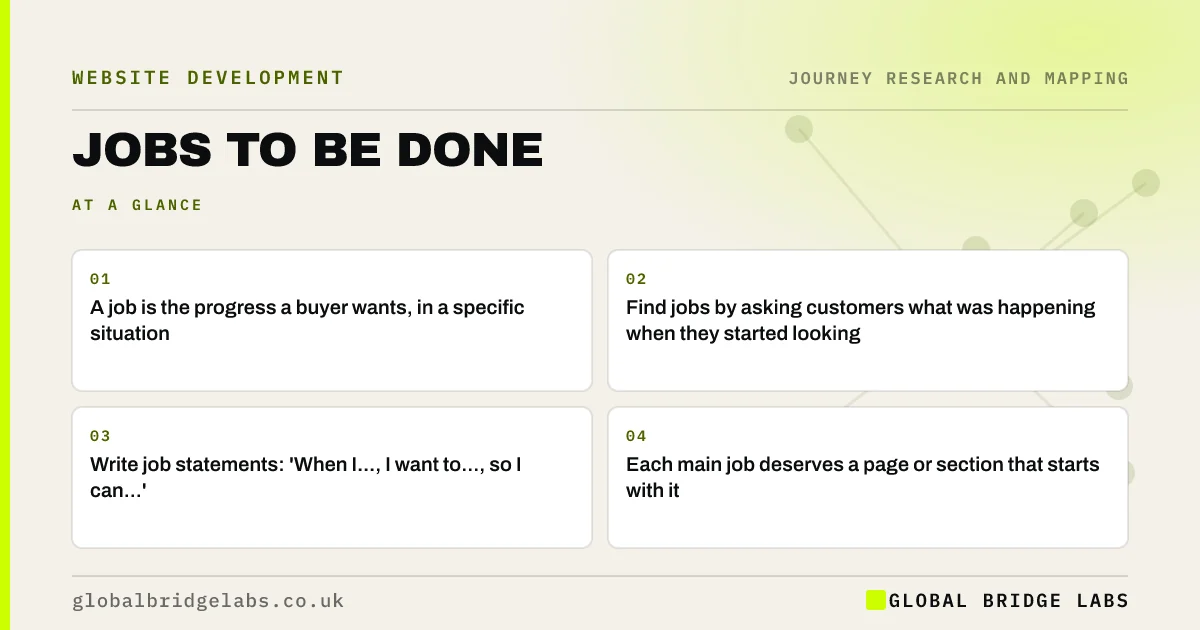
- A job is the progress a buyer wants, in a specific situation.
- Find jobs by asking customers what was happening when they started looking.
- Write job statements: 'When I..., I want to..., so I can...'.
- Each main job deserves a page or section that starts with it.
Want help finding the jobs your buyers hire you for? Message us on WhatsApp.
Chat on WhatsApp →What is jobs to be done?
Jobs to be done is a theory of customer behaviour, popularised by Clayton Christensen, that says people 'hire' products and services to make progress in a particular circumstance. In a 2016 Harvard Business Review article, Christensen and colleagues argued that understanding the job, rather than the customer's characteristics, explains why people buy.
The famous illustration is a fast-food milkshake bought by commuters for a long, boring drive: the job was 'keep me occupied and full until lunch', and competing products were bananas and bagels, not other milkshakes. Small businesses face the same logic. A buyer of bookkeeping may be hiring 'stop me worrying about the VAT deadline'.
How does jobs to be done change a website?
Jobs to be done changes a website by changing what each page starts with. Instead of 'We offer bookkeeping services', the page opens with the situation and progress: 'Behind on your books and worried about the VAT deadline? We get you up to date and keep you there.' The rest of the page answers what stands in the way: cost, effort, trust and timing.
- Headlines name the progress, not the service category.
- Pages address the circumstance that triggered the search.
- Proof shows buyers in the same situation getting the progress.
- Competitors include doing nothing and doing it yourself.
How do you find your buyers' jobs?
Find jobs by asking recent customers about the moment they started looking: what was happening, what they tried first, what nearly stopped them and what they hoped would change. Listen for situations and outcomes, not features. Five conversations per buyer type usually reveal two or three main jobs.
- What was happening when you first started looking for help?
- What had you tried before, including doing it yourself?
- What nearly made you put it off or choose someone else?
- What did you hope would be different afterwards?
- How would you describe what we do to a friend in your position?
How do you write a job statement?
Write a job statement in the form 'When [situation], I want to [motivation], so I can [outcome].' For example: 'When a tenant reports a leak on a Friday, I want a plumber who will attend the same day, so I can keep the landlord and tenant happy.' One statement per main job, in the buyer's words, then build the page around it.
When does jobs to be done not fit?
Jobs to be done fits less well for simple commodity purchases where the job is obvious and price decides, and it can become abstract if the job statements drift from what customers actually said. It is a lens for writing and structure, not a replacement for practical details such as price, area and availability, which buyers still need.
What does this look like in practice?
A pattern we see with service firms: a page titled 'Commercial cleaning services' lists frequencies, products and accreditations. Customer conversations reveal the job is 'stop me getting complaints from staff and visitors about the office'. Buyers switched after their previous cleaner was unreliable, not because of products.
Rewriting the page to open with reliability, show how cover and checks work, and quote clients who switched for that reason speaks to the job. Across our client work we have seen a 2.4x enquiry rate from conversion changes of this kind. Global Bridge Labs (GBL) writes the job statement before the headline.
Jobs to be done checklist
- Interview five recent customers about the moment they started looking.
- Write two or three job statements per buyer type.
- Rewrite service page headlines around the progress.
- Address the alternatives: doing nothing and doing it yourself.
- Use proof from buyers in the same situation.
- Keep practical answers: price guidance, area, timing.
Next step
If your service pages describe what you do rather than what buyers are trying to achieve, a jobs to be done review will show the gap. We can run the interviews and draft the job statements with you.
Message us on WhatsApp to find your buyers' jobs to be done, or book a 30-minute consultation.
Chat on WhatsApp →Sources and further reading
- Know your customers' jobs to be done (Christensen and others, 2016) · Harvard Business Review
- Personas make users memorable for product team members · Nielsen Norman Group
- User research · GOV.UK Service Manual
Frequently asked questions
What is jobs to be done in simple terms?
It is the idea that people buy products and services to make progress in a specific situation. Instead of asking who the customer is, you ask what job they are hiring you to do, such as 'get my accounts filed without a fine', and design around that progress.
How do I use jobs to be done on my website?
Find the main jobs by asking customers what was happening when they started looking, write job statements in the form 'When..., I want to..., so I can...', then open each service page with the situation and progress, and answer what stands in the way.
Is jobs to be done better than personas?
Neither is better in every case. Jobs to be done is often more useful for writing pages because it focuses on the progress buyers want. Personas help when different buyer types decide differently. Many small businesses combine them by leading each persona with its main job.
Written by

Global Bridge Labs (GBL) is a UK–Sri Lanka partner for social media, websites and BPO. Everything here comes from client delivery, not theory.