On this page
- 01Key takeaways
- 02What is a buyer persona in website design?
- 03When do personas help a website project?
- 04When do personas become fiction?
- 05How do you build research-based personas quickly?
- 06Should you use personas or jobs to be done?
- 07When should you skip personas?
- 08What does this look like in practice?
- 09Persona checklist
- 10Next step
- 11Sources and further reading
- 12Frequently asked questions
Key takeaways
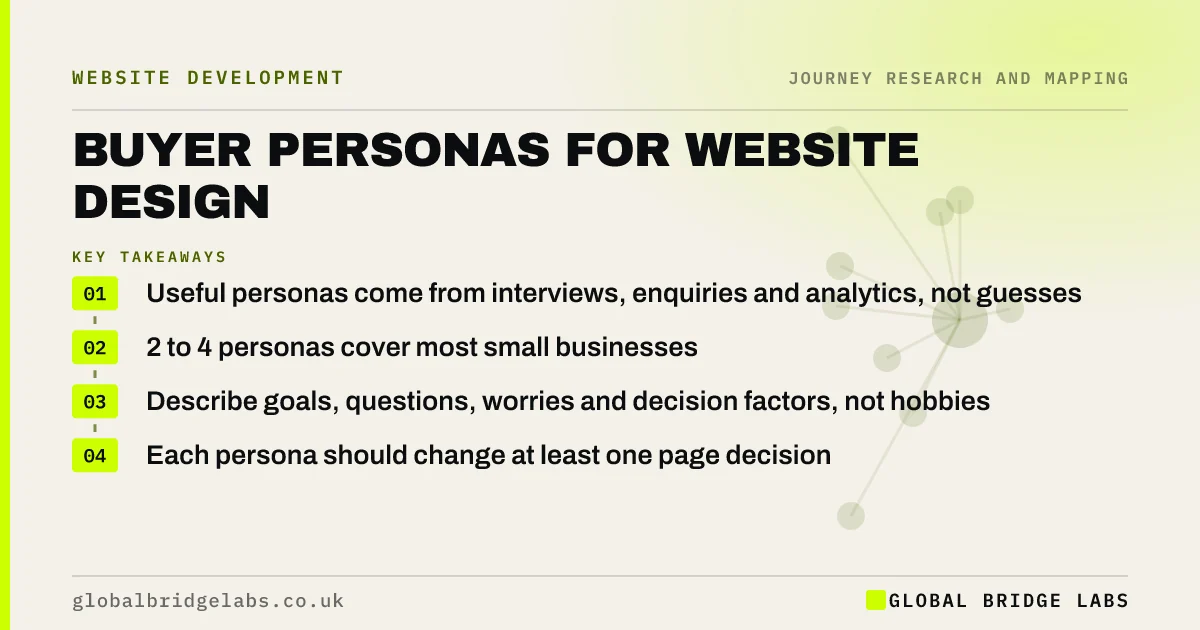
Buyer personas help website design when they are based on research, few enough to remember and focused on what buyers need to know and do. They become fiction when they are invented in a meeting, padded with hobbies and stock photos, or so numerous nobody uses them. Two to four research-based personas, built around goals and questions, are enough for most UK small businesses.
- Useful personas come from interviews, enquiries and analytics, not guesses.
- 2 to 4 personas cover most small businesses.
- Describe goals, questions, worries and decision factors, not hobbies.
- Each persona should change at least one page decision.
Want your personas checked against your real customers? Message us on WhatsApp.
Chat on WhatsApp →What is a buyer persona in website design?
A buyer persona in website design is a short, research-based description of a typical buyer type: what they are trying to get done, what they need to know, what worries them and how they decide. Nielsen Norman Group describes a persona as a fictional yet realistic description of a typical or target user, and is clear that personas must be based on user research.
For a website, the persona's job is to settle arguments. When someone asks whether a page needs prices, case studies or a booking button, the persona, and the research behind it, answers.
When do personas help a website project?
Personas help when a business serves buyers with genuinely different goals, such as homeowners and letting agents, or sole traders and limited companies. They keep the team designing for real people rather than for themselves, and they help writers choose the right words and order. They help most when each persona is linked to the pages built for it.
When do personas become fiction?
Personas become fiction when they are invented rather than researched, when they describe demographics instead of decisions, and when there are so many that nobody can remember them. 'Busy Brian, 42, enjoys golf' tells a designer nothing. 'Letting agent managing 40 properties, needs a contractor who answers within two hours and invoices cleanly' tells them a great deal.
- Built in a meeting with no customer contact.
- Full of age, hobbies and stock photos, empty of questions and worries.
- More than five for a small business.
- Never referred to after the kickoff.
How do you build research-based personas quickly?
Build personas by grouping real customers by what they are trying to get done and how they decide. Interview five recent customers per suspected type, read a month of enquiries, and check which pages each type lands on. Where groups share goals and questions, merge them. Where they differ in ways that change the website, keep them separate.
- Goal: what they are trying to get done, in their words.
- Trigger: what made them start looking now.
- Questions: the five things they need to know before contacting you.
- Worries: what could make them choose someone else.
- Decision: who else is involved and what tips them.
- Pages: where they land and what they need next.
Should you use personas or jobs to be done?
You can use both. Jobs to be done focuses on the progress a buyer is trying to make, regardless of who they are, which is often more useful for writing pages. Personas focus on who the buyer is and how they decide. A good small business persona leads with the job, so the two approaches end up close together.
When should you skip personas?
Skip formal personas when you sell one service to one kind of buyer, or when your journey map already captures the differences you need. A single journey map with clear buyer notes is enough for many sole traders and micro businesses. Personas are a tool, not a requirement.
What does this look like in practice?
A pattern we see in inherited website briefs: five personas with names and photos, and service pages that read identically for all of them. Interviews usually collapse them into two real types with different questions, for example owners who want a price and timescale, and managers who need something to forward to a director.
Writing for those two types, with a clear route for each, does more than five unused profiles. Across our client work we have seen a 2.4x enquiry rate from conversion changes of this kind. Global Bridge Labs (GBL) keeps personas to the number the research supports.
Persona checklist
- Base each persona on at least five real customer conversations.
- Lead with the goal and trigger, not age or hobbies.
- List their top five questions and main worries.
- Note who else is involved in the decision.
- Link each persona to the pages built for it.
- Keep to 2 to 4 for a small business.
Next step
If your personas were written once and never used, a short review against real customers will show which to keep, merge or drop, and what each means for the website.
Message us on WhatsApp to review your buyer personas, or book a 30-minute consultation.
Chat on WhatsApp →Sources and further reading
- Personas make users memorable for product team members · Nielsen Norman Group
- Know your customers' jobs to be done (Christensen and others, 2016) · Harvard Business Review
- User research · GOV.UK Service Manual
Frequently asked questions
Do I need buyer personas for my website?
Not always. If you serve buyers with different goals, two to four research-based personas help decide what each page says. If you sell one service to one kind of buyer, a single journey map with buyer notes is usually enough.
How many personas should a website have?
Two to four for most small businesses. Each should represent a buyer type whose goals or questions are different enough to change the website. More than five tends to go unused, and fewer, well-researched personas are more useful than many invented ones.
What should a website persona include?
The buyer's goal and what triggered their search, the questions they need answered, their worries, who else is involved in the decision and the pages they land on. Demographic detail is only worth including if it changes what the website should say or do.
Written by

Global Bridge Labs (GBL) is a UK–Sri Lanka partner for social media, websites and BPO. Everything here comes from client delivery, not theory.