On this page
- 01Key takeaways
- 02Why analyse lost deals?
- 03How do you ask lost prospects why?
- 04What reasons usually come up?
- 05How do lost-deal reasons change the website?
- 06How do you record and review the reasons?
- 07When are lost-deal answers unreliable?
- 08What does this look like in practice?
- 09Lost-deal checklist
- 10Next step
- 11Sources and further reading
- 12Frequently asked questions
Key takeaways
Buyers who enquired and chose someone else know exactly where your journey fell short. A short, polite question to lost prospects, such as 'What made you go elsewhere?', often reveals gaps that website analytics cannot: unclear prices, slow replies, missing proof or a competitor who explained the process better. Ask regularly, record the reasons, and look for the ones the website could fix.
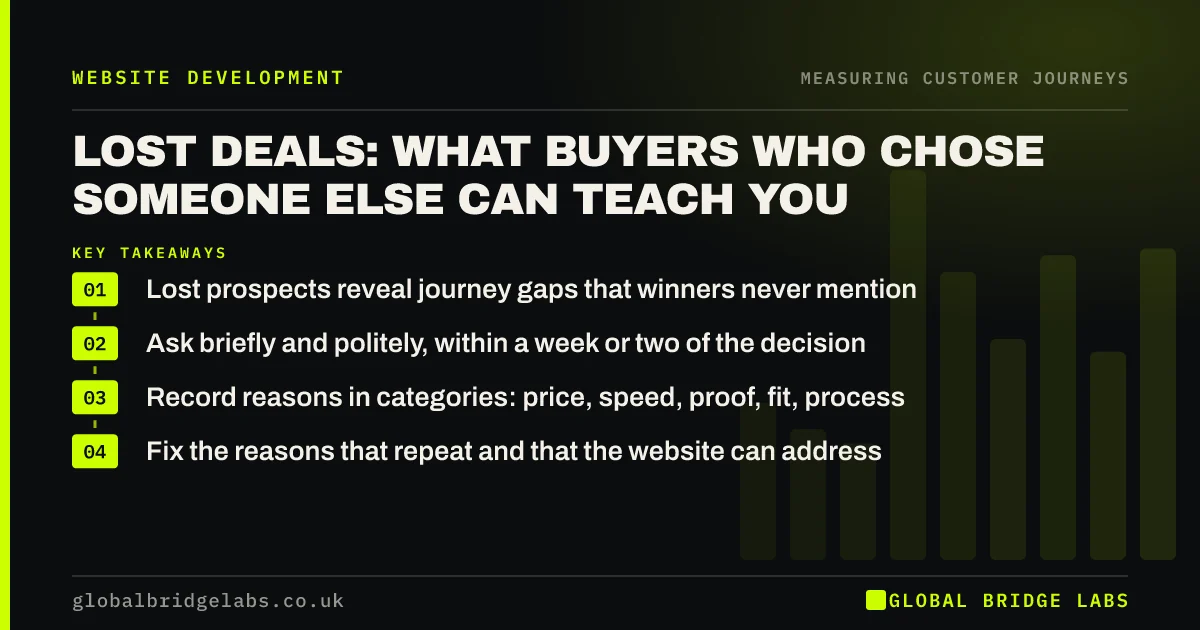
- Lost prospects reveal journey gaps that winners never mention.
- Ask briefly and politely, within a week or two of the decision.
- Record reasons in categories: price, speed, proof, fit, process.
- Fix the reasons that repeat and that the website can address.
Want a short lost-deal question you can send? Ask for it on WhatsApp.
Chat on WhatsApp →Why analyse lost deals?
Analyse lost deals because they show the journey from the buyer who left. Customers who chose you tend to describe what went well; prospects who chose a competitor tell you what was missing. In sales this is often called win-loss analysis. For a small business, a handful of lost-deal conversations each quarter is enough to see patterns.
How do you ask lost prospects why?
Ask briefly, politely and without trying to re-sell. A short message or call within a week or two of the decision works best: thank them, say you are trying to improve, and ask one or two questions. Many people are happy to answer when there is no pressure. Accept the answer without arguing.
- What made you decide to go with another option?
- Was there anything you could not find out from us?
- Was anything slow or unclear in how we responded?
- What did the business you chose do well?
What reasons usually come up?
Lost-deal reasons usually fall into five groups: price or perceived value, speed of reply or availability, proof and trust, fit with what the buyer needed, and clarity of the process or quote. Price is often given as the reason, but follow-up questions frequently reveal that the competitor explained their price better or replied faster.
- Price or value: 'they were cheaper' or 'we did not understand what was included'.
- Speed: 'they called back first' or 'they could start sooner'.
- Proof: 'they had done jobs like ours'.
- Fit: 'they specialised in our situation'.
- Clarity: 'their quote and process were easier to follow'.
How do lost-deal reasons change the website?
Lost-deal reasons change the website when they repeat and the website could have answered them. 'We did not understand what was included' points to a clearer price and scope section. 'They had done jobs like ours' points to proof by sector. 'Their process was easier to follow' points to a 'how it works' block. 'They called back first' points to the steps after the form.
- Consideration stage: help buyers compare without leaving
- After the enquiry: designing the journey to the first call
Have lost-deal reasons and not sure which are website fixes? Send them to us on WhatsApp.
Chat on WhatsApp →How do you record and review the reasons?
Record each lost deal in your CRM or a spreadsheet with the date, service, source, main reason category and the buyer's words. Review quarterly. Look for categories that rise, reasons tied to particular services or sources, and quotes that could inform the website copy. Keep the buyer's details only as long as needed under UK GDPR.
When are lost-deal answers unreliable?
Lost-deal answers are unreliable when buyers give a polite reason, usually price, to end the conversation, or when only a few answer. Treat single answers as anecdotes and patterns as evidence. Combine them with what your analytics and recordings show at the same journey stage.
What does this look like in practice?
A pattern we see when businesses start asking lost prospects: 'too expensive' is the most common first answer. A follow-up question often shows the competitor's quote was similar, but it came with a clear breakdown, a start date and examples of similar work, while the business's quote was a single figure.
Adding a 'what is included' section to the website and the quote template addresses the real gap. Across our client work we have seen a 2.4x enquiry rate from conversion changes of this kind. Global Bridge Labs (GBL) treats lost deals as journey research.
Lost-deal checklist
- Ask every lost prospect one or two polite questions.
- Do it within a week or two of the decision.
- Record the category and the buyer's words.
- Review patterns quarterly.
- Fix reasons the website or follow-up can address.
- Delete personal details when no longer needed.
Next step
Lost deals are the cheapest research you can do. We can help you ask the right questions and turn the answers into website changes.
Message us on WhatsApp to set up lost-deal analysis, or book a 30-minute consultation.
Chat on WhatsApp →Sources and further reading
- Lawful basis for processing personal data · Information Commissioner's Office
- User research · GOV.UK Service Manual
- Journey mapping 101 · Nielsen Norman Group
Frequently asked questions
How do I find out why customers did not buy from me?
Ask them, briefly and politely, within a week or two of their decision: what made them choose another option, and whether anything was unclear or slow. Do not try to re-sell. Record the reasons and look for patterns each quarter.
What is win-loss analysis?
Win-loss analysis is the practice of asking buyers who chose you and those who chose someone else why they decided as they did, then looking for patterns. Small businesses can do a simple version with a short message to lost prospects and a spreadsheet.
Is price really the main reason customers go elsewhere?
It is the most common first answer, but often not the full story. Follow-up questions frequently show the competitor explained their price, scope or process more clearly, replied faster or showed more relevant proof. Ask one more question before cutting prices.
Written by

Global Bridge Labs (GBL) is a UK–Sri Lanka partner for social media, websites and BPO. Everything here comes from client delivery, not theory.