On this page
- 01Key takeaways
- 02What is a GA4 funnel exploration?
- 03Which steps should a small business funnel use?
- 04Should you use an open or closed funnel?
- 05How do you read the drop-off?
- 06What are the limits of funnel exploration?
- 07When is a funnel the wrong model?
- 08What does this look like in practice?
- 09Funnel exploration checklist
- 10Next step
- 11Sources and further reading
- 12Frequently asked questions
Key takeaways
A GA4 funnel exploration shows how many users complete each step of a journey you define, such as landing page, service page, pricing, form start and form submit, and where they drop. Build one from the steps your customer journey map says matter, compare mobile and desktop, and investigate the step with the biggest drop. Keep data retention at 14 months, because funnel reports use it.
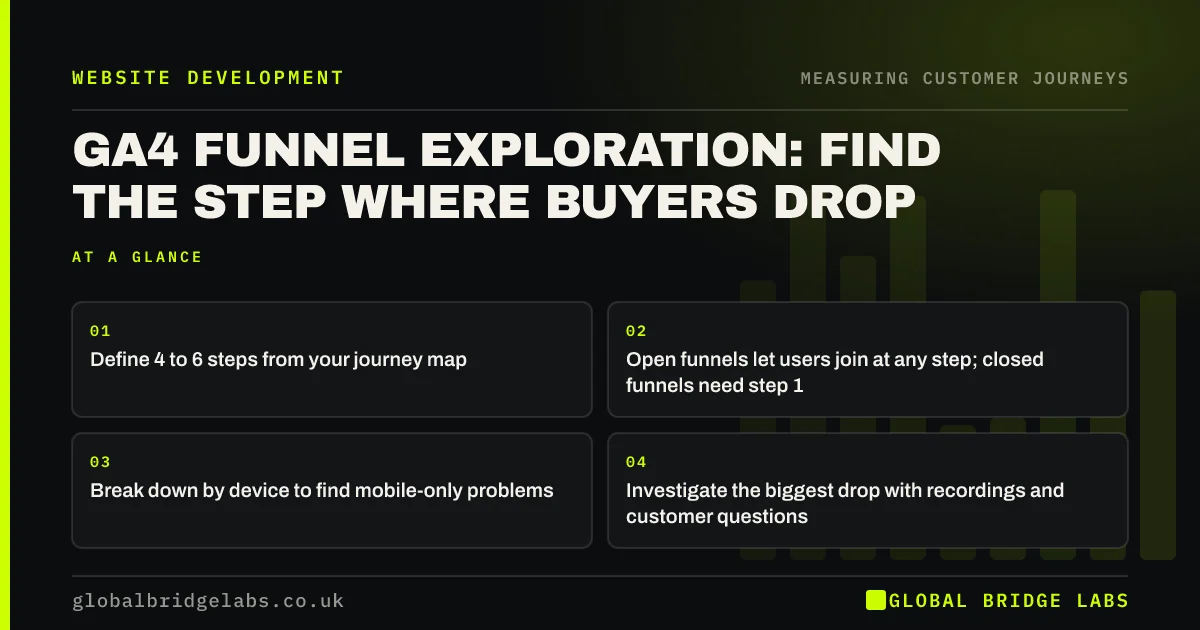
- Define 4 to 6 steps from your journey map.
- Open funnels let users join at any step; closed funnels need step 1.
- Break down by device to find mobile-only problems.
- Investigate the biggest drop with recordings and customer questions.
Want a funnel exploration built from your customer journey? Message us on WhatsApp.
Chat on WhatsApp →What is a GA4 funnel exploration?
A GA4 funnel exploration is a report in the Explore section of Google Analytics 4 that shows how users progress through a sequence of steps you define, and how many abandon at each. Steps can be page views, events or conditions. It turns a part of your customer journey into numbers, so you can see which step loses the most buyers.
Which steps should a small business funnel use?
Use steps that the customer journey says matter, in the order buyers take them. A typical service business funnel is: any session, service page view, pricing or proof page view, form start, form submit. An e-commerce funnel is: product view, add to basket, begin checkout, add payment info, purchase. Four to six steps is enough.
- Step 1: session start or landing on a key page.
- Step 2: service or product page view.
- Step 3: pricing, proof or add to basket.
- Step 4: form start or begin checkout.
- Step 5: form submit, phone click or purchase.
Should you use an open or closed funnel?
Use an open funnel for most website journeys. In GA4, a closed funnel only counts users who enter at the first step, while an open funnel lets users join at any step. Because many buyers land on inner pages or return directly to pricing, an open funnel better reflects real journeys. Use a closed funnel for strict sequences such as checkout.
How do you read the drop-off?
Read drop-off as a pointer, not a verdict. The biggest percentage drop shows where to look. Break down by device category to see if the drop is mainly on mobile, and by session source to see if certain visitors behave differently. Then watch session recordings at that step and check what customers ask. Some drop is normal: not every visitor is a buyer.
- Session recordings: watch real journeys without guesswork
- Mobile and desktop in GA4: find where phones lose enquiries
Have a funnel with a drop you cannot explain? Send us a screenshot on WhatsApp.
Chat on WhatsApp →What are the limits of funnel exploration?
Funnel explorations count steps on the website only. Buyers who read your pricing and then phone may look like drop-offs unless phone clicks are tracked. Visitors who decline analytics cookies are not counted. Google notes that data retention affects funnel reports. And small sites may need longer date ranges to see stable patterns.
When is a funnel the wrong model?
A funnel is the wrong model when buyers rarely follow a sequence on the site, for example referral-led businesses where visitors go straight to contact, or long B2B journeys spread over months. Path explorations, customer interviews and asking how buyers found you will tell you more.
What does this look like in practice?
A pattern we see in first funnel explorations: the biggest drop is between form start and form submit, and only on mobile. Recordings show the form's date picker failing on some phones, and a required field asking for information buyers do not have yet. Desktop users barely notice.
Fixing the field and the date picker recovers buyers who were already trying to enquire. Across our client work we have seen a 2.4x enquiry rate from conversion changes of this kind. Global Bridge Labs (GBL) splits every funnel by device before drawing conclusions.
Funnel exploration checklist
- Set data retention to 14 months.
- Track form start, form submit and phone clicks as events.
- Choose 4 to 6 steps from your journey map.
- Use an open funnel for website journeys.
- Break down by device and source.
- Investigate the biggest drop with recordings.
Next step
A funnel built from your customer journey shows exactly which step to fix first. We will set one up and walk you through what it shows.
Message us on WhatsApp for a GA4 funnel exploration, or book a 30-minute consultation.
Chat on WhatsApp →Sources and further reading
- Funnel exploration · Google Analytics Help
- Data retention · Google Analytics Help
- About key events · Google Analytics Help
Frequently asked questions
How do I create a funnel in GA4?
In GA4, go to Explore and choose the Funnel exploration template. Add four to six steps based on page views or events, such as service page view, form start and form submit. Choose an open or closed funnel, set the date range and break down by device.
What is the difference between an open and closed funnel in GA4?
A closed funnel only counts users who enter at the first step. An open funnel lets users join at any step. Open funnels suit most website journeys, where buyers land on inner pages; closed funnels suit strict sequences like checkout.
Why does my GA4 funnel show a big drop at the form?
Common causes are a long or broken form on mobile, required fields buyers cannot answer, unclear next steps, or buyers phoning instead. Break the funnel down by device, watch session recordings of the form and track phone clicks before deciding.
Written by

Global Bridge Labs (GBL) is a UK–Sri Lanka partner for social media, websites and BPO. Everything here comes from client delivery, not theory.