On this page
- 01Key takeaways
- 02What is the difference between a customer journey and a sales funnel?
- 03Why is a funnel not enough to design a website?
- 04How do the journey and the funnel work together?
- 05Which should a small business start with?
- 06When does the funnel model mislead?
- 07What does this look like in practice?
- 08Journey and funnel checklist
- 09Next step
- 10Sources and further reading
- 11Frequently asked questions
Key takeaways
A sales funnel counts how many prospects move through your process. A customer journey describes what buyers do, ask and feel on the way, including steps you never see. Use the customer journey to decide what the website says and where, and use the funnel to measure whether it is working. One without the other gives you either guesses or numbers without causes.
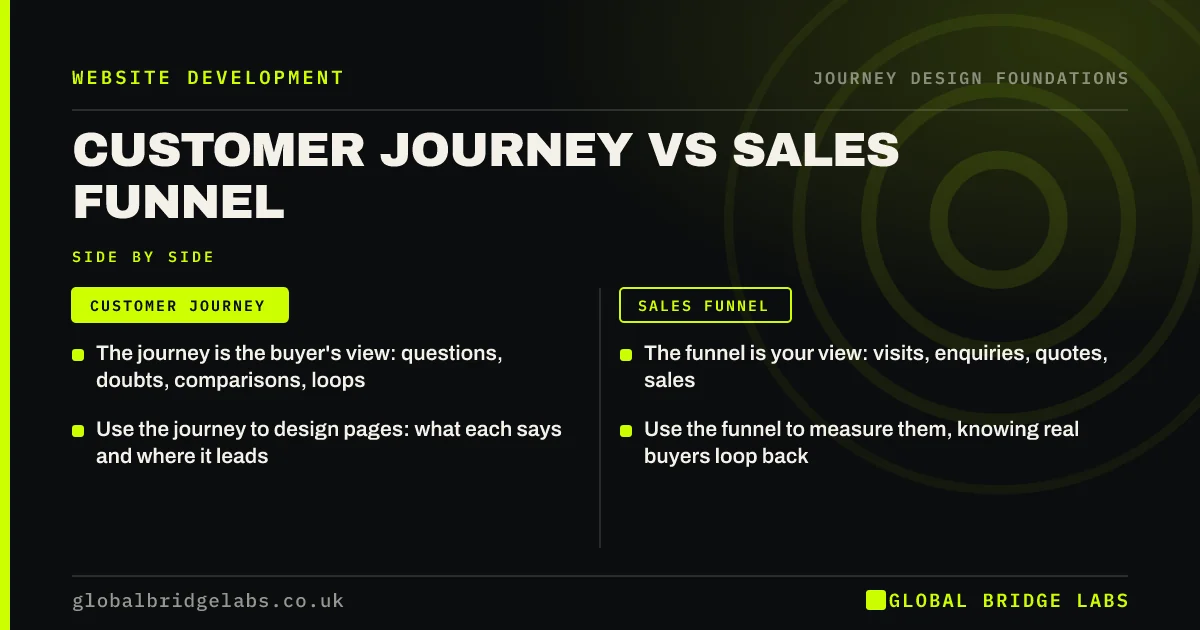
- The journey is the buyer's view: questions, doubts, comparisons, loops.
- The funnel is your view: visits, enquiries, quotes, sales.
- Use the journey to design pages: what each says and where it leads.
- Use the funnel to measure them, knowing real buyers loop back.
Want your funnel numbers explained by your customer journey? Message us on WhatsApp.
Chat on WhatsApp →What is the difference between a customer journey and a sales funnel?
The difference is whose view you take. A sales funnel is the business's view: a narrowing count of people from visit to enquiry to quote to sale. A customer journey is the buyer's view: the steps, questions and feelings they go through, across channels and over time. The funnel tells you where numbers fall; the journey tells you why.
Why is a funnel not enough to design a website?
A funnel is not enough because it shows a drop without explaining it. If 1,000 people view a service page and 15 enquire, the funnel says the page leaks. It cannot say whether buyers wanted a price, doubted the proof, needed to check with a partner or simply were not ready. Those answers come from journey research: interviews, sales calls and recordings.
Funnels also assume a straight line. Real buyers leave, compare, come back on another device and enquire through a different route. A funnel built only on single sessions can make good pages look weak, because the enquiry happened a week later on a laptop.
How do the journey and the funnel work together?
The journey and the funnel work together as design and measurement. Map the journey to decide which pages, answers and routes the site needs. Then turn the key steps into funnel stages in analytics, for example landing page, service page, pricing or proof view, form start, form submit. When a funnel step drops, go back to the journey to understand why.
- Map the journey for each main buyer type.
- Pick four to six steps on the website that the journey says matter.
- Build a GA4 funnel exploration with those steps.
- Investigate the biggest drop with recordings and customer questions.
- Change the page, then check the funnel again.
Which should a small business start with?
Start with the journey if you are planning a new site or a redesign, because structure decisions need the buyer's view. Start with the funnel if the site already exists and you need to find the leak quickly, because the numbers point to where research will pay. Either way, you need both within the first month.
When does the funnel model mislead?
The funnel model misleads when the buying decision happens off the website. Many service buyers read your site, then phone. Unless calls are tracked, the funnel shows a drop where there was actually a sale. It also misleads for referral-led businesses, where buyers arrive already decided and skip the early stages. Count calls and ask how people heard of you before trusting the shape.
What does this look like in practice?
A pattern we see in funnel reports: the pricing page has the highest exit rate on the site, and the conclusion is that prices scare people off. Recordings and a few customer conversations tell a different story. Buyers check the price, leave, and ring the next day. The pricing page is working; the funnel was not counting calls.
Adding call tracking and a 'how did you hear about us' question changes the picture and protects a page that was doing its job. Across our client work we have seen a 2.4x enquiry rate from conversion changes made once the real journey was understood. Global Bridge Labs (GBL) reads the funnel through the journey, never alone.
Journey and funnel checklist
- Write your funnel stages from visit to sale.
- Write the buyer's questions at each stage beside them.
- Track phone calls as well as form submissions.
- Build one GA4 funnel exploration from the key steps.
- Check the biggest drop against what customers say.
- Review both every quarter.
Next step
If your funnel shows a leak but nobody can say why, the answer is usually in the journey. We will match your numbers to what buyers actually do.
Message us on WhatsApp with your funnel numbers, or book a 30-minute consultation.
Chat on WhatsApp →Sources and further reading
- Funnel exploration · Google Analytics Help
- Journey mapping 101 · Nielsen Norman Group
- Get started with attribution · Google Analytics Help
Frequently asked questions
Is the customer journey the same as the marketing funnel?
No. The marketing or sales funnel is a business view that counts prospects at each stage of your process. The customer journey is the buyer's view of the same period, including their questions, doubts and steps that happen off your website. Use the journey to design and the funnel to measure.
Should I design my website around a funnel?
Design it around the customer journey and measure it with a funnel. A funnel shows where visitors drop but not why, and it assumes a straight line that real buyers rarely follow. The journey tells you which answers and routes each page needs.
What replaces the sales funnel?
Nothing needs to replace it. The funnel is still useful for counting. Many teams add a journey map alongside it, and some use loop or flywheel models to show repeat and referral business, but a small business can use a simple funnel and one journey map per buyer type.
Written by

Global Bridge Labs (GBL) is a UK–Sri Lanka partner for social media, websites and BPO. Everything here comes from client delivery, not theory.