On this page
- 01Key takeaways
- 02What is a website conversion funnel?
- 03What are the five stages for a service business?
- 04How do you measure each stage?
- 05What does a typical funnel look like?
- 06Where do most small business sites lose buyers?
- 07When is funnel thinking misleading?
- 08What does this look like in practice?
- 09Funnel checklist
- 10Next step
- 11Sources and further reading
- 12Frequently asked questions
Key takeaways
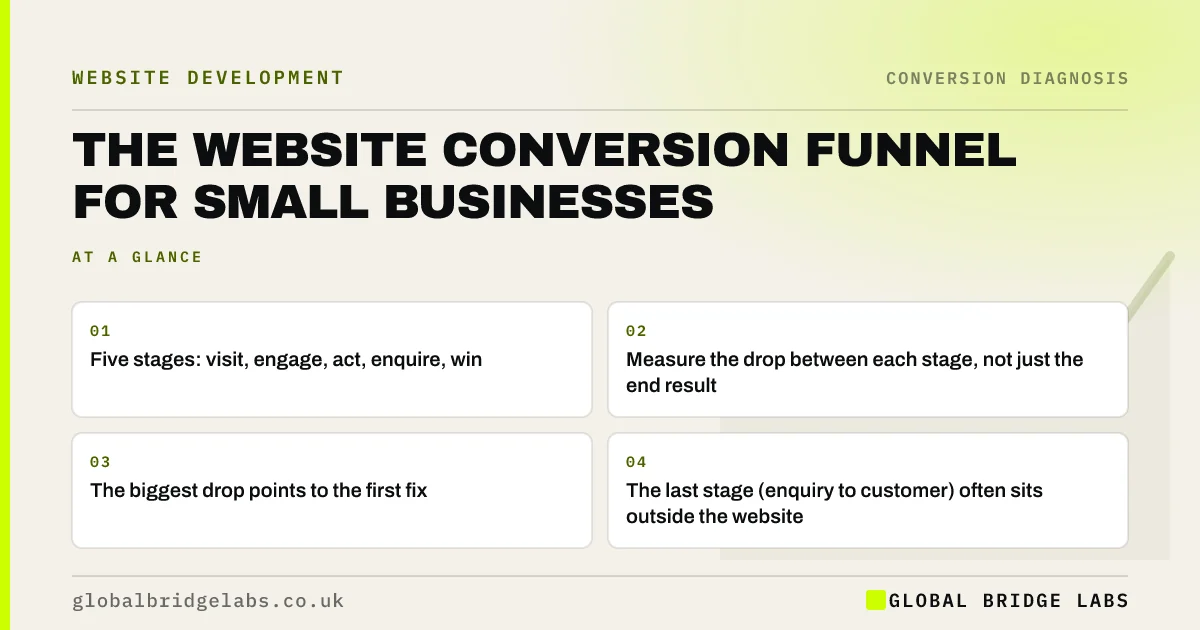
A website conversion funnel is the sequence of steps from a visitor arriving to them becoming a customer. For a small service business it has five stages: visit, engage, act, enquire and win. Measuring the drop between each stage shows exactly where a good website loses buyers, which is more useful than a single conversion rate.
- Five stages: visit, engage, act, enquire, win.
- Measure the drop between each stage, not just the end result.
- The biggest drop points to the first fix.
- The last stage (enquiry to customer) often sits outside the website.
Want your funnel mapped with real numbers? Message us on WhatsApp.
Chat on WhatsApp →What is a website conversion funnel?
A website conversion funnel is a model of the steps visitors take from first arriving on a site to becoming a customer, with the number of people at each step. It narrows at every stage because some visitors leave. The shape of the narrowing tells you where the website is weakest.
What are the five stages for a service business?
Most service business funnels fit five stages. E-commerce funnels are similar, with product view, basket and checkout in place of act and enquire.
- Visit: a session starts on any page.
- Engage: the visitor reads, scrolls or views a second page (GA4 engaged sessions).
- Act: the visitor starts an action, such as opening the form or tapping call.
- Enquire: the form is sent, the call connects or the chat starts.
- Win: the enquiry becomes a paying customer.
How do you measure each stage?
Google Analytics 4 covers the first four stages if events are set up: sessions, engaged sessions, events for form starts and call clicks, and key events for completed enquiries. The fifth stage needs your CRM or a simple spreadsheet recording which enquiries became customers and where they came from.
What does a typical funnel look like?
Here is an illustrative funnel for a UK service business with 2,000 visits a month. The numbers are working ranges from our audits, not benchmarks, but the pattern is common.
- Visit: 2,000 sessions.
- Engage: 1,000 to 1,200 engaged sessions (50% to 60%).
- Act: 80 to 120 form starts or call taps.
- Enquire: 30 to 60 completed enquiries.
- Win: 8 to 20 new customers.
Want to see how your funnel compares? Send us your numbers on WhatsApp.
Chat on WhatsApp →Where do most small business sites lose buyers?
The most common big drops are between engage and act, where visitors read but never start an action because the next step is unclear or the page leaves questions unanswered, and between act and enquire, where forms and routes fail. A low engagement rate usually points to landing page mismatch or slow mobile pages.
- Low engage: wrong visitors, slow page, weak first screen.
- Low act: unclear next step, missing price or proof.
- Low enquire: long or broken form, failing route.
- Low win: slow follow-up, poor-fit enquiries, sales process gaps.
When is funnel thinking misleading?
Real buyers do not move in a straight line. They visit several times, from different devices, and may call after seeing your van rather than clicking. Treat the funnel as a diagnostic model, not a map of every journey. Returning visitors and offline enquiries will always blur the edges.
What does this look like in practice?
A UK wedding venue assumed its low enquiry count meant the site was not attracting enough couples. The funnel showed healthy visits and engagement, a reasonable share opening the enquiry form, and very few sending it. The form asked for 14 details, including guest numbers by meal choice. Cutting it to five fields fixed the biggest drop in the funnel within weeks.
Funnel checklist
- Define the five stages for your business.
- Set up events for form starts and call taps, and key events for completions.
- Record which enquiries become customers.
- Calculate the drop between each stage monthly.
- Fix the biggest drop first.
- Re-measure after 8 weeks.
Next step
A funnel with real numbers turns 'the website is not working' into 'we lose most people between opening the form and sending it'. That is a problem you can fix. We can set it up with you.
Message us on WhatsApp to map your website funnel, or book a 30-minute consultation.
Chat on WhatsApp →Sources and further reading
- About key events · Google Analytics Help
- Engagement rate and bounce rate · Google Analytics Help
- Structuring forms · GOV.UK Service Manual
Frequently asked questions
What are the stages of a website conversion funnel?
For a service business: visit, engage, act, enquire and win. Visitors arrive, engage with content, start an action such as opening a form, complete an enquiry and finally become customers. E-commerce funnels use product view, basket, checkout and purchase. Each stage narrows as some visitors leave.
How do I track my website funnel in GA4?
Use sessions and engaged sessions for the first two stages, create events for form starts and phone or WhatsApp taps, and mark completed enquiries as key events. GA4's funnel exploration report can then show the drop between steps. Record which enquiries became customers in your CRM or a spreadsheet.
What is a good engagement rate for a small business website?
In GA4, many small business sites see roughly 50% to 60% of sessions counted as engaged, depending on traffic mix. Very low rates suggest landing page mismatch, slow mobile pages or a weak first screen. Compare with your own trend rather than a single benchmark.
Where should I start fixing my funnel?
At the stage with the largest proportional drop, provided tracking is reliable. If many visitors start forms but few finish, fix the form. If many engage but few act, fix clarity, proof and the next step. If enquiries do not become customers, look at follow-up.
Written by

Global Bridge Labs (GBL) is a UK–Sri Lanka partner for social media, websites and BPO. Everything here comes from client delivery, not theory.