On this page
- 01Key takeaways
- 02What is research online, buy offline?
- 03Why does ROBO make websites look weaker than they are?
- 04How do you design pages for offline purchases?
- 05How do you measure the website's role in offline sales?
- 06Should you try to move offline sales online?
- 07When is ROBO not your main journey?
- 08What does this look like in practice?
- 09ROBO checklist
- 10Next step
- 11Sources and further reading
- 12Frequently asked questions
Key takeaways
Many buyers research on your website and then buy by phone, in person or at a visit. This research online, buy offline pattern means the website does the selling while the sale is recorded elsewhere. Design for it: make calling and visiting easy, give buyers what they need to arrive ready, and measure calls, visits and 'how did you hear about us' alongside forms.
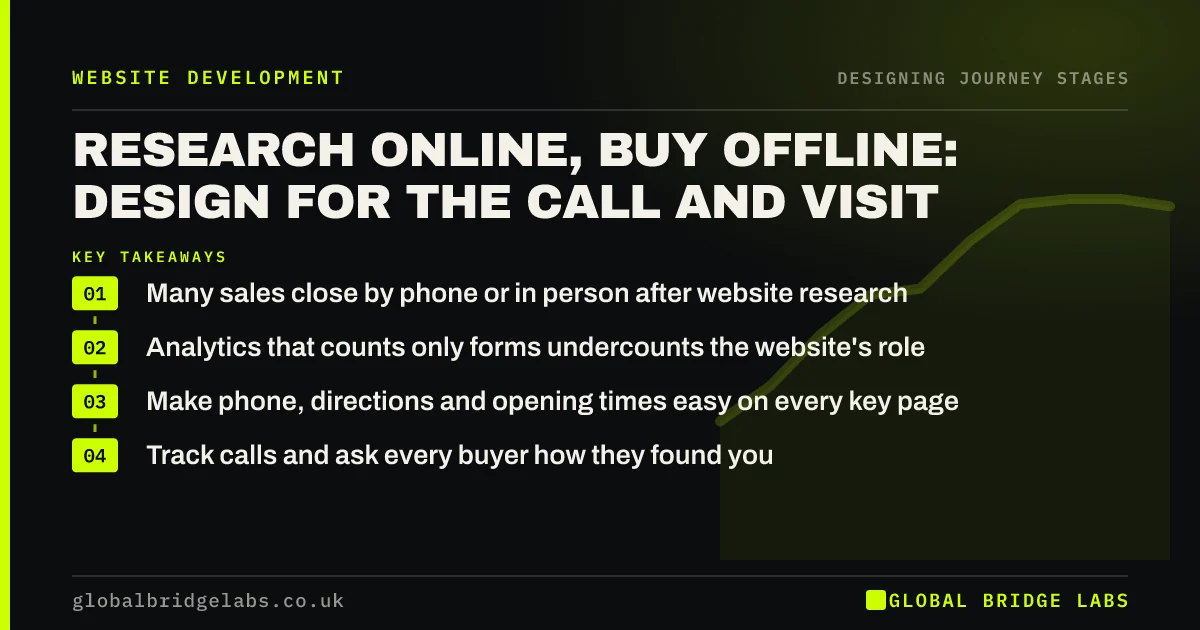
- Many sales close by phone or in person after website research.
- Analytics that counts only forms undercounts the website's role.
- Make phone, directions and opening times easy on every key page.
- Track calls and ask every buyer how they found you.
Want to know how many of your calls start on your website? Message us on WhatsApp.
Chat on WhatsApp →What is research online, buy offline?
Research online, buy offline, often shortened to ROBO, is a customer journey where buyers gather information on websites, reviews and search results, then complete the purchase offline: by phone, in a shop, at a showroom or during a visit. It is common for services, higher-value goods and local businesses, where buyers want to talk or see before committing.
Why does ROBO make websites look weaker than they are?
ROBO makes websites look weaker because analytics records the research but not the purchase. A buyer reads three service pages, notes the number and calls the next morning from a different device. GA4 shows a visit with no conversion; the sale appears in your diary, not your reports. Judging the site on form submissions alone undervalues it.
How do you design pages for offline purchases?
Design pages for offline purchases by giving buyers what they need to make the call or visit confidently. That means a tappable phone number with opening hours, a clear address with directions and parking, what to bring or prepare, price guidance so the call is not a shock, and an option to book a time to talk or visit.
- Tappable phone number with hours on every key page.
- Address, map, directions and parking for visits.
- Price guidance so buyers arrive with realistic expectations.
- What to bring or prepare for the call or visit.
- A way to book a call back or appointment.
How do you measure the website's role in offline sales?
Measure the website's role with three tools. Track clicks on phone numbers and directions as key events in GA4. Use call tracking numbers on the website to count calls it generates. Ask every buyer how they found you, and record it in your sales system. Together they show what share of offline sales started online.
- Call tracking for small businesses: which advert made it ring?
- 'How did you hear about us?' Asking the question properly
Want phone and directions clicks tracked in GA4? Message us on WhatsApp.
Chat on WhatsApp →Should you try to move offline sales online?
Only where buyers want it. Some prefer to book or buy online and are frustrated when they must phone; others want a conversation for anything significant. Offer the online route where it fits, such as booking a survey or a consultation slot, and keep the phone prominent for buyers who prefer to talk.
When is ROBO not your main journey?
ROBO is not your main journey if most sales complete online, such as low-value e-commerce, or if buyers rarely use the website before calling, such as long-standing trade accounts. Ask a sample of buyers to find out. The answer decides whether the phone or the checkout deserves most design attention.
What does this look like in practice?
A pattern we see in local service businesses: the owner thinks the website brings few customers because forms are rare. Adding call tracking and asking callers shows that a large share read the website first. The phone number, though, is in small type at the bottom of service pages.
Moving a tappable number and hours to the top of each service page makes the main route easier, and the reports start to show what the site was already doing. Across our client work we have seen a 2.4x enquiry rate from conversion changes of this kind. Global Bridge Labs (GBL) counts calls before judging a website.
ROBO checklist
- Ask 20 recent buyers whether they used the website first.
- Put a tappable phone number and hours on every key page.
- Add directions and parking if buyers visit.
- Track phone and directions clicks in GA4.
- Use call tracking numbers on the website.
- Record 'how did you hear about us?' for every sale.
Next step
If your sales close by phone or in person, your website may be doing more than your reports show. We will help you measure it and make the offline step easier.
Message us on WhatsApp to measure your research-online, buy-offline journey, or book a 30-minute consultation.
Chat on WhatsApp →Sources and further reading
- About key events · Google Analytics Help
- Get started with attribution · Google Analytics Help
- Maps URLs: launch Google Maps for search and directions · Google Maps Platform
Frequently asked questions
What does research online, buy offline mean?
It describes buyers who gather information on websites, reviews and search, then complete the purchase offline by phone, in person or during a visit. It is common for services, higher-value goods and local businesses, where buyers want to talk or see before committing.
How do I measure website visitors who call instead of filling in a form?
Track clicks on phone numbers as key events in GA4, use call tracking numbers on the website to count calls it generates, and ask every caller how they found you. Combining all three gives a reasonable picture of the website's role.
Should I force customers to buy online?
No. Offer online routes, such as booking a call or survey, where buyers want them, and keep the phone and visit options prominent for those who prefer to talk. Removing the offline route usually loses buyers rather than moving them online.
Written by

Global Bridge Labs (GBL) is a UK–Sri Lanka partner for social media, websites and BPO. Everything here comes from client delivery, not theory.