On this page
- 01Key takeaways
- 02What is the difference between flat and deep structures?
- 03Which is easier to navigate?
- 04How does structure affect search?
- 05When does a deeper structure make sense?
- 06What are the warning signs of the wrong structure?
- 07What does this look like in practice?
- 08Structure checklist
- 09Next step
- 10Sources and further reading
- 11Frequently asked questions
Key takeaways
A flat site structure puts most pages one or two levels below the homepage; a deep one stacks them several levels down. For most small business sites, a moderately flat structure is easier to navigate: fewer decisions to reach key pages, and each page closer to the homepage for search. Go deeper only when there are many pages in clear groups.
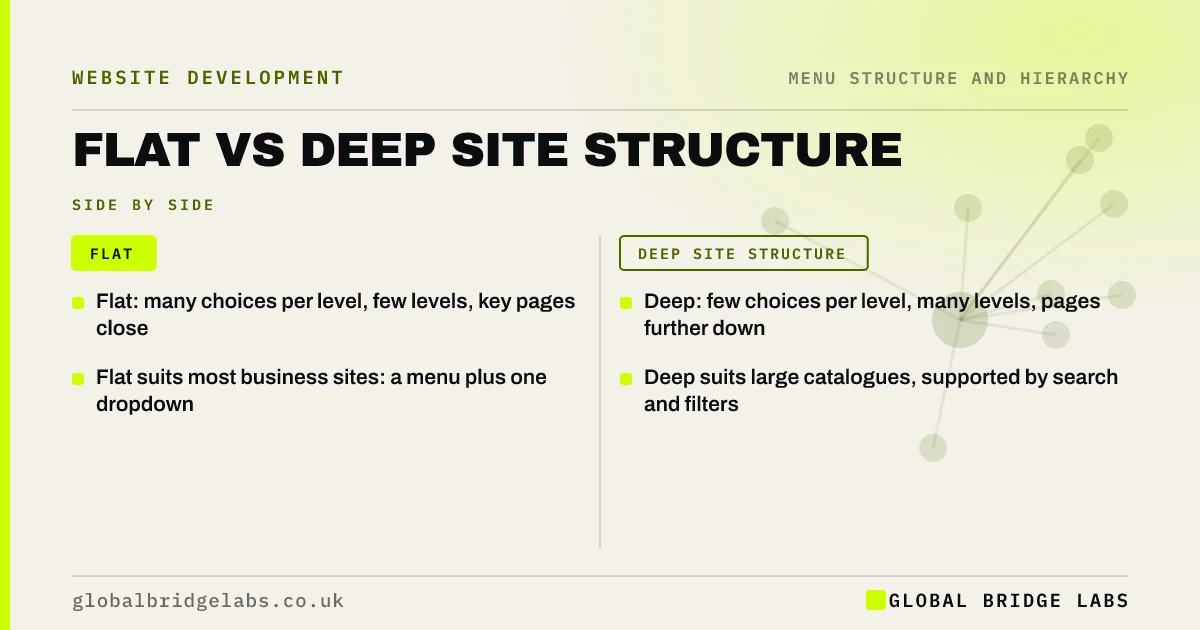
- Flat: many choices per level, few levels, key pages close.
- Deep: few choices per level, many levels, pages further down.
- Flat suits most business sites: a menu plus one dropdown.
- Deep suits large catalogues, supported by search and filters.
Want to know if your structure is too deep or too flat? Message us on WhatsApp.
Chat on WhatsApp →What is the difference between flat and deep structures?
A flat site structure, also called broad or shallow, has many pages at the top level and few levels beneath. A deep structure has few top-level options, each leading through several layers of sub-pages. The difference is a trade-off between choices per level and levels to click through.
- Flat: more choices at each step, fewer steps.
- Deep: fewer choices at each step, more steps.
Which is easier to navigate?
Research on menu breadth and depth has generally found that moderately broad structures perform better than deep ones, because each extra level adds a chance to take the wrong turn. But a menu with 30 options at the top is hard to scan. The balance for most business sites is five to seven top-level items with one level of dropdown.
How does structure affect search?
Flatter structures keep important pages closer to the homepage, which helps them get discovered and signals importance through internal links. Deep structures can bury pages at four or five clicks. Use a crawl to check depth, and link key pages from the menu or hubs rather than letting them sink.
When does a deeper structure make sense?
Depth makes sense when there are many pages in clear, nested groups, such as a retailer with categories, subcategories and products, or a firm with many specialisms. Support depth with breadcrumbs, section navigation and search, so visitors always know where they are and can move sideways.
- Breadcrumb navigation: does your website need it?
- Section navigation: help visitors move within a topic
Want the right depth planned for your page count? Message us on WhatsApp and we will discuss your requirements.
Chat on WhatsApp →What are the warning signs of the wrong structure?
Signs of a structure that is too flat are a menu that wraps onto two lines, vague groupings to save space and dropdowns with 20 items. Signs of one that is too deep are key pages more than three clicks down, visitors relying on search, and pages that exist only as lists of links.
What does this look like in practice?
A pattern we see: a clinic's treatments sit under 'Services', then 'Treatments', then a body area, then the treatment, four levels down. Removing the redundant middle level and grouping treatments by area in one dropdown brings every treatment to two clicks.
Structure checklist
- Count top-level items: about five to seven.
- Keep key pages within two levels.
- Remove levels that only list links.
- Add breadcrumbs where depth is needed.
- Crawl the site to check page depth.
Next step
Sketch your site's levels on paper and mark any key page more than two levels down.
Message us on WhatsApp for a structure review, or book a 30-minute consultation.
Chat on WhatsApp →Sources and further reading
- Hick's Law: designing long menu lists · Nielsen Norman Group
- Large site owner's guide to managing your crawl budget · Google Search Central
- SEO link best practices for Google · Google Search Central
Frequently asked questions
Is a flat site structure better for SEO?
A moderately flat structure usually helps, because important pages sit closer to the homepage and receive more internal links. Extremely flat structures with hundreds of links on every page are not better, because they dilute signals and confuse visitors.
How many levels should a website have?
Most small business sites need two levels: the main menu and one dropdown or section level. Larger sites may need three. If key pages sit four or more levels deep, the structure is probably too deep for visitors.
What is a broad navigation structure?
A broad structure offers many options at each level and few levels overall. It reduces the number of clicks to reach a page but increases the number of choices at each step. The aim is a balance visitors can scan comfortably.
Written by

Global Bridge Labs (GBL) is a UK–Sri Lanka partner for social media, websites and BPO. Everything here comes from client delivery, not theory.