On this page
Key takeaways
Click depth is the number of clicks it takes to reach a page from the homepage by the shortest route. Pages close to the homepage tend to be found, crawled and visited more than pages buried deep. Keep important pages within about three clicks, ideally one or two, and use hubs and contextual links to bring deeper pages closer.
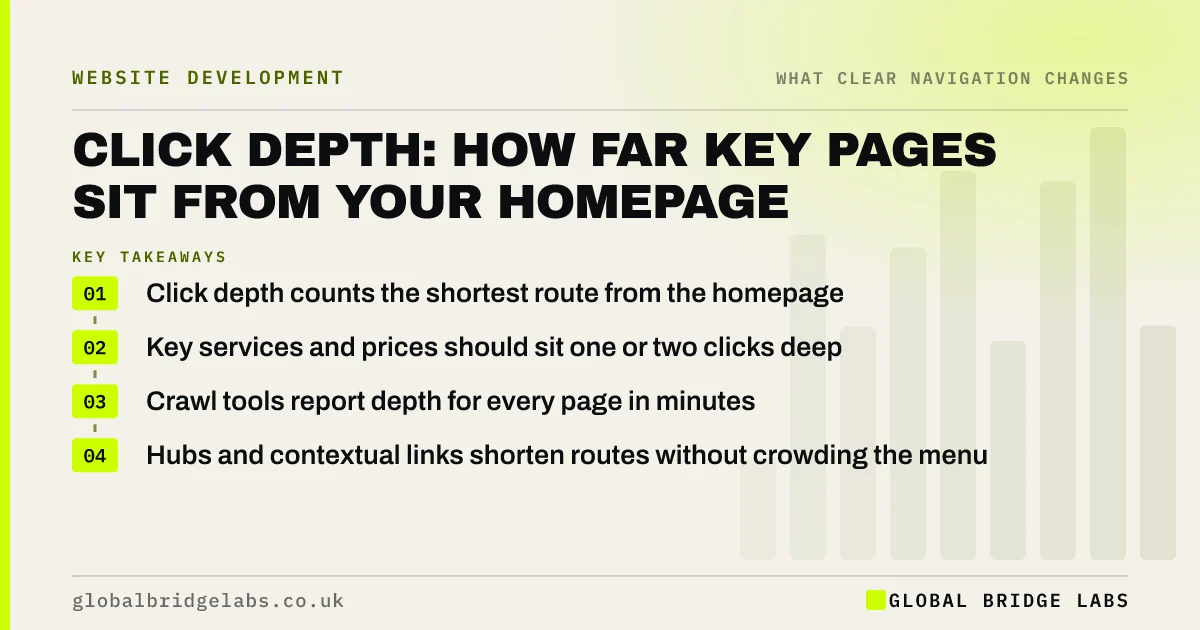
- Click depth counts the shortest route from the homepage.
- Key services and prices should sit one or two clicks deep.
- Crawl tools report depth for every page in minutes.
- Hubs and contextual links shorten routes without crowding the menu.
Want a click depth report for your site? Message us on WhatsApp.
Chat on WhatsApp →What is click depth?
Click depth, also called crawl depth or page depth, is the minimum number of links a visitor or crawler must follow from the homepage to reach a page. The homepage is depth 0, pages linked from it are depth 1, and so on. It is a property of your linking, not of the URL folders.
Why does click depth matter?
Click depth matters for visitors and search engines. For visitors, deep pages need more decisions to reach, and each one is a chance to give up. For search engines, pages linked from the homepage and menu are discovered sooner and signalled as more important. Google's guidance on crawl budget notes that it matters most for large sites, but discovery applies to all.
How do you measure click depth?
Run a site crawl with a tool such as Screaming Frog, Sitebulb or a similar crawler, which reports the depth of every page. Sort by depth and look for important pages at depth 4 or more, and for orphan pages that have no internal links at all.
- Crawl the site from the homepage.
- Export pages with their depth.
- Flag key pages deeper than depth 2.
- Flag orphan pages with no internal links.
- Compare with Search Console's indexing report.
How do you reduce click depth?
Bring important pages closer by linking them from the menu, the homepage or a hub page, and by adding contextual links from related pages. Avoid long paginated lists, where items on page 8 sit eight clicks deep. Do not solve it by adding every page to the menu.
- Flat vs deep site structure: which is easier to navigate?
- HTML sitemap pages: do visitors still use them?
Want your deepest important pages brought closer? Message us on WhatsApp and we will discuss your requirements.
Chat on WhatsApp →Is a deep page always a problem?
No. Older blog posts, archived news and detailed product variants can sit deeper without harm, as long as they are reachable. Click depth matters most for pages you want visitors and search engines to find often: services, locations, prices, key products and high-value guides.
What does this look like in practice?
A pattern we see: a firm's location pages are linked only from a 'Coverage' page, which is linked only from the footer of the About page, putting them at depth 4. Linking them from the services pages and the homepage brings them to depth 1 or 2.
Click depth checklist
- Crawl the site and export page depth.
- Keep key pages at depth 1 or 2.
- Fix orphan pages.
- Use hubs instead of long paginated lists.
- Add contextual links from related pages.
Next step
Crawl your site this week and list any important page deeper than two clicks.
Message us on WhatsApp for a click depth review, or book a 30-minute consultation.
Chat on WhatsApp →Sources and further reading
- Large site owner's guide to managing your crawl budget · Google Search Central
- SEO link best practices for Google · Google Search Central
- What is a sitemap · Google Search Central
Frequently asked questions
What is a good click depth?
For important pages, one or two clicks from the homepage is good. Most guidance suggests keeping key content within about three clicks. Less important pages can sit deeper, provided they are linked and reachable.
Is click depth the same as URL depth?
No. URL depth is how many folders appear in the address. Click depth is how many links it takes to reach the page. A page at /services/plumbing/boilers/ can be one click from the homepage if the homepage links to it directly.
Does click depth affect rankings?
Indirectly. Pages closer to the homepage are usually discovered and crawled more readily, and internal links signal importance. Click depth on its own will not make a page rank; content quality and relevance still decide that.
Written by

Global Bridge Labs (GBL) is a UK–Sri Lanka partner for social media, websites and BPO. Everything here comes from client delivery, not theory.