On this page
- 01Key takeaways
- 02Why does speed matter more for online shops?
- 03What does the evidence show for retail?
- 04Where do online shops lose orders to speed?
- 05What should a shop fix first?
- 06What does it cost, and when is it not worth it?
- 07What does this look like in practice?
- 08E-commerce speed checklist
- 09Next step
- 10Sources and further reading
- 11Frequently asked questions
Key takeaways
E-commerce website speed matters at every step from product listing to payment, because an online shop has no salesperson to hold a customer's attention while a page loads. Published research ties small speed gains to measurable increases in conversions and order value. Most shops are slow in the same places: collection pages, product galleries, filters and a checkout loaded with marketing scripts. Fix templates, not individual pages.
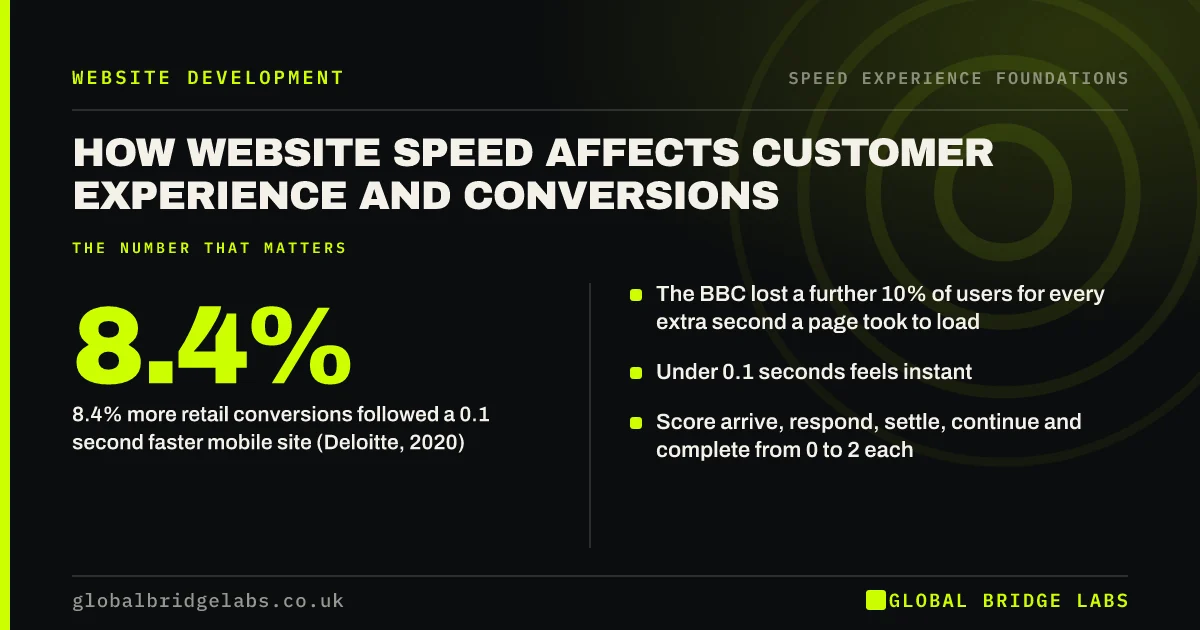
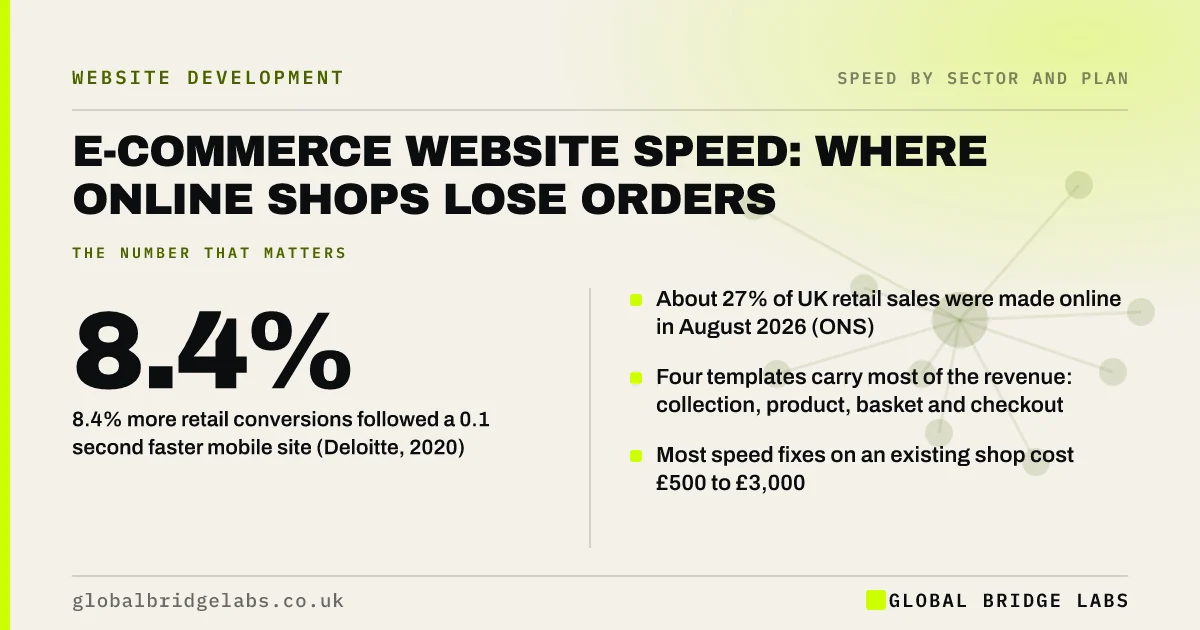
- 8.4% more retail conversions followed a 0.1 second faster mobile site (Deloitte, 2020).
- About 27% of UK retail sales were made online in August 2026 (ONS).
- Four templates carry most of the revenue: collection, product, basket and checkout.
- Most speed fixes on an existing shop cost £500 to £3,000.
Want your shop timed from listing to payment on a phone? Message us on WhatsApp.
Chat on WhatsApp →Why does speed matter more for online shops?
Speed matters more for online shops because the whole sale happens on the site, across many page views. A shopper might see a collection page, three products, the basket and four checkout steps. A delay on each compounds, and an alternative shop is always one search away.
The Office for National Statistics reported internet sales at about 27% of all UK retail sales in August 2026. With that much spending online, small differences in how a shop feels decide where it goes.
What does the evidence show for retail?
Deloitte's Milliseconds Make Millions study, commissioned by Google and published in 2020, is the most useful single source for retail. It found that a 0.1 second improvement in mobile site speed was associated with 8.4% more conversions and 9.2% higher average order value, with a 9.1% increase in shoppers moving from a product page to adding to basket.
Single-company case studies agree. Vodafone recorded 8% more sales after a 31% improvement in Largest Contentful Paint, and Rakuten 24 reported 53% more revenue per visitor after investing in Core Web Vitals. A small shop should treat these as direction, not forecast.
Where do online shops lose orders to speed?
Shops lose orders at four points, each tied to a template.
- Collection pages: dozens of product images loaded at once, and filters that reload the page.
- Product pages: full-size galleries, review widgets and carousels before the buy button works.
- Basket: every quantity change triggers a full reload.
- Checkout: marketing scripts, live delivery lookups and silence after Pay.
- Slow site search and filters: when finding takes too long
- Product page speed: fast pages without losing the detail
- Checkout speed: how slow payment steps lose orders
Want to know which of the four templates is costing you most? Ask us on WhatsApp.
Chat on WhatsApp →What should a shop fix first?
Work backwards from the money. The shoppers closest to paying are the most expensive to lose.
- 1. Checkout: remove everything that does not help take payment.
- 2. Product template: first image, price and buy button load first.
- 3. Collection template: images load on scroll, filters update in place.
- 4. Apps and tags: audit and remove those that earned nothing.
- 5. Homepage: one image and a route to the best sellers.
What does it cost, and when is it not worth it?
Indicative UK market ranges are £500 to £3,000 for focused speed work on an existing shop, more where templates need redesigning. Shops are at the upper end because baskets, checkouts and tracking must be tested carefully after every change.
It is not worth it when the shop already passes on mobile and the problem is elsewhere: prices, delivery costs, trust or traffic. Speed will not rescue a product nobody wants or a delivery charge revealed at the last step.
What does this look like in practice?
A pattern we see in growing online shops: marketing effort goes into driving traffic to collection pages that load sixty product images at once on a phone, with filters that reload everything. Shoppers scroll a little, wait and leave before reaching a product.
Loading images as they come into view and updating filters in place makes browsing feel immediate across the whole catalogue. Across client work at Global Bridge Labs (GBL), we have seen a 2.4x enquiry rate from conversion changes like these.
E-commerce speed checklist
- Place a test order on a phone over mobile data.
- Time collection, product, basket and each checkout step.
- List scripts and apps on checkout and remove the non-essential.
- Fix the product and collection templates.
- Check Core Web Vitals by page group in Search Console.
- Re-test before every sale or campaign.
Next step
In a shop, speed is part of the service. We will buy something from yours on a phone and show you every place a customer waits.
Message us on WhatsApp for an e-commerce speed review, or book a 30-minute consultation.
Chat on WhatsApp →Sources and further reading
- Milliseconds make millions: mobile site speed and conversion · Deloitte
- Internet sales as a percentage of total retail sales · Office for National Statistics
- Vodafone: a 31% improvement in LCP increased sales by 8% · web.dev
- The business impact of Core Web Vitals · web.dev (Google)
- Cart abandonment rate statistics · Baymard Institute
Frequently asked questions
Does website speed affect e-commerce sales?
Yes. Deloitte's 2020 study found a 0.1 second improvement in mobile site speed was associated with 8.4% more retail conversions and 9.2% higher average order value. Shoppers view many pages per visit, so delays add up quickly.
How fast should an online shop load?
Aim for the main content of collection and product pages within 2.5 seconds on mobile, taps answered within 200 milliseconds and no layout shift. At checkout, every button should respond at once and show progress while payment is processed.
Which pages should an online shop speed up first?
Start with checkout, then the product template, then collection pages. Shoppers nearest to paying are the costliest to lose, and fixing a template improves every page built from it. Leave the homepage until last, because most shoppers arrive directly on a product or collection.
Why is my online store slow on mobile?
Usually because collection and product pages load many large images at once, apps and marketing tags add scripts to every page, and themes enable sliders and carousels by default. Phones have slower processors and connections, so the same page takes longer.
Written by

Global Bridge Labs (GBL) is a UK–Sri Lanka partner for social media, websites and BPO. Everything here comes from client delivery, not theory.