On this page
- 01Key takeaways
- 02What is a customer journey pain point?
- 03What are common pain points for small business customers?
- 04How do you find pain points on your website?
- 05How do you find pain points off the website?
- 06How do you decide which pain points to fix first?
- 07When is a pain point not worth fixing?
- 08What does this look like in practice?
- 09Pain point checklist
- 10Next step
- 11Sources and further reading
- 12Frequently asked questions
Key takeaways
Customer journey pain points are the moments where buyers struggle, wait, doubt or give up, on your website or off it. Find them in four places: customer conversations, your inbox, analytics and recordings. Rank them by how many buyers they affect and what they cost, and fix the ones closest to the decision first. Many of the worst sit just after the website.
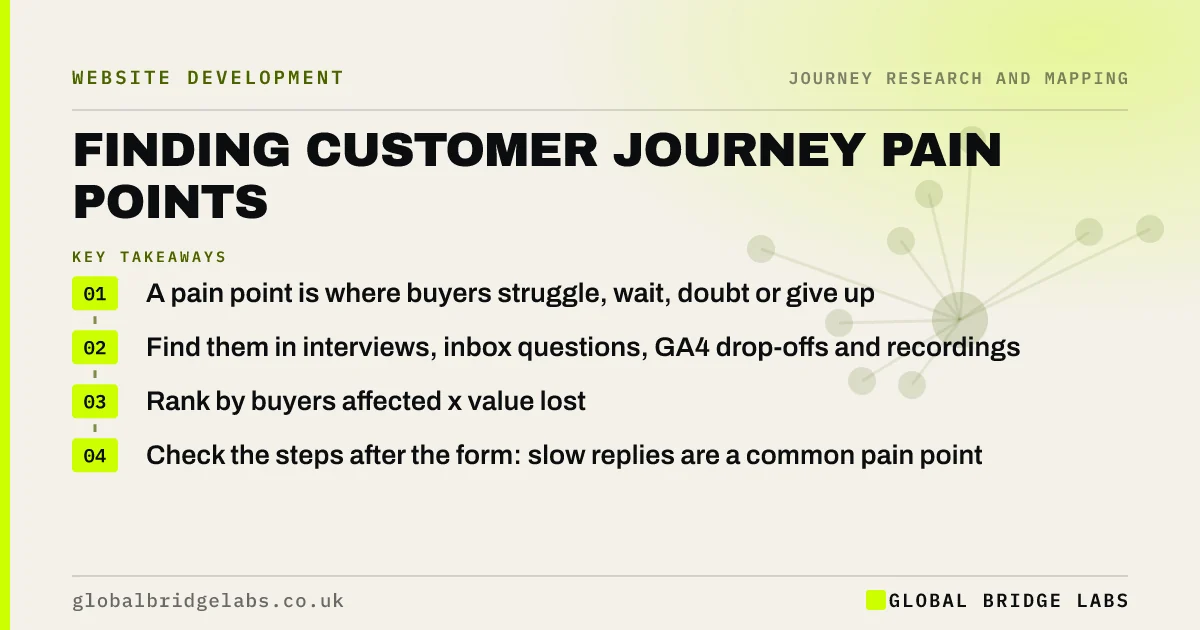
- A pain point is where buyers struggle, wait, doubt or give up.
- Find them in interviews, inbox questions, GA4 drop-offs and recordings.
- Rank by buyers affected x value lost.
- Check the steps after the form: slow replies are a common pain point.
Want your journey's pain points found and ranked? Message us on WhatsApp.
Chat on WhatsApp →What is a customer journey pain point?
A customer journey pain point is any moment where a buyer experiences effort, uncertainty, delay or frustration that makes them more likely to give up or choose someone else. Some are on the website, such as a missing price or a long form. Many are off it, such as an unanswered phone or a vague quote. Pain points are where journeys break.
What are common pain points for small business customers?
Common pain points cluster around four themes: not finding basic answers, not trusting the business enough, too much effort to get in touch, and waiting too long afterwards. The same handful appear across most UK small businesses, whatever the sector.
- No price guidance, so buyers cannot judge if you are in range.
- Unclear service area or availability.
- No proof from customers like them.
- Long or broken forms, or no phone number on mobile.
- No idea what happens after they enquire.
- Slow or vague replies, and quotes that differ from the website.
How do you find pain points on your website?
Find website pain points by combining numbers with observation. GA4 funnel and path explorations show where visitors drop. Session recordings show what they were doing when they left: scrolling up and down, tapping things that do not respond, or hesitating at a form field. On-site surveys ask the ones leaving why.
How do you find pain points off the website?
Find pain points off the website by asking customers about the whole journey and by testing it yourself. Call your own number at lunchtime. Submit your own form and time the reply. Read the last ten quotes as a buyer would. Ask customers what was slow or confusing after they got in touch. Many of the worst pain points live here.
How do you decide which pain points to fix first?
Rank pain points by how many buyers they affect and how close they sit to the decision. A missing price on your busiest service page affects many buyers at the compare stage; a typo on the careers page affects few. Fix the high-volume, near-decision pain points first, and those that are cheap to fix.
- Volume: how many buyers pass this point each month?
- Proximity: how close is it to the enquiry or purchase?
- Severity: does it cause hesitation or abandonment?
- Cost to fix: hours of work or a rebuild?
When is a pain point not worth fixing?
A pain point is not worth fixing when it filters out buyers you do not want, such as a minimum order value that deters very small jobs, or when the fix costs more than the buyers it would win. Some effort is deliberate. Make sure it is chosen, explained on the site and not accidental.
What does this look like in practice?
A pattern we see in pain point reviews: the team is sure the problem is the website's design, and the evidence points to two dull issues. The mobile form's postcode field rejects valid postcodes with a space, and the confirmation email goes to spam. Neither shows in a design review.
Fixing both is quick, and buyers who were silently failing start getting through. Across our client work we have seen a 2.4x enquiry rate from conversion changes of this kind. Global Bridge Labs (GBL) tests the journey end to end before judging the design.
Pain point checklist
- Ask five customers what was hard, slow or unclear.
- Tally a month of repeated questions.
- Check GA4 funnel and path explorations for drop-offs.
- Watch ten session recordings at the biggest drop.
- Test your own phone, form and reply times.
- Rank by volume, proximity, severity and cost to fix.
Next step
Pain points are easier to see from outside the business. We will walk your journey as a buyer, on and off the website, and rank what we find.
Message us on WhatsApp for a journey pain point review, or book a 30-minute consultation.
Chat on WhatsApp →Sources and further reading
- Funnel exploration · Google Analytics Help
- About Microsoft Clarity (heatmaps and session recordings) · Microsoft
- Stop trying to delight your customers (Dixon, Freeman and Toman, 2010) · Harvard Business Review
- Journey mapping 101 · Nielsen Norman Group
Frequently asked questions
What are customer pain points in a customer journey?
They are moments where buyers face effort, uncertainty, delay or frustration that makes them more likely to give up or choose someone else. Examples include missing prices, unclear service areas, long forms, no phone number on mobile, slow replies and quotes that contradict the website.
How do I identify pain points on my website?
Use GA4 funnel and path explorations to find where visitors drop, session recordings to see what they were doing, on-site surveys to ask why, and customer interviews and inbox questions to hear what was hard. Then test your own forms, phone and replies.
Which pain points should I fix first?
Those affecting the most buyers closest to the decision, and those that are cheap to fix. A missing price on your busiest service page usually matters more than a small issue on a rarely visited page. Rank by volume, proximity to the sale, severity and cost to fix.
Written by

Global Bridge Labs (GBL) is a UK–Sri Lanka partner for social media, websites and BPO. Everything here comes from client delivery, not theory.