On this page
- 01Key takeaways
- 02What does a broken customer journey cost?
- 03How do you put a number on lost enquiries?
- 04What does a broken journey cost in advertising?
- 05What does a broken journey cost in staff time?
- 06Where do journeys usually break?
- 07When is the cost too small to chase?
- 08What does this look like in practice?
- 09Cost of a broken journey checklist
- 10Next step
- 11Sources and further reading
- 12Frequently asked questions
Key takeaways
A broken customer journey costs a business in three ways: enquiries that never happen, marketing spend that brings visitors who leave, and staff time spent answering questions the website should have answered. You can estimate the first with four numbers: monthly visits, enquiry rate, close rate and average sale value. Even a half-point change in enquiry rate is usually worth more than owners expect.
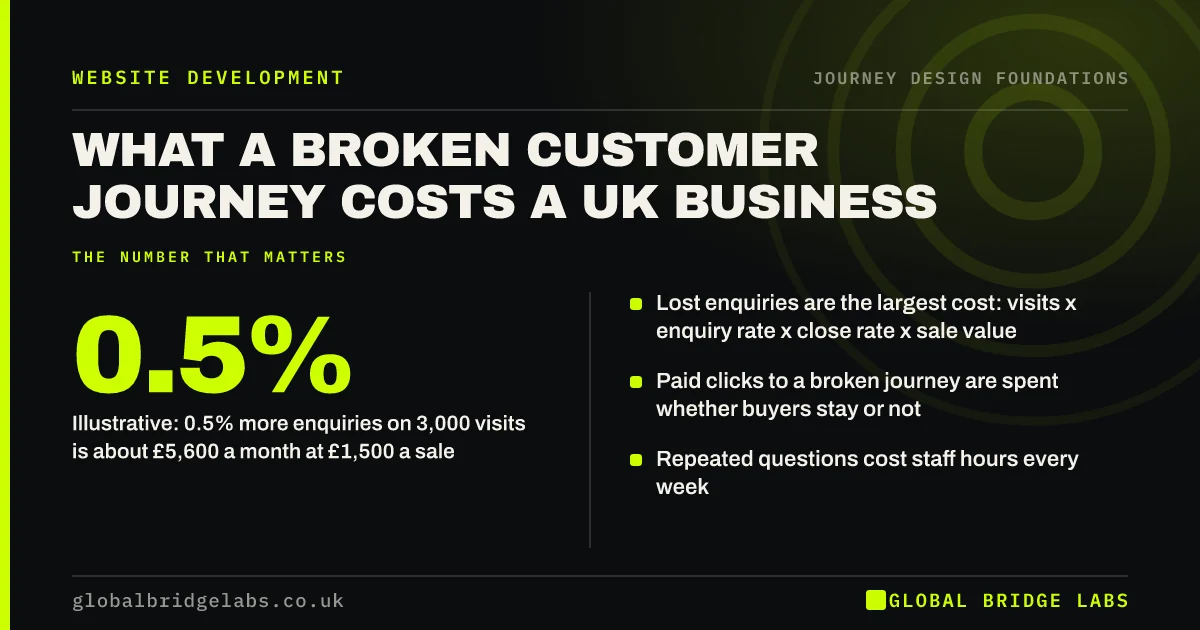
- Lost enquiries are the largest cost: visits x enquiry rate x close rate x sale value.
- Illustrative: 0.5% more enquiries on 3,000 visits is about £5,600 a month at £1,500 a sale.
- Paid clicks to a broken journey are spent whether buyers stay or not.
- Repeated questions cost staff hours every week.
Want this sum done with your own numbers? Send them to us on WhatsApp.
Chat on WhatsApp →What does a broken customer journey cost?
A broken customer journey costs the enquiries and sales lost at the step where buyers give up, plus the marketing money spent bringing them there, plus the team time spent filling the gaps by phone and email. The first is usually the largest and the easiest to estimate, because it follows from numbers most businesses already have.
How do you put a number on lost enquiries?
Multiply four numbers: monthly visits, the change in enquiry rate a fix might deliver, your enquiry-to-sale rate and your average sale value. Use cautious figures. The result is not a forecast, but it tells you whether a journey fix is worth hundreds or thousands of pounds a month, which is what you need to prioritise.
An illustrative sum: 3,000 visits a month at a 2% enquiry rate gives 60 enquiries. A fix that lifts the rate to 2.5% gives 75. If one in four enquiries becomes a customer at an average of £1,500, the 15 extra enquiries are worth about £5,600 a month, or roughly £67,000 a year. Halve every number and the fix is still worth doing.
- Monthly visits: GA4 sessions to the pages that matter.
- Enquiry rate: forms, calls and chats divided by sessions.
- Close rate: how many enquiries become customers.
- Average sale value: first sale only, ignoring repeat business.
What does a broken journey cost in advertising?
A broken journey wastes advertising because every paid click is charged whether the visitor finds what they need or not. If adverts send people to a page that does not answer their question, the spend buys exits. An illustrative sum: 1,000 clicks a month at £1.50 is £1,500. If a journey fix means one more visitor in fifty enquires, those same clicks produce 20 more enquiries.
What does a broken journey cost in staff time?
A broken journey costs staff time when the website leaves questions unanswered and buyers phone or email to ask. Count the repeated questions in a typical week. If your team answers 30 calls a week about prices, areas or timescales at five minutes each, that is two and a half hours a week, or about 130 hours a year, spent on answers a page could give.
Some of those calls are welcome sales conversations. Many are not: they are buyers checking basics before deciding whether to bother. Answering them on the site frees time for the conversations that close.
Where do journeys usually break?
Journeys usually break at four points: the landing page does not match the search or advert, the service page gives no price guidance or proof, the form or booking step asks too much, and the reply after the enquiry is slow or vague. The first three are website fixes. The fourth is an operational one, and it can undo the other three.
When is the cost too small to chase?
The cost is too small to chase when traffic is very low, when you already have more work than capacity, or when the sum comes to less than the fix. A site with 200 visits a month and a full order book should spend on visibility or capacity, not journey refinement. Run the sum before spending; it is as useful for saying no as for saying yes.
What does this look like in practice?
A pattern we see when owners run the sum: they assumed the website was a minor channel, because most enquiries arrive by phone. Asking callers where they found the number shows most of them read the website first. The website was feeding the phone all along, and gaps in it were costing calls.
Once that is visible, the business case for fixing the compare stage writes itself. Across our client work we have seen a 2.4x enquiry rate from conversion changes of this kind. Global Bridge Labs (GBL) runs this sum before recommending any spend.
Cost of a broken journey checklist
- Pull monthly sessions, enquiries, close rate and average sale value.
- Include phone calls in your enquiry count.
- Model a cautious 0.25 and 0.5 point lift in enquiry rate.
- Add paid click spend to the pages concerned.
- Count a week of repeated questions and the time they take.
- Compare the total with the cost of the fix.
Next step
If you do not know what your weakest journey step costs, you cannot know what fixing it is worth. We will run the numbers with you and show the size of the gap.
Message us on WhatsApp to cost your customer journey gaps, or book a 30-minute consultation.
Chat on WhatsApp →Sources and further reading
- About key events · Google Analytics Help
- Funnel exploration · Google Analytics Help
- About landing page experience · Google Ads Help
Frequently asked questions
How do I calculate the cost of a poor customer journey?
Multiply monthly visits by the change in enquiry rate a fix could deliver, then by your enquiry-to-sale rate and average sale value. Add wasted paid clicks and the staff time spent answering questions the site should cover. Use cautious figures; the aim is to size the problem.
What is the biggest cost of a bad website journey?
For most small businesses it is lost enquiries: buyers who were interested but gave up at a step that confused or failed them. Because the loss is invisible, it is usually underestimated. Wasted advertising and staff time are smaller but easier to see.
Is it worth fixing the customer journey on a low-traffic site?
Sometimes. If the site gets a few hundred visits a month, journey fixes still help each visitor, but the total gain is small. Run the sum first. If it is less than the cost of the fix, spend on visibility or capacity instead.
Written by

Global Bridge Labs (GBL) is a UK–Sri Lanka partner for social media, websites and BPO. Everything here comes from client delivery, not theory.