On this page
- 01Key takeaways
- 02What is customer effort score?
- 03Why does effort matter in the customer journey?
- 04Where should you ask the effort question?
- 05How do you use the results?
- 06How is CES different from NPS and satisfaction scores?
- 07When is an effort survey the wrong tool?
- 08What does this look like in practice?
- 09Customer effort checklist
- 10Next step
- 11Sources and further reading
- 12Frequently asked questions
Key takeaways
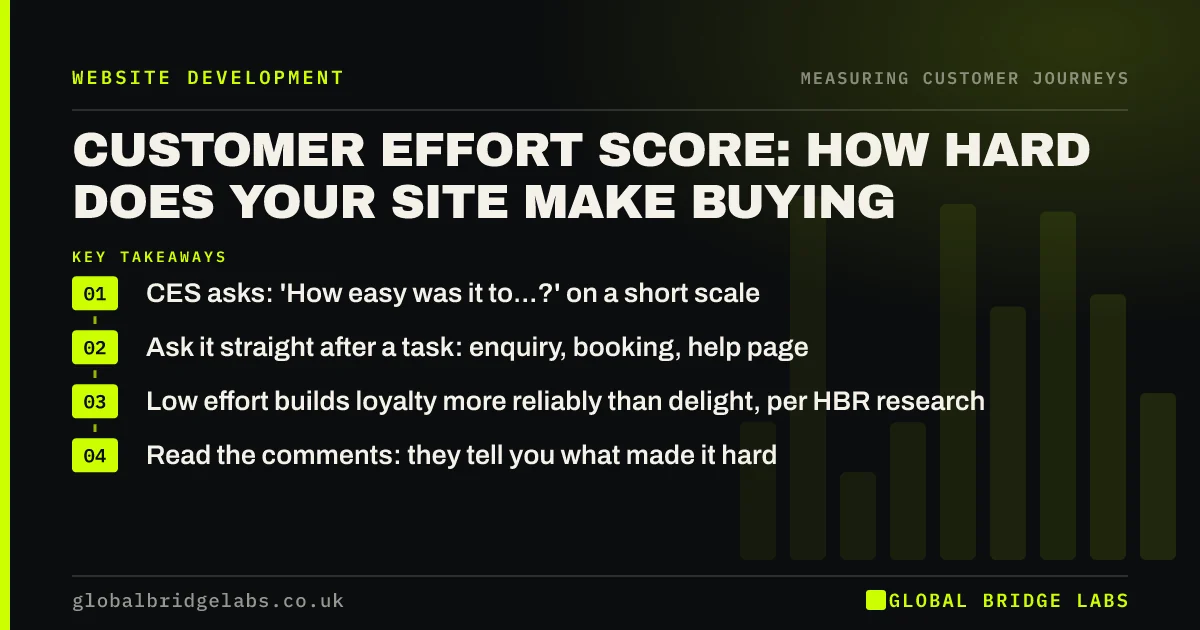
Customer effort score (CES) asks customers how easy it was to do something, such as get a quote, book or find an answer, usually on a scale of 1 to 5 or 1 to 7. On a website, ask it straight after a task. Dixon, Freeman and Toman argued in Harvard Business Review that reducing effort does more for loyalty than trying to delight. Use the score to find which tasks are hard, then fix them.
- CES asks: 'How easy was it to...?' on a short scale.
- Ask it straight after a task: enquiry, booking, help page.
- Low effort builds loyalty more reliably than delight, per HBR research.
- Read the comments: they tell you what made it hard.
Want a one-question effort survey added after your forms? Message us on WhatsApp.
Chat on WhatsApp →What is customer effort score?
Customer effort score is a measure of how much effort a customer felt they had to make to complete a task with a business. It is usually one question, such as 'How easy was it to get the help you needed today?', answered on a scale from very difficult to very easy. It was popularised by research from the Corporate Executive Board, published in Harvard Business Review in 2010.
Why does effort matter in the customer journey?
Effort matters because every extra step, unanswered question or repeated detail is a reason to give up or choose someone easier. Dixon, Freeman and Toman's Harvard Business Review article, 'Stop Trying to Delight Your Customers', argued that customers reward businesses that make things easy more than those that go above and beyond. For a small business website, ease is mostly about answers, routes and short forms.
Where should you ask the effort question?
Ask it straight after a task, while the experience is fresh. Good places are the enquiry confirmation page, after an online booking, at the end of a help page ('Did this answer your question? How easy was it to find?') and in a short follow-up after the first call. Keep it to one question plus an optional comment box.
- Enquiry confirmation page: 'How easy was it to get in touch?'.
- After booking: 'How easy was booking today?'.
- Help pages: 'How easy was it to find this answer?'.
- After first contact: a one-question message.
How do you use the results?
Use the results to compare tasks and track change. A task with a lower average score, or many 'difficult' answers, is where to look first. Read every comment; they usually name the problem directly. After fixing it, watch whether the score improves. With small volumes, treat scores as signals and comments as the main evidence.
Have effort scores and comments to make sense of? Send them to us on WhatsApp.
Chat on WhatsApp →How is CES different from NPS and satisfaction scores?
Net Promoter Score asks how likely a customer is to recommend you, which reflects the whole relationship. Customer satisfaction asks how happy they were. Customer effort score asks how easy a specific task was. For journey design, CES is the most actionable, because it points to a particular step you can change.
When is an effort survey the wrong tool?
An effort survey is the wrong tool when very few customers complete a task, because a handful of answers will swing wildly, and when the survey itself adds effort, for example a pop-up interrupting someone mid-task. Never ask before the task is done. With low volumes, a short conversation with a few customers tells you more.
What does this look like in practice?
A pattern we see when businesses add an effort question after enquiries: most answers are positive, but the comments from the few 'difficult' scores repeat the same point. They could not tell which service to choose in the form's dropdown, because the options used internal names.
Renaming the options in customers' words removes the problem for everyone, including those who never complained. Across our client work we have seen a 2.4x enquiry rate from conversion changes of this kind. Global Bridge Labs (GBL) reads the comments before the averages.
Customer effort checklist
- Pick 2 or 3 key tasks to measure.
- Ask one effort question straight after each.
- Add an optional comment box.
- Read every comment monthly.
- Fix the hardest task first.
- Check whether the score changes after the fix.
Next step
Effort is the quiet reason many buyers give up. We will add an effort question to your key tasks and help you act on what customers say.
Message us on WhatsApp to measure customer effort on your website, or book a 30-minute consultation.
Chat on WhatsApp →Sources and further reading
- Stop trying to delight your customers (Dixon, Freeman and Toman, 2010) · Harvard Business Review
- Structuring forms · GOV.UK Service Manual
- About Microsoft Clarity (heatmaps and session recordings) · Microsoft
Frequently asked questions
What is a customer effort score?
A measure of how easy customers found a specific task, such as getting a quote or booking, usually one question answered on a scale from very difficult to very easy. It was popularised by research published in Harvard Business Review in 2010.
What is a good customer effort score question?
Keep it specific and immediate, for example 'How easy was it to request a quote today?', with a five- or seven-point scale from very difficult to very easy and an optional comment box. Ask it straight after the task is complete.
Is customer effort score better than NPS?
They measure different things. NPS reflects the whole relationship and likelihood to recommend; customer effort score reflects how easy a particular task was. For improving website journeys, effort scores are more actionable because they point to a specific step.
Written by

Global Bridge Labs (GBL) is a UK–Sri Lanka partner for social media, websites and BPO. Everything here comes from client delivery, not theory.