On this page
- 01Key takeaways
- 02Why do high-ticket services need a different website?
- 03What do considered buyers need from a website?
- 04Should high-ticket services show prices?
- 05What is the right first step?
- 06How do you measure conversion for high-ticket services?
- 07When can depth go too far?
- 08What does this look like in practice?
- 09High-ticket website checklist
- 10Next step
- 11Sources and further reading
- 12Frequently asked questions
Key takeaways
Websites for high-ticket services, such as extensions, bespoke software or long-term contracts, convert differently. Buyers visit several times, compare providers and often need to persuade someone else. A high-converting site gives them depth, detailed proof, honest pricing guidance and a low-risk first step, rather than a short page and a 'Buy now' button.
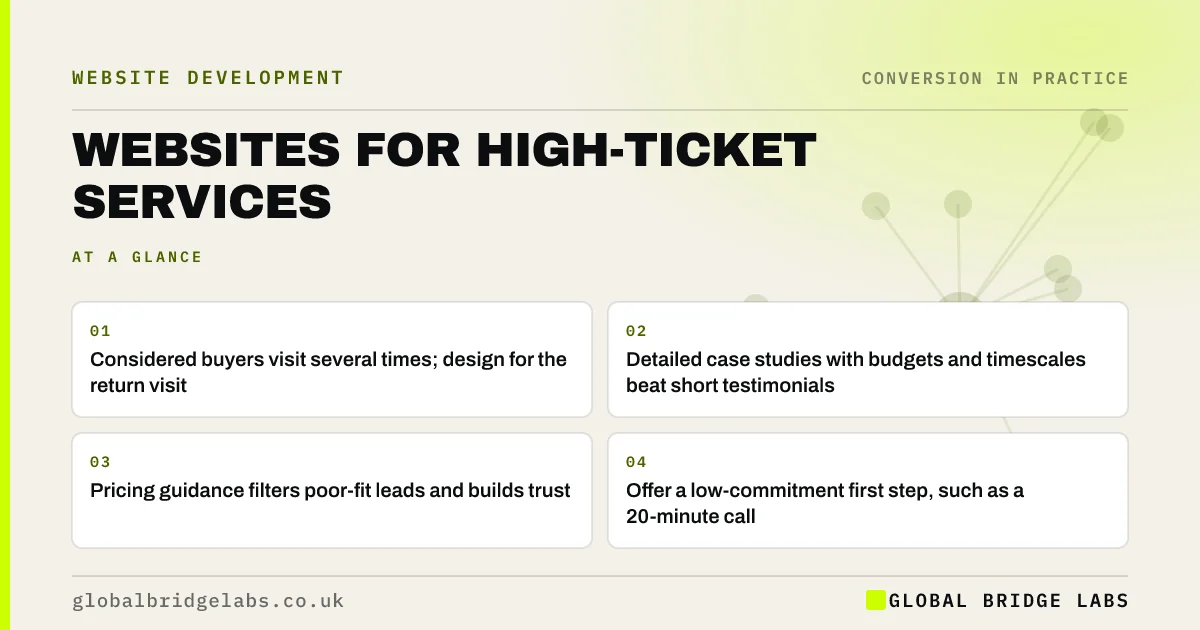
- Considered buyers visit several times; design for the return visit.
- Detailed case studies with budgets and timescales beat short testimonials.
- Pricing guidance filters poor-fit leads and builds trust.
- Offer a low-commitment first step, such as a 20-minute call.
Want your high-value service pages reviewed? Message us on WhatsApp.
Chat on WhatsApp →Why do high-ticket services need a different website?
The higher the price, the higher the perceived risk, and the longer and more careful the decision. A buyer spending £40,000 wants evidence that you have done similar work, understands the process and will not surprise them. A short page designed for impulse decisions leaves those questions unanswered and those buyers go elsewhere.
What do considered buyers need from a website?
They need enough depth to justify a large decision, organised so the essentials are still easy to find.
- Detailed case studies: the problem, the budget, the timescale, the result.
- Pricing guidance: typical ranges and what drives them.
- Process: each stage, who is involved and how long it takes.
- People: who they will work with, with real photos and experience.
- Risk reducers: guarantees, contract terms, insurance, accreditations.
- Material to share with partners, boards or spouses.
Should high-ticket services show prices?
Usually yes, as ranges. Buyers of high-value services fear wasting time on providers far outside their budget, and many will not enquire without some idea. 'Projects typically £25,000 to £60,000' filters out poor-fit leads and reassures good ones. Explain what moves the price so the range feels honest.
Want help wording price guidance for a premium service? Ask us on WhatsApp.
Chat on WhatsApp →What is the right first step?
'Get a quote' can feel like a big commitment for a large purchase. A lower-risk first step converts better: a 20-minute call, a site visit, a sample report, a planning checklist or a pricing guide. The aim is to start a relationship, not close the sale online.
How do you measure conversion for high-ticket services?
Enquiry numbers will be low, so conversion rate alone is noisy. Track micro-conversions such as pricing and case study views, qualified enquiries, enquiry-to-sale rate and revenue per enquiry. Judge over quarters, not weeks.
When can depth go too far?
Depth without structure becomes a wall of text that hides the essentials. Keep the offer, proof and next step at the top of each page, use clear headings for the detail, and put long material in case studies and guides. Premium buyers value clarity as much as detail.
What does this look like in practice?
A UK bespoke software firm's site had a short services page and a 'Get a quote' form. Enquiries were few and often for tiny jobs. We added three detailed case studies with budgets and timescales, a 'typical projects from £30,000' line, a six-stage process and a 30-minute scoping call as the main action. Enquiries fell slightly in number and rose sharply in value.
High-ticket website checklist
- Publish detailed case studies with budgets and timescales.
- Give honest price ranges and what drives them.
- Explain the process stage by stage.
- Show the people buyers will work with.
- Offer a low-commitment first step.
- Track qualified enquiries and revenue per enquiry, not just rate.
Next step
For high-value services, one extra good enquiry a month can be worth more than the whole website. We can help you build pages that give considered buyers what they need to choose you.
Message us on WhatsApp for a high-ticket website review, or book a 30-minute consultation.
Chat on WhatsApp →Sources and further reading
- Transparency rules · Solicitors Regulation Authority
- About key events · Google Analytics Help
- How long do users stay on web pages? · Nielsen Norman Group
Frequently asked questions
How do you sell high-ticket services online?
Give considered buyers depth and reassurance: detailed case studies, honest price ranges, a clear process, the people involved and risk reducers such as guarantees. Offer a low-commitment first step, such as a short call, rather than asking for a quote or sale immediately.
Should I put prices on my website for expensive services?
Usually yes, as ranges with an explanation of what drives the price. It filters out buyers far outside your budget and reassures good-fit buyers that enquiring will not waste their time. Explain what moves the price, so the range feels honest rather than evasive.
What conversion rate should a high-ticket service website expect?
Often lower than for simple services, sometimes 1% to 3% of visits, but each enquiry is worth much more. Track qualified enquiries, enquiry-to-sale rate and revenue per enquiry alongside the headline rate. Judge results over quarters rather than weeks, because small numbers of enquiries swing a lot from month to month.
How long should a high-ticket service page be?
Long enough to answer a considered buyer's questions, organised so the offer, proof and next step appear first. Use headings to structure the detail and move very long material into case studies and guides. Keep a clear call to action after each major section.
Written by

Global Bridge Labs (GBL) is a UK–Sri Lanka partner for social media, websites and BPO. Everything here comes from client delivery, not theory.