On this page
- 01Key takeaways
- 02What should a homepage design brief include?
- 03Why give the copy before design?
- 04What must not change?
- 05How should success be measured?
- 06When does a brief need more detail?
- 07What does this look like in practice?
- 08Homepage brief checklist
- 09Next step
- 10Sources and further reading
- 11Frequently asked questions
Key takeaways
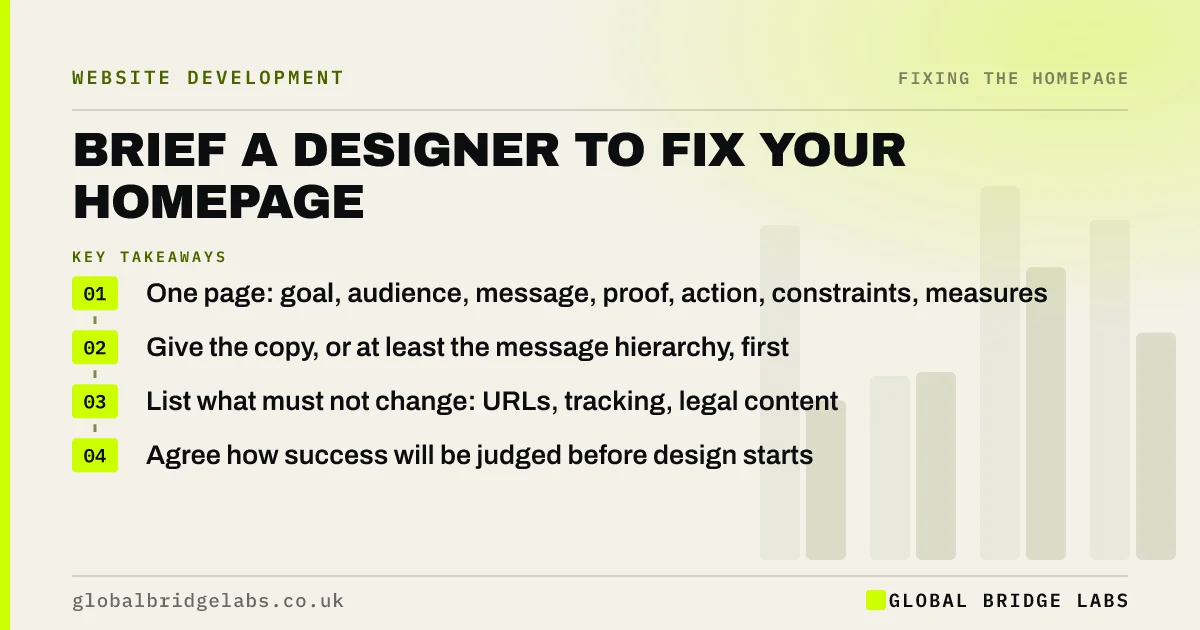
A homepage design brief should fit on one page and cover the goal, who the page is for, the message hierarchy, the proof available, the main action, constraints such as platform and brand, and how success will be measured. Designers given a clear brief produce better pages faster; designers given 'make it modern' produce opinions.
- One page: goal, audience, message, proof, action, constraints, measures.
- Give the copy, or at least the message hierarchy, first.
- List what must not change: URLs, tracking, legal content.
- Agree how success will be judged before design starts.
Want help writing your homepage brief? Message us on WhatsApp.
Chat on WhatsApp →What should a homepage design brief include?
A homepage brief is a short document that tells a designer what the page must achieve and what they have to work with. The whole-site version is covered in our website brief template; for the homepage alone, seven headings on one page are enough.
- Goal: the one action the homepage should drive.
- Audience: the main visitor types and what each needs.
- Message hierarchy: one main point, three supports.
- Proof: reviews, accreditations, work and numbers available.
- Action: the button, its wording and what happens next.
- Constraints: platform, brand, legal content, budget, deadline.
- Measures: the numbers that will show success.
Why give the copy before design?
Designers who receive the words first design around the message. Those who receive 'lorem ipsum' design around shapes, and the real copy is squeezed into boxes later. At minimum, give the message hierarchy and the hero copy.
What must not change?
List anything the designer must keep: the homepage URL, title tag and core service words for search; tracking tags and key events; legal content such as company details and regulatory badges; and any brand elements that are fixed. Losing these is a common cause of drops after a redesign.
How should success be measured?
Agree two or three numbers before design starts, such as the share of homepage sessions reaching a service page or contact route, key events from homepage sessions and mobile LCP. Record the baseline now so the comparison afterwards is fair.
When does a brief need more detail?
Add detail when several audiences must be served, when sector rules apply to claims and images, or when the homepage depends on integrations such as booking or e-commerce. Keep the core on one page and attach the rest.
What does this look like in practice?
A pattern we see: a brief that says 'clean, modern, like our competitor's site' and nothing about goals. Rewriting it with a goal, message hierarchy and success measures usually changes the first design concept completely, and the feedback rounds become shorter.
Homepage brief checklist
- Write the goal in one sentence.
- List audiences and what each needs.
- Include the message hierarchy and hero copy.
- List available proof.
- List what must not change.
- Record the baseline numbers.
Next step
Write your homepage brief under the seven headings on one page before you contact any designer.
Message us on WhatsApp for feedback on the brief, or book a 30-minute consultation.
Chat on WhatsApp →Sources and further reading
- Government design principles · GOV.UK
- Site moves with URL changes · Google Search Central
Frequently asked questions
What should I tell a web designer about my homepage?
The goal, who visits and what they need, the main message and supporting points, the proof you have, the main action, constraints such as platform and brand, what must not change and how success will be measured.
Should I write the copy before the design?
Ideally, yes, or at least the message hierarchy and hero copy. Designers who know the message design around it. Placeholder text leads to layouts that do not fit the real words.
How long should a homepage brief be?
One page for the core, with attachments for detail such as brand guidelines or sector rules. A short, clear brief is more likely to be read and followed than a long one.
Written by

Global Bridge Labs (GBL) is a UK–Sri Lanka partner for social media, websites and BPO. Everything here comes from client delivery, not theory.