On this page
- 01Key takeaways
- 02What is opportunity cost in an outsourcing decision?
- 03How do you calculate the opportunity cost?
- 04What does a worked example look like?
- 05Who carries the highest opportunity cost?
- 06When is opportunity cost not real?
- 07How do you make sure freed time is used well?
- 08How do you show opportunity cost in a business case?
- 09What does this look like in practice?
- 10Opportunity cost checklist
- 11Next step
- 12Sources and further reading
- 13Frequently asked questions
Key takeaways
The opportunity cost of doing work in-house is the value of what your people could have done instead. When skilled staff or owners spend hours on admin, the real cost is their loaded rate plus the revenue they did not generate. For many UK SMEs it is the largest cost in the in-house vs outsourcing comparison.
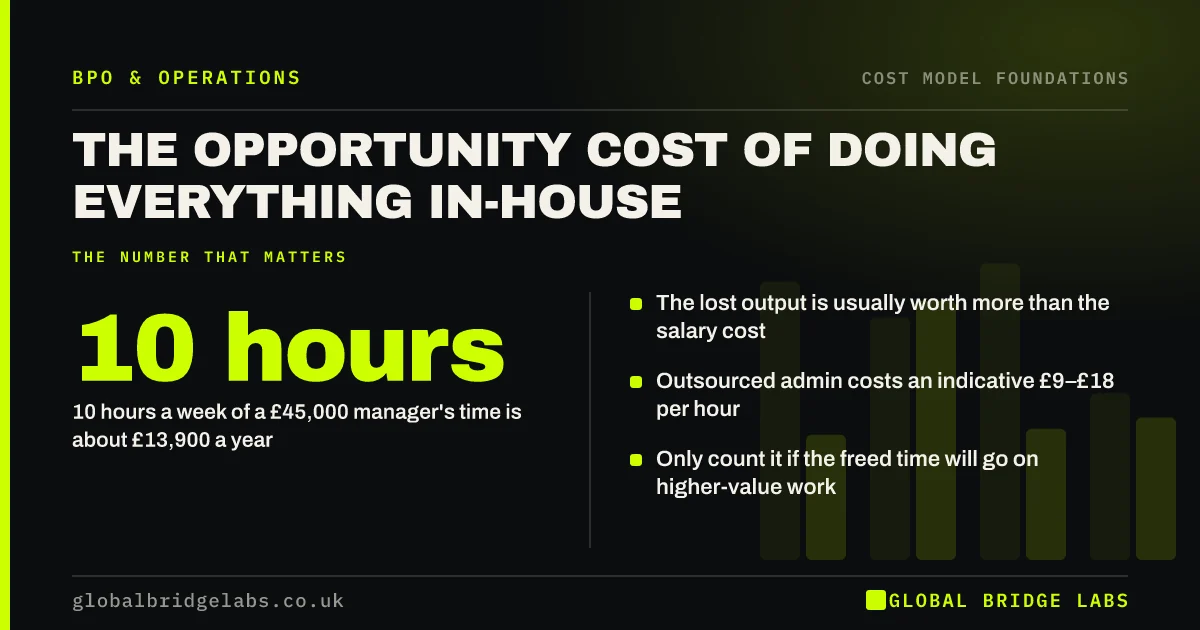
- 10 hours a week of a £45,000 manager's time is about £13,900 a year.
- The lost output is usually worth more than the salary cost.
- Outsourced admin costs an indicative £9–£18 per hour.
- Only count it if the freed time will go on higher-value work.
Want the opportunity cost of your team's admin worked out? Message us on WhatsApp.
Chat on WhatsApp →What is opportunity cost in an outsourcing decision?
Opportunity cost is the value of the best alternative use of a resource. In an in-house vs outsourcing decision, it is the revenue, delivery or growth work your people could do with the hours they currently spend on tasks a provider could handle. It is real, but it only turns into money if the freed time is used.
How do you calculate the opportunity cost?
Start with the hours spent on work that could be outsourced, then value them two ways: the loaded cost of the person, and the value of what they would do instead, such as billable hours or sales. The difference between that value and the outsourced cost is the opportunity gain.
- Hours per week on outsourceable work.
- Loaded cost per hour of the person doing it.
- Value per hour of their alternative work (billable rate, sales per hour).
- Outsourced cost per hour for the same work.
- Opportunity gain: alternative value minus outsourced cost.
What does a worked example look like?
A consultant billed at £90 an hour spends 8 hours a week on proposals admin, scheduling and invoicing. If 6 of those hours could be billed instead, that is £540 a week, or about £24,800 over 46 working weeks. Outsourcing the 8 hours at £14 per hour costs about £5,150. The net gain is nearly £20,000.
Want this run for your own billable or senior staff? Send the numbers on WhatsApp.
Chat on WhatsApp →Who carries the highest opportunity cost?
Owners, fee earners, sales staff and skilled specialists. Their time either brings in revenue directly or delivers the work customers pay for. Admin that sits with them is the most expensive admin in the business.
When is opportunity cost not real?
When the freed hours will not be used on higher-value work. If there are no extra clients to bill, or the person simply works fewer hours, the opportunity gain is zero and only the direct cost saving counts. Be honest about this in any business case.
How do you make sure freed time is used well?
Decide in advance what the freed hours are for, and track it. Set a target, such as billable hours, sales calls or projects delivered, and review it monthly alongside the outsourcing cost. Without a plan, freed time tends to fill with other low-value tasks.
How do you show opportunity cost in a business case?
Keep it separate from the direct cost saving and state the assumption behind it. For example: moving 8 hours of admin frees 6 billable hours a week at £90, worth about £24,800 a year if the hours are billed. Show the direct saving as the base case and the opportunity gain as the upside, with a named owner for using the freed time.
What does this look like in practice?
A pattern we see in UK trades firms: the owner spends evenings on quotes, invoices and callbacks. Moving callbacks, booking and invoice chasing to a managed team gives back several evenings a week, which the owner uses for surveys and quoting, the work that wins jobs.
Across our client work, owners have got 31 hours a week back once admin moved to a managed team.
Opportunity cost checklist
Use these steps to size it.
- List outsourceable tasks done by senior or billable staff.
- Measure the hours each week.
- Value the hours at loaded cost and at alternative value.
- Get an outsourced price for the same work.
- Set a target for the freed time.
- Review the target and the cost monthly.
Next step
Tell us who is doing the admin today and what they would do instead. We will size the opportunity cost and the outsourced alternative in a 30-minute call.
Message us on WhatsApp for an opportunity cost estimate, or book a 30-minute consultation.
Chat on WhatsApp →Sources and further reading
- Rates and thresholds for employers 2026 to 2027 · HM Revenue & Customs
- Workplace pensions: what you, your employer and the government pay · GOV.UK
- Holiday entitlement · GOV.UK
Frequently asked questions
What is the opportunity cost of doing tasks yourself?
The value of the higher-value work you could have done with the same hours, such as billable work, selling, quoting or delivery. For owners and fee earners, it is often several times the cost of outsourcing the same tasks, which is why admin sitting with senior people is so expensive.
Should opportunity cost be in an outsourcing business case?
Yes, but separately from the direct cost saving, and only if there is a clear plan for the freed time. Base the decision on the direct saving where possible, and show the opportunity gain as the upside, with a named owner and a monthly measure of how the time is used.
How do you value an employee's time?
Use two values: the loaded cost per worked hour, including employer National Insurance, pension and holiday, and the value of their best alternative work, such as a billable rate or sales generated per hour. The first shows the direct cost; the second shows the opportunity cost.
What if the freed time is not used for higher-value work?
Then only the direct cost saving counts, and the opportunity gain is zero. That is still worth having if the direct saving is positive. To avoid it, decide in advance what the freed hours are for, set a target, and review the target each month alongside the outsourcing cost.
Written by

Global Bridge Labs (GBL) is a UK–Sri Lanka partner for social media, websites and BPO. Everything here comes from client delivery, not theory.