On this page
- 01Key takeaways
- 02What is a soft call to action?
- 03Which soft actions work best?
- 04How should it look next to the main action?
- 05Where should a soft action lead?
- 06When should you skip a soft action?
- 07What does this look like in practice?
- 08Soft call to action checklist
- 09Next step
- 10Sources and further reading
- 11Frequently asked questions
Key takeaways
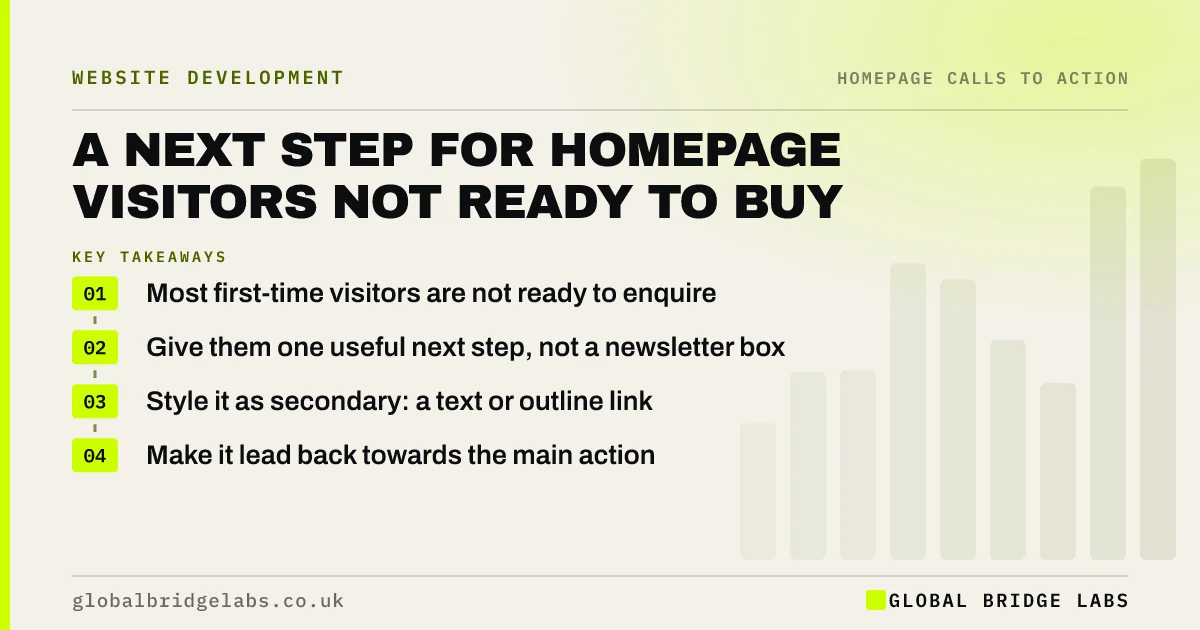
A soft call to action is a lower-commitment next step for homepage visitors who are not ready to enquire: a price guide, a service page, a short call or a checklist. It keeps them moving instead of leaving. Style it as clearly secondary, and make sure it leads back towards the main action.
- Most first-time visitors are not ready to enquire.
- Give them one useful next step, not a newsletter box.
- Style it as secondary: a text or outline link.
- Make it lead back towards the main action.
Want a soft next step designed for your homepage? Message us on WhatsApp.
Chat on WhatsApp →What is a soft call to action?
A soft call to action is a secondary link or button that asks for less than your main action. 'See prices and examples', 'Read how it works' or 'Get the checklist' are soft; 'Get a quote' is hard. It exists for the many visitors who are interested but not ready, so they take a step rather than leave.
Which soft actions work best?
The best soft actions answer what stops people from acting now. If price uncertainty holds them back, offer a price guide. If they are not sure you do their kind of work, link to examples. If they want to understand the process, link to how it works. A newsletter is rarely the right answer.
How should it look next to the main action?
Visibly lighter: a text link under the main button, or an outline button beside it. The eye should land on the main action first. If both look the same, the soft action steals clicks from people who were ready to enquire.
Where should a soft action lead?
It should lead to a page that answers the hesitation and then asks for the main action, such as a service page with prices and a quote button. A soft action that leads to a dead end, like a PDF with no contact details, loses the visitor.
When should you skip a soft action?
Skip it when visitors arrive ready to act, such as emergency services or a restaurant at 6pm. Then a second option only slows them down. Keep the hero to one action and put any soft routes lower down.
What does this look like in practice?
A pattern we see in professional services: a single 'Book a consultation' button that most visitors are not ready for, and no other route. Adding 'See typical fees' as a text link beneath it usually increases visits to the fees page and, from there, consultation requests.
Soft call to action checklist
- Name the main reason visitors hesitate.
- Choose a soft action that answers it.
- Style it as a link or outline button.
- Make the destination page ask for the main action.
- Leave it out of the hero for urgent services.
Next step
Ask three recent customers what they wanted to check before getting in touch. Build your soft action around the most common answer.
Message us on WhatsApp to plan it, or book a 30-minute consultation.
Chat on WhatsApp →Sources and further reading
- Progressive disclosure · Nielsen Norman Group
- Electronic and telephone marketing under PECR · Information Commissioner's Office
Frequently asked questions
What is a soft call to action?
It is a lower-commitment action offered to visitors who are not ready for the main step, such as viewing prices, seeing examples or reading how the service works. It keeps them engaged and leads back towards the main call to action.
What is a secondary call to action on a website?
It is an alternative action shown alongside the primary one but styled less prominently, often as a text link or outline button. It serves visitors who need more information first without competing with the main action.
Should a soft call to action collect email addresses?
Only if you will follow up with something genuinely useful and have consent under PECR for any marketing emails. For many small businesses, linking to prices, examples or the process is more effective than asking for an email address early.
Written by

Global Bridge Labs (GBL) is a UK–Sri Lanka partner for social media, websites and BPO. Everything here comes from client delivery, not theory.