On this page
- 01Key takeaways
- 02What is a lead magnet?
- 03Which lead magnets work for service businesses?
- 04Why do generic ebooks attract the wrong people?
- 05Where should a lead magnet appear?
- 06How should you deliver a lead magnet?
- 07When is a lead magnet not worth it?
- 08What does this look like in practice?
- 09Lead magnet checklist
- 10Next step
- 11Sources and further reading
- 12Frequently asked questions
Key takeaways
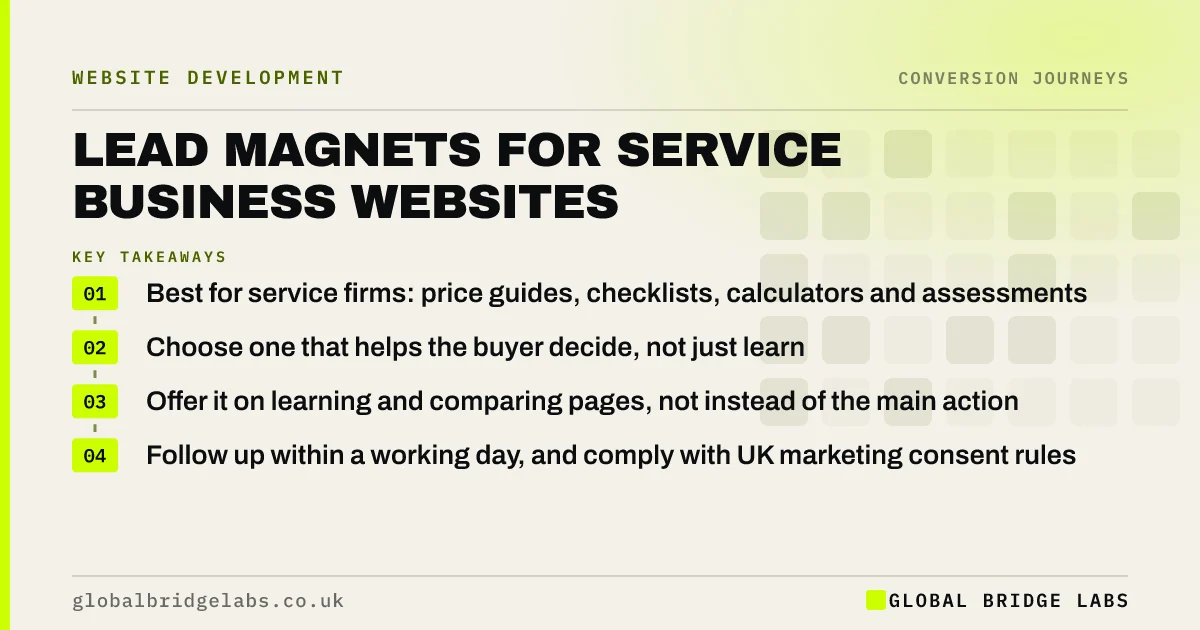
A lead magnet is something useful you offer in exchange for contact details or a conversation. For service businesses, the best lead magnets help a buyer make the decision you want them to make: a price guide, a checklist, a calculator or a short assessment. Generic ebooks attract readers who never buy.
- Best for service firms: price guides, checklists, calculators and assessments.
- Choose one that helps the buyer decide, not just learn.
- Offer it on learning and comparing pages, not instead of the main action.
- Follow up within a working day, and comply with UK marketing consent rules.
Want a lead magnet idea for your business? Message us on WhatsApp.
Chat on WhatsApp →What is a lead magnet?
A lead magnet is a free, useful resource or tool offered to website visitors in exchange for their contact details or permission to start a conversation. It gives visitors who are not ready to enquire a reason to stay in touch, and it gives you a way to help them reach a decision.
Which lead magnets work for service businesses?
Lead magnets that work are close to the buying decision. They answer the questions buyers have just before they enquire.
- Price guide: typical costs for common jobs, with what affects the price.
- Checklist: what to prepare, check or ask before buying.
- Calculator: a quick estimate of cost, savings or return.
- Assessment or scorecard: a short self-test with a result.
- Sample: an example report, plan or design.
Why do generic ebooks attract the wrong people?
A broad guide such as 'The ultimate guide to home improvement' attracts people interested in the topic, most of whom will never buy from you. A 'Loft conversion costs in Bristol' guide attracts people planning a loft conversion in Bristol. The narrower and closer to the purchase, the better the leads.
Where should a lead magnet appear?
Offer lead magnets where visitors are learning or comparing: blog posts, guides, pricing pages and comparison pages. On service pages, keep the main enquiry action dominant and offer the lead magnet as a secondary option for visitors not ready to talk.
Want help choosing where your lead magnet should appear? Ask us on WhatsApp.
Chat on WhatsApp →How should you deliver a lead magnet?
Keep delivery simple. Ask only for what you need to send it, deliver it immediately, and follow up within a working day with a helpful message. Delivering over WhatsApp or email and starting a conversation often works better for service businesses than an automated email sequence.
If you plan to send marketing afterwards, get clear consent. The ICO's direct marketing guidance and the Privacy and Electronic Communications Regulations (PECR) set the rules for UK businesses.
When is a lead magnet not worth it?
Skip it if your buyers are mostly urgent (they want to call now, not download a guide), if you cannot follow up, or if your site has little learning or comparing traffic. A lead magnet also adds a maintenance job: prices and checklists go out of date and must be reviewed.
What does this look like in practice?
A UK commercial property surveyor added a 'What a building survey should cover' checklist, sent over WhatsApp or email, to its guides and pricing pages. Downloads became a steady source of conversations, and the surveyor followed each one with a short, helpful message. A meaningful share turned into quotes within two months.
Lead magnet checklist
- Choose a price guide, checklist, calculator or assessment close to purchase.
- Make it specific to your service and area.
- Offer it on learning and comparing pages.
- Ask only for what you need to deliver it.
- Follow up within one working day.
- Get marketing consent under ICO and PECR rules.
- Review the content every six months.
Next step
A good lead magnet turns interested visitors into conversations. We can help you choose one that attracts buyers and deliver it without creating a form wall.
Message us on WhatsApp for a lead magnet idea, or book a 30-minute consultation.
Chat on WhatsApp →Sources and further reading
- Direct marketing and privacy and electronic communications · Information Commissioner's Office
- Electronic and telephone marketing under PECR · Information Commissioner's Office
- About key events · Google Analytics Help
Frequently asked questions
What is a lead magnet?
A lead magnet is a free, useful resource or tool offered to website visitors in exchange for contact details or permission to start a conversation. Examples include price guides, checklists, calculators and assessments. It gives visitors who are not ready to enquire a reason to stay in touch, and gives you a way to help them decide.
What is the best lead magnet for a service business?
One that helps buyers make the decision to buy, such as a local price guide, a pre-purchase checklist, a cost calculator or a short assessment. The closer it is to the purchase, the better the leads it attracts. Generic guides attract readers, not buyers.
Do lead magnets still work?
Yes, when they are specific and genuinely useful. Generic ebooks work less well than they once did. Practical tools and guides tied to a real decision, delivered quickly and followed up personally, still start valuable conversations. Review them twice a year so figures stay current.
Do I need consent to email people who download a lead magnet?
You need a lawful basis and, for most electronic marketing to individuals, consent under PECR. Be clear at the point of download about what you will send. The ICO's direct marketing guidance explains the rules. Say clearly at the point of download what you will send and how often.
Written by

Global Bridge Labs (GBL) is a UK–Sri Lanka partner for social media, websites and BPO. Everything here comes from client delivery, not theory.