On this page
- 01Key takeaways
- 02What is thought leadership?
- 03Where does a real point of view come from?
- 04What format works?
- 05How does it attract the right customers?
- 06Who in the business should write it?
- 07When is thought leadership a poor use of time?
- 08What does this look like in practice?
- 09Thought leadership checklist
- 10Next step
- 11Sources and further reading
- 12Frequently asked questions
Key takeaways
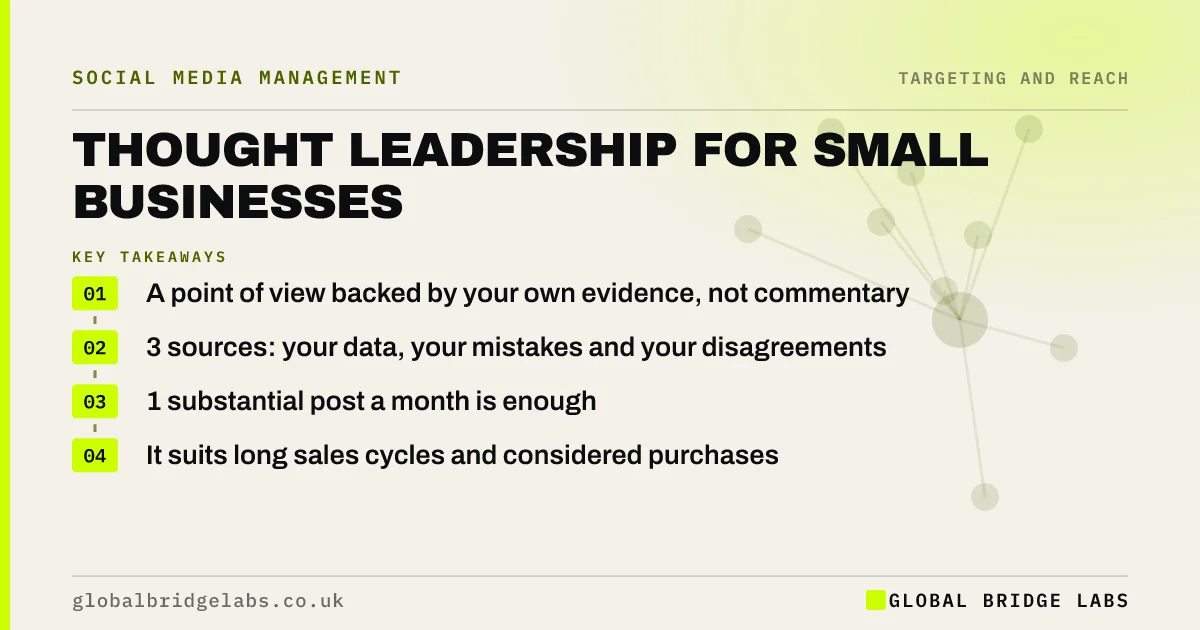
Thought leadership content for small business is a clear, evidence-based point of view on a question your buyers face. It is not inspirational quotes or commentary on the news. One well-argued post a month, drawn from your own work, does more to attract serious buyers than daily opinions.
- A point of view backed by your own evidence, not commentary.
- 3 sources: your data, your mistakes and your disagreements.
- 1 substantial post a month is enough.
- It suits long sales cycles and considered purchases.
Want your point of view shaped into a post? Message us on WhatsApp.
Chat on WhatsApp →What is thought leadership?
Thought leadership is content in which a named expert sets out a view on how something should be done, with reasons and evidence, in a way that helps buyers decide. The test is simple: could a competitor have written it? If so, it is general advice.
Where does a real point of view come from?
A real point of view comes from three sources: what your own numbers show, what you have got wrong and learned from, and where you disagree with common practice in your industry. All three are things only you can write, which is what makes them worth reading.
- Data: patterns across your own jobs or clients.
- Mistakes: what you used to do and why you stopped.
- Disagreements: advice in your sector you think is wrong.
What format works?
Use five parts: the claim, why the usual view is incomplete, your evidence, what to do instead, and the limits of your argument. About 200 to 300 words is enough on LinkedIn. State the claim in the first line so the right reader knows what is coming.
- Claim: one sentence.
- Usual view: what most people believe.
- Evidence: what you have seen.
- Instead: what to do.
- Limits: when it does not apply.
Send us a claim you believe on WhatsApp and we will help structure the post. Let us discuss your requirements.
Chat on WhatsApp →How does it attract the right customers?
It attracts the right customers by showing how you think before they hire you. Buyers who agree with your view arrive already persuaded of your approach. Those who disagree stay away, which spares both sides. In markets where few buyers are active at once, it keeps you remembered.
Who in the business should write it?
It should carry the name of the person with the expertise, usually a founder or senior specialist, and be posted from their own profile as well as the company page. Someone else can draft and edit, but the view must be theirs, and they must be able to defend it in conversation.
When is thought leadership a poor use of time?
It is a poor use of time for simple, low-cost or urgent purchases, where buyers want a price and availability. It is also poor when there is no real view behind it. Forced opinions and vague predictions are worse than plain, useful posts about your work.
What does this look like in practice?
A pattern we see with UK professional and technical firms: the strongest opinions are voiced in client meetings and never written down. Recording a senior person answering one pointed question, then editing the transcript, is often the quickest route to a post only they could have made.
Thought leadership checklist
Test each post.
- A competitor could not have written it.
- The claim is in the first line.
- It rests on your own evidence.
- It says what to do instead.
- It admits its limits.
- A named expert stands behind it.
Next step
Complete this sentence: 'Most people in our industry say X. We have found Y.' That is your first post.
Message us on WhatsApp for the five-part outline, or book a 30-minute consultation.
Chat on WhatsApp →Sources and further reading
- The 95-5 rule: most B2B buyers are out of market · LinkedIn B2B Institute
- LinkedIn Pages best practices · LinkedIn
- Creating helpful, reliable, people-first content · Google Search Central
Frequently asked questions
What is thought leadership content?
It is content in which a named expert sets out a clear view on how something should be done, supported by reasons and evidence from their own work, to help buyers make better decisions. A competitor should not be able to post the same piece.
Can a small business do thought leadership?
Yes. Small firms often have clearer views than large ones because the experts are close to the work. One well-argued post a month, based on real jobs, is enough to build a reputation in a niche. Start from one strong view.
How often should I post thought leadership?
About once a month for a substantial piece, supported by shorter posts in between. Quality and originality matter far more than frequency. A forced weekly opinion weakens the effect. Leave a month between pieces if that is what it takes to have something worth saying.
What is the difference between thought leadership and educational content?
Educational content explains how something works, and many businesses could write it. Thought leadership argues for a particular approach from the writer's own evidence, and takes a position others might dispute. Both have a place, and thought leadership needs evidence of your own to stand on.
Written by

Global Bridge Labs (GBL) is a UK–Sri Lanka partner for social media, websites and BPO. Everything here comes from client delivery, not theory.