On this page
Key takeaways
Coaching helps phone staff handle calls more confidently and efficiently, which supports service level without pushing people to rush. Short, regular sessions using real calls work best. Focus on one improvement at a time, start with what went well and look for process problems as well as individual habits. Coaching should feel like support, not inspection.
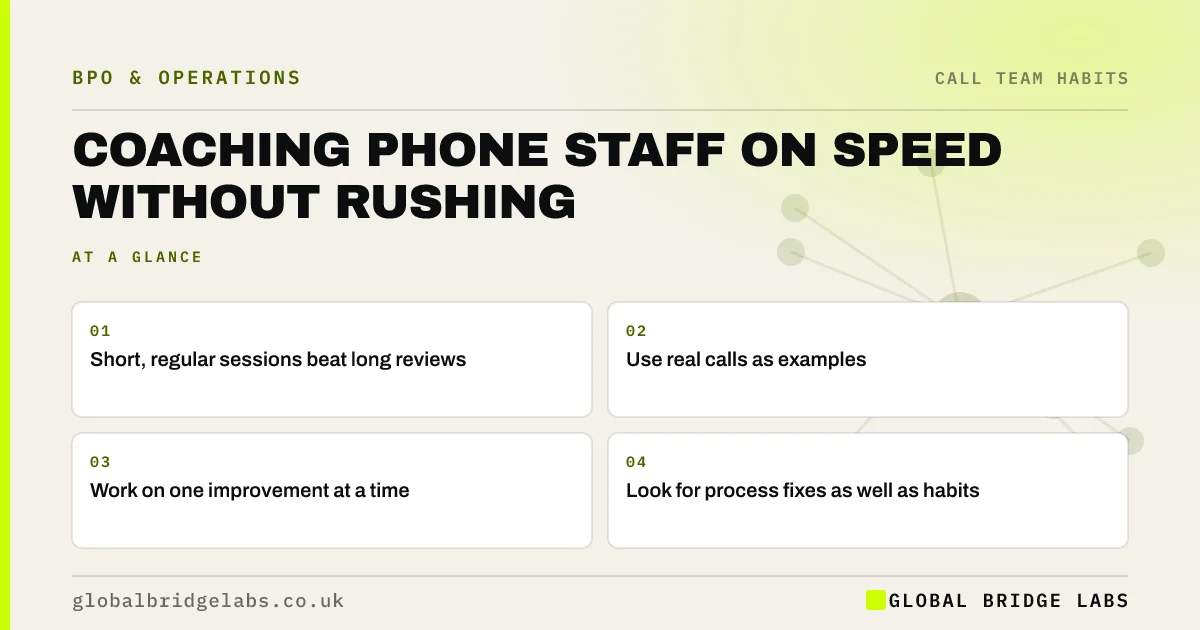
- Short, regular sessions beat long reviews.
- Use real calls as examples.
- Work on one improvement at a time.
- Look for process fixes as well as habits.
Want a simple coaching routine for your team? Message us on WhatsApp.
Chat on WhatsApp →Why coach for speed and quality together?
Coaching only for speed teaches people to cut corners; coaching only for quality can ignore time lost to searching, holds and long notes. Good coaching looks at the whole call: how quickly the need was understood, how efficiently it was resolved and how the caller felt.
What does a good session look like?
Fifteen to 20 minutes, every two weeks or so. Listen to one or two calls together. Ask the person what went well and what they would change. Agree one specific thing to try, such as summarising earlier or using the answer library instead of holding.
- Listen to one or two calls.
- Start with what went well.
- Agree one thing to try.
How do you find what to coach?
Use call samples, repeat calls, hold time and transfers by person, always with context. If several people struggle with the same call type, the problem is probably the process or information, not the people. Fix that first.
Want help setting up call coaching? Ask us on WhatsApp.
Chat on WhatsApp →How do you keep coaching positive?
Be open about how calls are chosen and recorded, focus on behaviours rather than personality and follow up on the agreed point next time. Recognise improvements publicly where people are comfortable with it. People improve faster when they feel supported.
What does this look like in practice?
A pattern we see: coaching happens only after complaints, and staff dread it. Switching to short fortnightly sessions on random calls, starting with strengths, makes coaching normal. Hold time falls as people learn to use the answer library.
Team leaders also spot a confusing process during sessions and get it changed, which helps the whole team, not just the person being coached.
Call coaching checklist
- Hold short sessions every two weeks.
- Use random real calls.
- Start with strengths.
- Agree one improvement.
- Fix shared problems in the process.
Next step
Book a 15-minute coaching session with each team member over the next two weeks, using one random call and agreeing one thing to try.
Message us on WhatsApp to build a coaching routine, or book a 30-minute consultation.
Chat on WhatsApp →Sources and further reading
- What are the Management Standards for work-related stress? · Health and Safety Executive
- Employment information · Information Commissioner's Office
Frequently asked questions
How often should phone staff be coached?
Short sessions every two weeks or so work well for most small teams. New starters may need weekly sessions at first. Regular, brief coaching is more effective than long annual reviews, because it addresses issues while calls are fresh and builds habits gradually.
Should coaching focus on call length?
Not on its own. Look at why calls take the time they do: searching for information, holds, transfers or long notes. Coach on those causes, alongside quality and resolution. Focusing only on length encourages people to end calls early, which leads to repeat calls.
Who should do the coaching?
Usually a team leader or experienced colleague who handles calls themselves and understands the processes. They should be trained in giving feedback. In very small teams, peer coaching, where colleagues listen to each other's calls, can work well if everyone agrees to it.
Written by

Global Bridge Labs (GBL) is a UK–Sri Lanka partner for social media, websites and BPO. Everything here comes from client delivery, not theory.