On this page
Key takeaways
Transfers add waiting, repetition and effort for callers, and they use two people's time on one call. Most come from menus that route wrongly, staff who lack the authority or information to help, or unclear ownership. Measure your transfer rate, find the top reasons for transfers and fix them, so more callers are helped by the first person they reach.
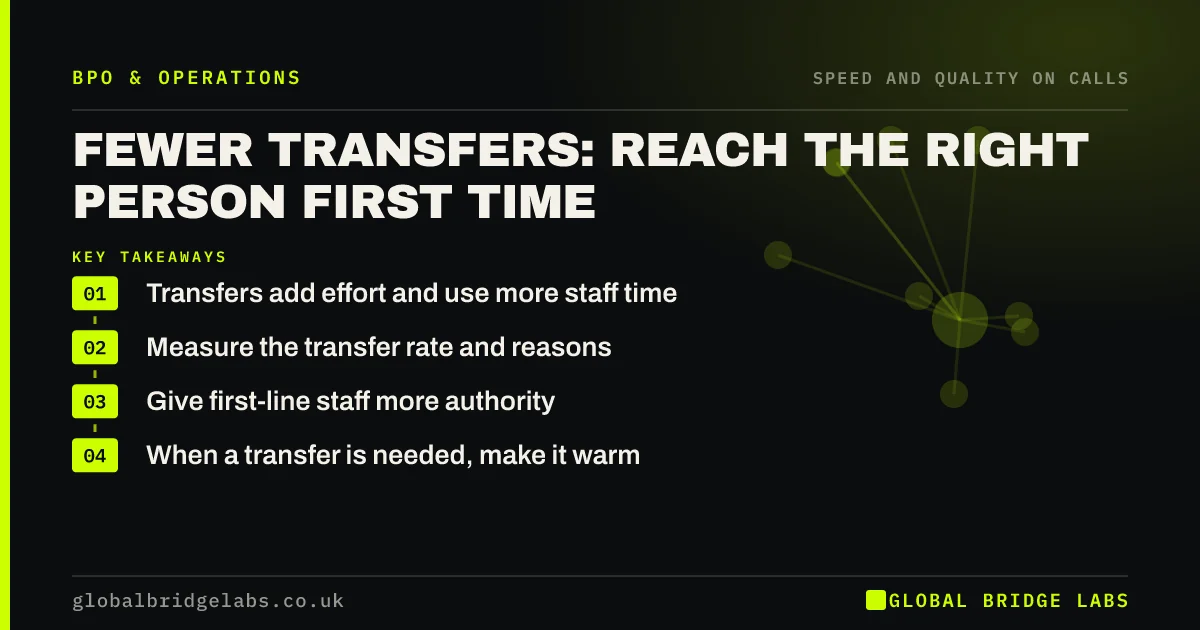
- Transfers add effort and use more staff time.
- Measure the transfer rate and reasons.
- Give first-line staff more authority.
- When a transfer is needed, make it warm.
Want to cut transfers on your lines? Message us on WhatsApp.
Chat on WhatsApp →Why do transfers happen?
The common causes are wrong menu choices, first-line staff who cannot see the right system or approve a simple request, and questions that only one person can answer. Some transfers are necessary, but many come from rules and access that could be changed.
How do you measure transfers?
Most phone systems report how many calls were transferred and to which queue or person. Divide transfers by calls answered to get a rate. Then add a transfer reason to your call codes for a few weeks, so you know why each one happened.
How do you reduce them?
Fix the reasons behind the most common transfers. Small changes often make the biggest difference.
- Reword or reorder menu options.
- Give first-line staff access to key systems.
- Allow small refunds or changes without approval.
- Build an answer library for specialist questions.
- Name an owner for each type of request.
- A phone answer library for your top 20 questions
- The tiered support model: send each query to the right cost
Want your transfer reasons analysed? Send us a sample of calls on WhatsApp.
Chat on WhatsApp →How should necessary transfers work?
Use a warm transfer: tell the colleague who is calling and why, then introduce the caller so they do not repeat themselves. If nobody is free, take details and arrange a callback at a set time rather than putting the caller into another queue.
What does this look like in practice?
A pattern we see: about a fifth of calls are transferred, mostly to accounts for small refund approvals. Allowing first-line staff to approve refunds below a set amount removes most of those transfers and shortens queues for both teams.
The accounts team also gains time back, because it no longer handles calls that were simple once the right permission was in place.
Call transfer checklist
- Measure your transfer rate.
- Code transfer reasons for a few weeks.
- Fix the top two reasons.
- Widen first-line authority where safe.
- Use warm transfers when needed.
Next step
Code every transfer for two weeks, find the top two reasons and agree one change that would let first-line staff handle them.
Message us on WhatsApp to reduce call transfers, or book a 30-minute consultation.
Chat on WhatsApp →Sources and further reading
- Stop trying to delight your customers (Dixon, Freeman and Toman, 2010) · Harvard Business Review
- UK Customer Satisfaction Index · Institute of Customer Service
Frequently asked questions
What is a good call transfer rate?
It depends on your business and how calls are routed, so there is no single benchmark. Track your own rate and its reasons over time. If many transfers are for simple requests that first-line staff could handle with more access or authority, there is room to bring the rate down.
What is a warm transfer?
A warm transfer is when the person handling the call speaks to the colleague first, explains who is calling and why, and then connects the caller. The caller does not have to repeat their story. It takes a little longer for staff but is much better for callers.
Do transfers affect service level?
They can. A transferred caller may wait in a second queue, which the first service level figure does not show. Transfers also use two people's time, reducing capacity for new calls. Reducing unnecessary transfers usually improves both the caller's experience and the team's ability to answer quickly.
Written by

Global Bridge Labs (GBL) is a UK–Sri Lanka partner for social media, websites and BPO. Everything here comes from client delivery, not theory.