
On this page
Key takeaways
Constant queues, back-to-back calls and pressure to hit targets can wear phone staff down. Burnout shows up as rising sickness, staff turnover, short tempers and falling quality. HSE identifies demands, control and support among the main causes of work-related stress. Reducing pressure usually means fixing staffing and demand, not asking people to cope better.
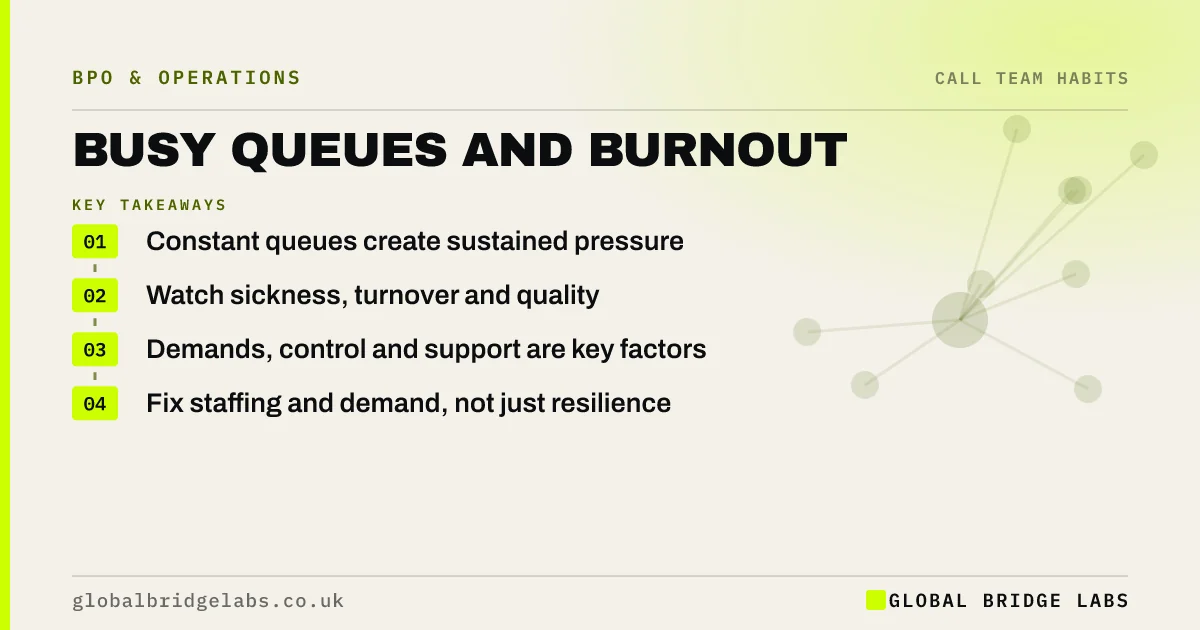
- Constant queues create sustained pressure.
- Watch sickness, turnover and quality.
- Demands, control and support are key factors.
- Fix staffing and demand, not just resilience.
Worried about pressure on your phone team? Message us on WhatsApp.
Chat on WhatsApp →Why do call teams burn out?
When the queue never empties, there is no recovery time between calls. Difficult callers, rigid targets and little say over breaks add to the strain. Over weeks, this leads to exhaustion and disengagement, which in turn makes the queue worse as people go off sick or leave.
What are the warning signs?
Look for patterns, not single bad days. Changes in several of these signs together usually mean the pressure needs addressing.
- Rising short-term sickness.
- More people leaving.
- Falling quality scores.
- Irritable or flat calls.
- People skipping breaks.
What reduces the pressure?
Fix the causes: staff to forecast so queues are not constant, remove avoidable calls, give people some control over breaks and shifts, and support them after difficult calls. Occupancy that stays very high for long periods is a warning sign in itself.
Want an outside view on your team's workload? Send us your call data on WhatsApp.
Chat on WhatsApp →What should managers do day to day?
Check in regularly, especially after hard calls. Make sure breaks happen. Share good news and progress, not just problems. HSE's Management Standards give a practical framework for reviewing demands, control, support, relationships, role and change.
What does this look like in practice?
A pattern we see: a team at very high occupancy all day has rising sickness and two resignations in a quarter. Adding lunchtime cover, removing an avoidable call reason and letting staff swap shifts brings occupancy down and sickness follows.
Exit interviews from the people who left had mentioned the same issues, which shows how valuable it is to ask current staff about pressure before they decide to go.
Burnout prevention checklist
- Track sickness and turnover monthly.
- Watch occupancy over long periods.
- Protect breaks.
- Support staff after difficult calls.
- Use HSE's Management Standards.
Next step
Look at sickness, turnover and occupancy for the last three months, and ask the team what makes the busiest days hardest.
Message us on WhatsApp to reduce pressure on your call team, or book a 30-minute consultation.
Chat on WhatsApp →Sources and further reading
- Work-related stress and how to manage it · Health and Safety Executive
- What are the Management Standards for work-related stress? · Health and Safety Executive
Frequently asked questions
What causes stress in call centre work?
Common causes include constant high call volumes, little recovery time between calls, difficult or abusive callers, rigid targets and limited control over breaks and shifts. HSE identifies demands, control, support, relationships, role and change as key areas to manage for work-related stress. Reviewing each area with the team is a practical first step.
How can I tell if my phone team is burning out?
Watch for rising sickness, more people leaving, falling quality, irritable calls and people skipping breaks. Ask the team directly in one-to-ones and anonymous surveys. A combination of these signs usually means pressure is too high and needs addressing at its source.
Does better service level reduce burnout?
Often, yes. When staffing matches demand, queues are shorter and people get some recovery time. Removing avoidable calls also reduces pressure. Chasing service level through rushing or skipped breaks has the opposite effect, so how you improve it matters as much as the figure.
Written by

Global Bridge Labs (GBL) is a UK–Sri Lanka partner for social media, websites and BPO. Everything here comes from client delivery, not theory.


