On this page
Key takeaways
Putting a caller on hold mid-call is sometimes necessary, but it is one of the moments callers dislike most. Ask permission, say why and roughly how long, check back regularly and thank them on return. If a hold would be long, offer a callback instead. Fewer, shorter holds also lower handle time and protect service level.
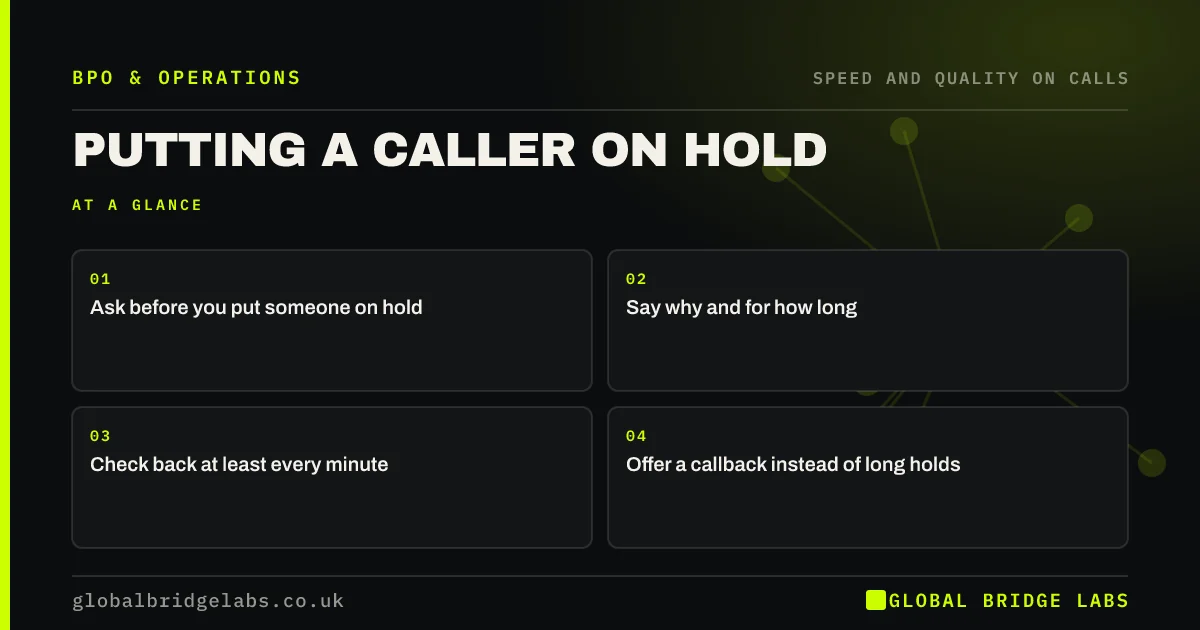
- Ask before you put someone on hold.
- Say why and for how long.
- Check back at least every minute.
- Offer a callback instead of long holds.
Want hold guidance for your team? Message us on WhatsApp.
Chat on WhatsApp →Why do holds matter?
A caller on hold cannot see what is happening, so a short hold can feel long. Unexpected holds also suggest the person does not know the answer. Holds add to handle time, which means fewer people are free for the queue and service level falls.
How should you put someone on hold?
Ask first and explain, for example: "Can I put you on hold for about a minute while I check your order?" Wait for an answer. Use the hold button, not mute, so the caller does not hear background conversation. Return when you said you would.
How long is too long?
Check back at least every minute, even if you need more time, so the caller knows they have not been forgotten. If you expect the hold to last more than a couple of minutes, offer to call back at an agreed time instead.
- Check back every minute.
- Offer a callback for long holds.
- Thank the caller on return.
Want to know how much hold time your calls include? Send us your call data on WhatsApp.
Chat on WhatsApp →How do you reduce holds?
Most holds happen because staff need information they cannot reach quickly. A good answer library, access to the right systems and a quick way to ask a colleague in writing all reduce holds. Track hold time by call reason to find where help is most needed.
What does this look like in practice?
A pattern we see: hold time makes up a large share of handle time on delivery calls, because staff check a separate courier system. Giving the team a direct link to tracking from the customer record cuts holds sharply.
Handle time on those calls falls, which frees capacity in the morning peak when most delivery questions arrive.
Putting callers on hold checklist
- Ask permission before holding.
- Say why and how long.
- Use hold, not mute.
- Check back every minute.
- Offer a callback for long holds.
Next step
Track hold time by call reason for two weeks, find the reason with the most hold time and fix the information gap behind it.
Message us on WhatsApp to cut hold time on calls, or book a 30-minute consultation.
Chat on WhatsApp →Sources and further reading
- Stop trying to delight your customers (Dixon, Freeman and Toman, 2010) · Harvard Business Review
- UK Customer Satisfaction Index · Institute of Customer Service
Frequently asked questions
How long should you keep a caller on hold?
As short as possible, ideally under a minute. If you need longer, check back at least every minute so the caller knows you are still working on it. For anything that will take several minutes, offer to call back at an agreed time instead of keeping them waiting.
Is it better to mute or hold a caller?
Use hold. Mute can let callers hear background conversation, and many callers cannot tell whether they are on mute or have been disconnected. Hold plays music or a tone, which reassures them the line is open, and keeps internal discussion private.
Does hold time count in handle time?
Usually yes. Average handle time normally includes talk time, hold time and after-call work. That is why reducing holds lowers handle time and frees capacity for the queue. Check how your phone system calculates it so you know whether hold time is included.
Written by

Global Bridge Labs (GBL) is a UK–Sri Lanka partner for social media, websites and BPO. Everything here comes from client delivery, not theory.