
On this page
Key takeaways
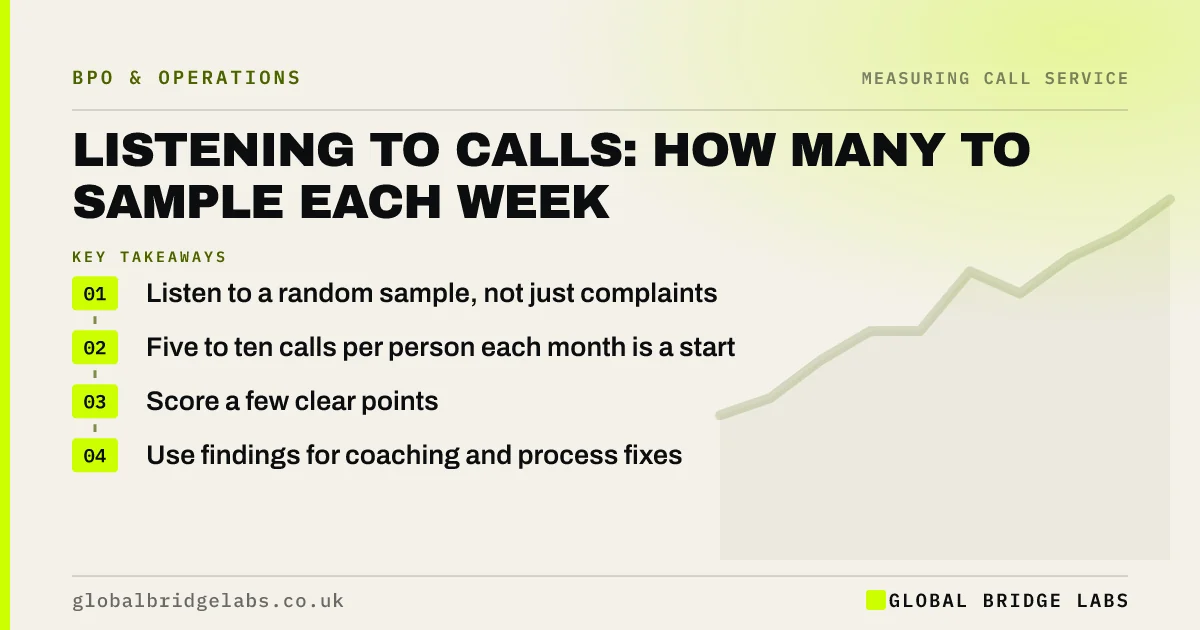
Listening to a sample of calls shows what numbers cannot: whether callers were helped, how they were treated and why calls take as long as they do. A small team can learn a lot from five to ten calls per person each month, chosen at random across times and reasons. Score a few clear points and use the findings to coach and fix processes.
- Listen to a random sample, not just complaints.
- Five to ten calls per person each month is a start.
- Score a few clear points.
- Use findings for coaching and process fixes.
Want a call sampling plan for your team? Message us on WhatsApp.
Chat on WhatsApp →Why sample calls at all?
Service level shows speed, but not whether the call went well. Listening shows where time goes, which answers are unclear, where transfers happen and how callers react. It is often the fastest way to find the root cause of a call reason.
How many calls should you sample?
For coaching, five to ten calls per person per month gives a reasonable view in a small team. For checking a specific process, such as a new answer, 20 to 30 calls on that reason is usually enough to see the pattern. More calls help only if someone acts on what they hear.
How should you choose calls?
Pick at random across days, times, reasons and people, including busy half hours. Do not only listen to complaints or very long calls, because they give a distorted picture. Add targeted samples when you are investigating a particular issue.
- Random across days and times.
- Include busy half hours.
- Add targeted samples for specific issues.
Want help setting up a scoring sheet? Ask us on WhatsApp.
Chat on WhatsApp →What should you score?
Keep it short: was the caller's need understood, was it resolved or a clear next step given, were details recorded, and how did the caller sound at the end? Four or five points scored consistently are more useful than a 30-point form.
What does this look like in practice?
A pattern we see: a team only listens to calls linked to complaints. Switching to a random sample shows that most calls go well, but one common answer about delivery times is wrong. Fixing that answer prevents many future calls.
Staff also respond better to feedback from random samples, because it includes plenty of good calls as well as the occasional problem.
Call sampling checklist
- Choose calls at random.
- Include busy times.
- Score four or five clear points.
- Share findings with the team.
- Tell staff calls are recorded and reviewed.
Next step
Pick ten random calls from last week, score them on four points and note one fix and one example to share with the team.
Message us on WhatsApp to set up call sampling, or book a 30-minute consultation.
Chat on WhatsApp →Sources and further reading
- Employment information · Information Commissioner's Office
- Sample size calculator for A/B tests · Evan Miller
Frequently asked questions
How many calls should a manager listen to?
In a small team, five to ten calls per person each month is a reasonable starting point for coaching. Add targeted samples when you are checking a specific process. The right number is one you can listen to properly and act on, not the largest number possible.
Do I need to tell staff that calls are reviewed?
Yes. Staff should know calls are recorded and may be reviewed, why and how the information is used. The ICO has guidance on monitoring workers. Being open about sampling also helps staff see it as support for coaching and fixing processes rather than surveillance.
Should I score calls or just listen?
A short score helps track trends and keeps reviews consistent between listeners. Keep it to four or five points. Add written comments, because they explain the score and give specific examples for coaching. Score the process, such as answers and routing, as well as the person.
Written by

Global Bridge Labs (GBL) is a UK–Sri Lanka partner for social media, websites and BPO. Everything here comes from client delivery, not theory.


