On this page
- 01Key takeaways
- 02When does a new market need website changes?
- 03What do new buyers need from the site?
- 04How do you test a new market cheaply?
- 05When does the new market justify a redesign?
- 06Can one site serve two markets?
- 07What are the risks of repositioning the site?
- 08Where will the new buyers find you?
- 09What does this look like in practice?
- 10New market checklist
- 11Next step
- 12Sources and further reading
- 13Frequently asked questions
Key takeaways
A new target market needs website changes when those buyers ask different questions, need different proof or judge a different price level. Start with a dedicated section or landing page and test it. Redesign when the new market becomes the main one and the current site's message, proof and look are all aimed at the old buyer.
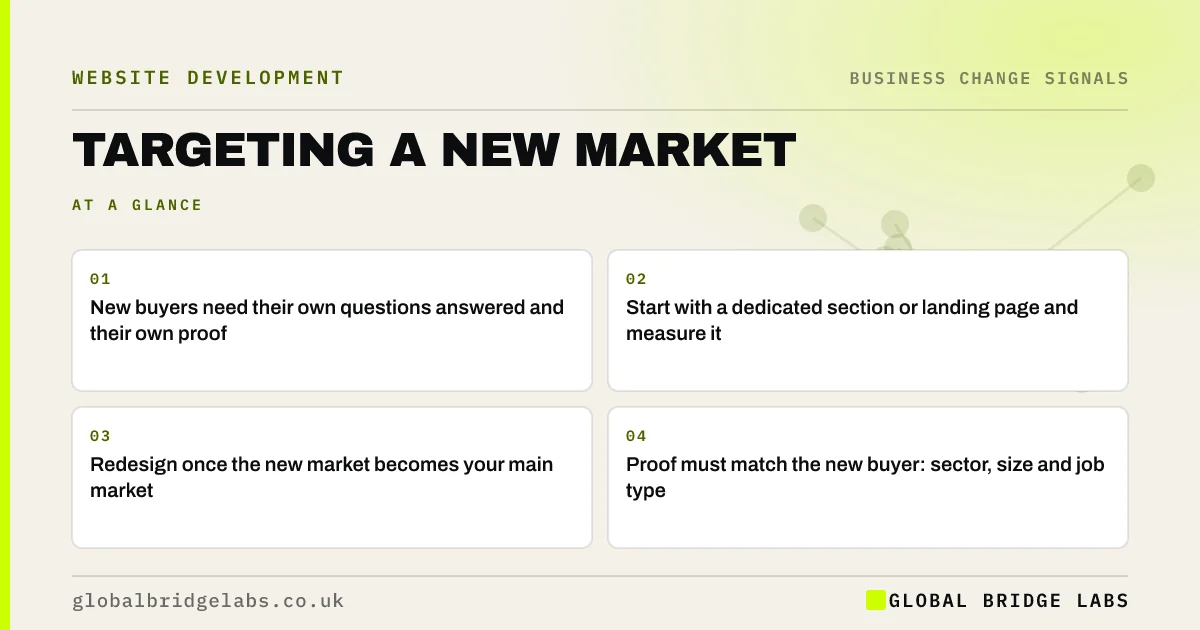
- New buyers need their own questions answered and their own proof.
- Start with a dedicated section or landing page and measure it.
- Redesign once the new market becomes your main market.
- Proof must match the new buyer: sector, size and job type.
Moving into a new market? We will tell you on WhatsApp what the site needs.
Chat on WhatsApp →When does a new market need website changes?
A new target market needs website changes when its buyers search differently, ask different questions, need different proof or expect a different level of polish. A commercial client assessing a contractor, for example, looks for accreditations, insurance and case studies that a homeowner rarely checks.
What do new buyers need from the site?
List the questions the new buyer asks before enquiring. They usually cluster into four groups.
- Relevance: do you work with businesses or people like me?
- Proof: examples, clients, results and accreditations in my sector.
- Process: how procurement, contracts and timescales work.
- Price level: signals that you fit my budget and expectations.
Want the new buyer's questions mapped to pages? Ask us on WhatsApp.
Chat on WhatsApp →How do you test a new market cheaply?
Build a dedicated section or landing page for the new market with its own headline, proof and enquiry route, and drive traffic to it through search, LinkedIn or direct outreach. Measure qualified enquiries for a quarter before redesigning the whole site around it.
When does the new market justify a redesign?
When it becomes the main market. If most of the revenue you want now comes from the new buyer, but the homepage, navigation, imagery and proof all speak to the old one, the site is working against you. At that point a redesign around the new buyer is the right move.
Can one site serve two markets?
Yes, if the homepage lets each buyer choose their route quickly and each route has its own pages and proof. It fails when both audiences are addressed on the same pages, because the message becomes too general for either.
What are the risks of repositioning the site?
Losing the existing market's enquiries while the new one builds. Keep pages that rank and convert for existing buyers, move them rather than deleting them, and redirect any URLs that change. Watch both markets' enquiries separately after launch.
Where will the new buyers find you?
Work this out before building pages, because it decides what the pages must do. Commercial buyers may search for specific services and check accreditations; consumers may arrive from social media or Google Business Profile and look for reviews and prices.
Map the main routes for the new market and make sure each lands on a page built for that buyer. A LinkedIn post to a procurement manager should not land on a homepage aimed at homeowners. Matching the page to the route is often the difference between a test that works and one that fails.
- List the searches the new buyers use.
- List the channels they already use.
- Land each route on a page built for them.
- Track enquiries from each route separately.
What does this look like in practice?
A pattern in UK hospitality: a restaurant begins taking corporate events, but the site shows only the à la carte menu and date-night photos. A dedicated events section with capacities, packages, a sample corporate booking and an enquiry form tests the market before any wider redesign.
New market checklist
Work through these before changing the whole site.
- List the new buyer's questions before enquiring.
- Gather proof relevant to that buyer.
- Build a dedicated section or landing page.
- Measure qualified enquiries for a quarter.
- Redesign once the new market becomes the main one.
- Protect existing pages that rank and convert.
Next step
If you are moving into a new market, we will plan the website changes with you in 30 minutes, starting with the smallest test that proves demand.
Message us on WhatsApp for a new market website plan, or book a 30-minute consultation.
Chat on WhatsApp →Sources and further reading
- SEO Starter Guide · Google Search Central
- Site moves with URL changes · Google Search Central
- LinkedIn Pages best practices · LinkedIn
Frequently asked questions
Do I need a new website to target a new market?
Not at first. Start with a dedicated section or landing page that answers the new buyer's questions and shows relevant proof, and measure enquiries. Redesign when the new market becomes your main market and the whole site is still aimed at the old buyer.
Can one website serve different types of customer?
Yes, if the homepage lets each type choose a clear route and each route has its own pages, proof and enquiry options. Addressing both audiences on the same pages usually makes the message too general for either. Test the routes with buyers from each group.
How do I reposition my website for a higher-end market?
Show proof from comparable clients, explain your process in detail, give pricing guidance that signals your level, use real, high-quality photography and remove content aimed at budget buyers. If the design itself signals a budget provider, a redesign may be needed.
Will changing my website's focus affect my rankings?
It can if pages that rank are removed or their URLs change without redirects. Keep and move pages that serve existing buyers, redirect changed URLs, and add new pages for the new market rather than rewriting ranking pages beyond recognition.
Written by

Global Bridge Labs (GBL) is a UK–Sri Lanka partner for social media, websites and BPO. Everything here comes from client delivery, not theory.