On this page
- 01Key takeaways
- 02Why does a 'how it works' section help conversion?
- 03What should the steps say?
- 04Where should it sit on the homepage?
- 05How does it connect to the call to action?
- 06When is a process section unnecessary?
- 07What does this look like in practice?
- 08'How it works' checklist
- 09Next step
- 10Sources and further reading
- 11Frequently asked questions
Key takeaways
A how it works section on a homepage turns an unknown process into three or four simple steps, so visitors know exactly what happens after they click. Name each step with a verb, say who does what and add a time, such as 'We reply within 2 hours'. Uncertainty about what happens next is a quiet reason people delay enquiring.
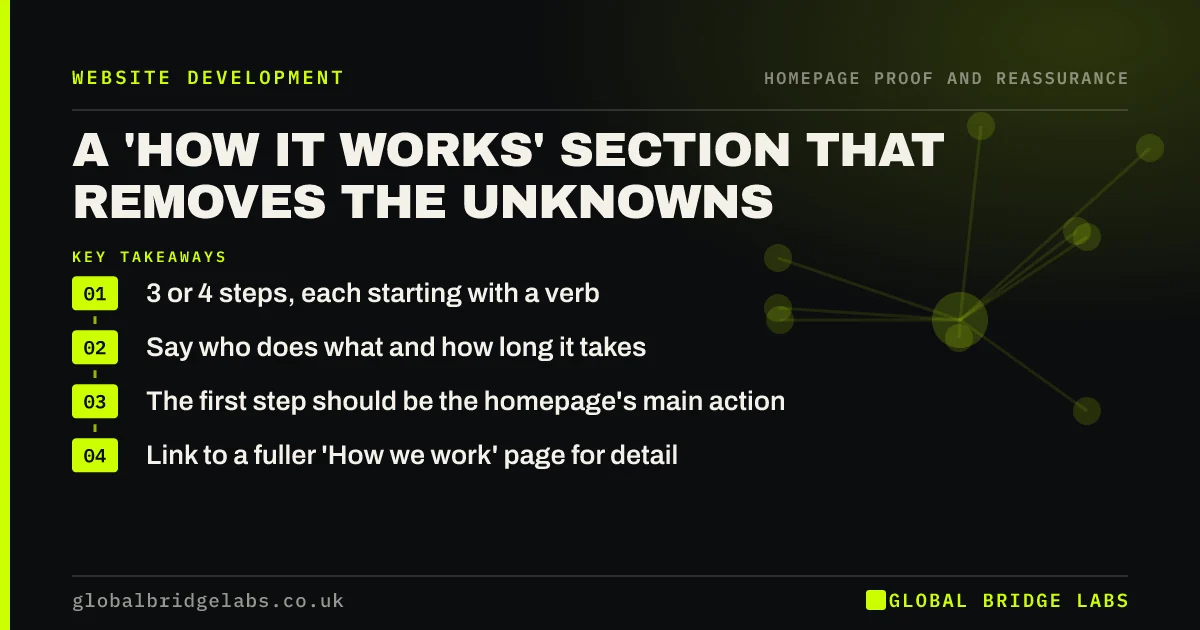
- 3 or 4 steps, each starting with a verb.
- Say who does what and how long it takes.
- The first step should be the homepage's main action.
- Link to a fuller 'How we work' page for detail.
Want your process written as three clear steps? Message us on WhatsApp.
Chat on WhatsApp →Why does a 'how it works' section help conversion?
A how it works section helps because many buyers do not know what happens after they enquire: a sales call, a site visit, a payment, a long wait. That uncertainty makes them put it off. Three clear steps with times make the first move feel small and safe.
What should the steps say?
Keep each step to about 10 words, with a verb and a time where you can.
- 1. Tell us about the job: a 2-minute form or a call.
- 2. Get a fixed quote: usually within 2 working days.
- 3. We do the work: on the agreed date, tidied up after.
Where should it sit on the homepage?
Place it after the services summary and before or beside the proof, so visitors understand what you sell, then how buying works, then that you are good at it. Put the main button directly under step 3 or beside step 1, because the section ends at the point of action.
How does it connect to the call to action?
Step 1 should be exactly what the main button does. If the button says 'Get a quote' and step 1 says 'Book a survey', visitors wonder which is real. Use the same words in both places, and repeat the reply time in the microcopy next to the button.
When is a process section unnecessary?
It is unnecessary when the process is obvious, such as buying a product online or booking a table, where the button itself explains it. It is also wrong if your process varies so much that three steps would mislead; then explain the first step only and what decides the rest.
What does this look like in practice?
A pattern we see with professional services: visitors fear that enquiring means a hard sales pitch. A three-step section saying 'a 20-minute call with a partner, a written proposal within 3 days, no obligation' answers that fear before it costs an enquiry.
'How it works' checklist
- Write 3 or 4 steps, each starting with a verb.
- Add who does what and a time to each.
- Make step 1 match the main button exactly.
- Place the button at the end of the steps.
- Link to a fuller process page.
Next step
Write down what actually happens in the first week after someone enquires. Turn it into three steps with times, then check your team agrees with the times.
Message us on WhatsApp to tighten the steps, or book a 30-minute consultation.
Chat on WhatsApp →Sources and further reading
- Stop trying to delight your customers (Dixon, Freeman and Toman, 2010) · Harvard Business Review
- Progressive disclosure · Nielsen Norman Group
Frequently asked questions
What should a how it works section include?
Three or four short steps that describe what happens from first contact to the work being done, each with a verb, who does it and a typical time. Step 1 should match the homepage's main call to action, with the button placed at the end.
How many steps should a process section have?
Three is ideal and four is fine. More than that makes the process look complicated, which is the opposite of the section's purpose. Group smaller actions into one step and explain the detail on a separate page.
Should my homepage explain what happens after an enquiry?
Yes. Many visitors delay enquiring because they do not know whether it leads to a hard sell, a fee or a long wait. Saying who replies, how and when removes that uncertainty and makes the first step feel safe.
Written by

Global Bridge Labs (GBL) is a UK–Sri Lanka partner for social media, websites and BPO. Everything here comes from client delivery, not theory.