On this page
- 01Key takeaways
- 02Why is a new service hard to sell on a homepage?
- 03How do you explain an unfamiliar service quickly?
- 04Should you use the category name at all?
- 05What proof works for something new?
- 06When should you avoid 'like X for Y' comparisons?
- 07What does this look like in practice?
- 08New service homepage checklist
- 09Next step
- 10Sources and further reading
- 11Frequently asked questions
Key takeaways
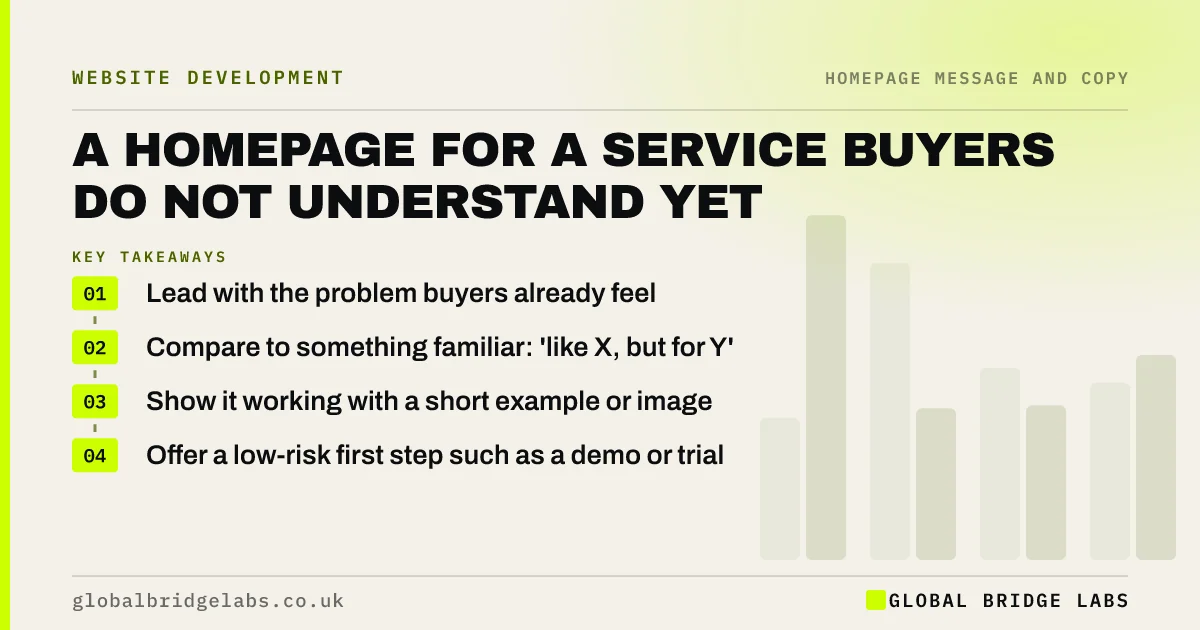
To explain a new service on your website when buyers do not have a word for it, lead with the problem they already feel, compare the service to something familiar, show it working and offer a low-risk first step. A category name you invented means nothing to strangers, so it cannot carry the headline on its own.
- Lead with the problem buyers already feel.
- Compare to something familiar: 'like X, but for Y'.
- Show it working with a short example or image.
- Offer a low-risk first step such as a demo or trial.
Selling something buyers do not understand yet? Message us on WhatsApp.
Chat on WhatsApp →Why is a new service hard to sell on a homepage?
A new or unfamiliar service is hard to sell because buyers have no word to search for and no picture of what they get. A headline built on your own category name, such as 'Smart compliance orchestration', asks visitors to learn a term before they know if they need it. Most will not.
How do you explain an unfamiliar service quickly?
Start where the buyer is. Name the problem in their words, then say what changes: 'Stop chasing staff for training certificates: one dashboard shows who is due, and reminds them for you.' Then compare to something known, show a screenshot or photo, and give one example of a customer using it.
Should you use the category name at all?
Yes, but as a label, not the headline. Introduce it after the problem and outcome are clear: 'We call this managed onboarding.' Over time, if people start searching for it, it can move up. Until then, use the words buyers search for, even if they are less precise.
What proof works for something new?
When there are few reviews, show the thing itself: a short demo, a real screenshot, a sample report or a before-and-after. Pilot results with permission, named advisers and a clear trial or guarantee also reduce the risk of being first.
When should you avoid 'like X for Y' comparisons?
Avoid them when the comparison brings baggage, such as a brand people dislike, or when buyers do not know X either. Comparisons also mislead if the service differs in important ways. Test the line with a few target buyers before using it.
What does this look like in practice?
A pattern we see with founders: the homepage describes the technology in detail because that is what they are proud of. Rewriting the hero around the buyer's daily headache, with one screenshot and 'book a 15-minute demo', turns visits into demos far more reliably than a better technical description.
New service homepage checklist
- Name the problem in buyers' words first.
- Say what changes for them in one line.
- Compare to something familiar, if it fits.
- Show it: screenshot, sample or short demo.
- Introduce your category name after the problem.
- Offer a low-risk first step.
Next step
Ask three target buyers to describe the problem your service solves without hearing your pitch. Use their words for your headline.
Message us on WhatsApp to test your headline, or book a 30-minute consultation.
Chat on WhatsApp →Sources and further reading
- Know your customers' jobs to be done (Christensen and others, 2016) · Harvard Business Review
- Plain language is for everyone, even experts · Nielsen Norman Group
Frequently asked questions
How do I explain a new product on my website?
Lead with the problem buyers already have, say what changes for them, compare it to something familiar and show it working with a screenshot, sample or short demo. Introduce any category name afterwards, and offer a low-risk first step such as a demo or trial.
Should I invent a name for my service category?
It can help with brand recognition, but do not rely on it in the headline. Buyers will not search for a term they have never heard. Use their problem language first and introduce your name as a label once they understand what it means.
How do I build trust for a service nobody has heard of?
Show the service itself through demos, sample outputs and real screenshots, share pilot results with permission, introduce the people behind it and offer a trial or guarantee. Specific evidence matters more when buyers cannot rely on familiarity.
Written by

Global Bridge Labs (GBL) is a UK–Sri Lanka partner for social media, websites and BPO. Everything here comes from client delivery, not theory.