On this page
- 01Key takeaways
- 02Why do two tools disagree about the same page?
- 03Why does the same tool change between runs?
- 04Why do tests differ from what customers experience?
- 05How do you get numbers you can compare?
- 06Which differences can you ignore?
- 07What does this look like in practice?
- 08Consistent testing checklist
- 09Next step
- 10Sources and further reading
- 11Frequently asked questions
Key takeaways
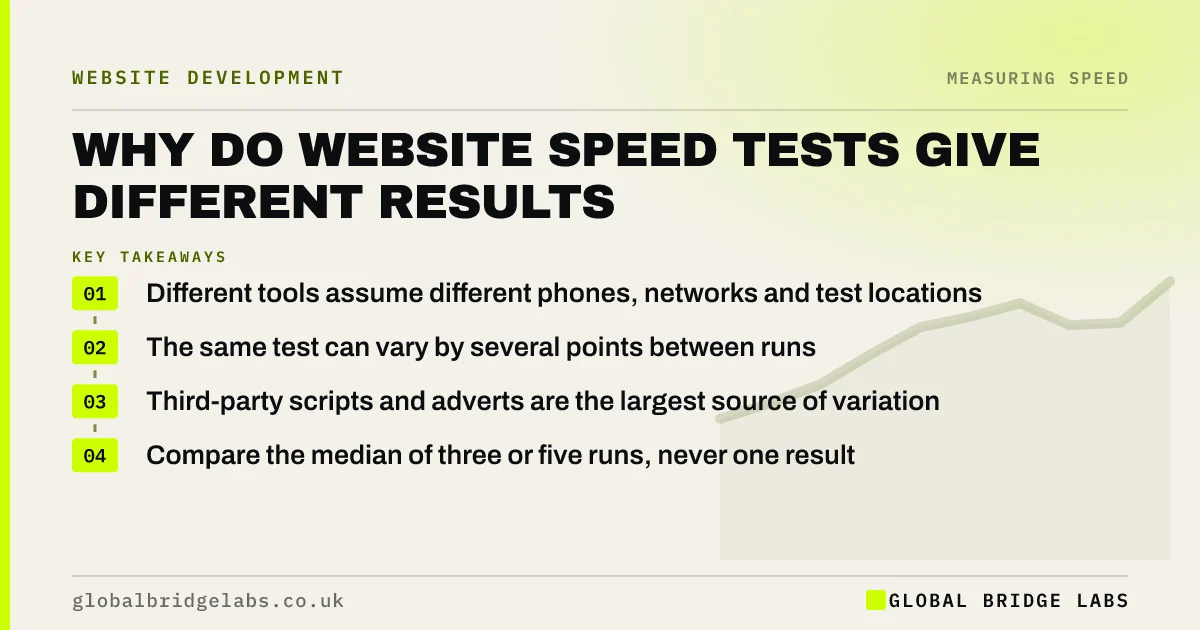
Website speed tests give different results because each test is a different visit. Tools use different simulated devices, connection speeds and locations, and the same tool varies from run to run as networks, servers and third-party scripts fluctuate. None of this means the tools are broken. It means a single number is not evidence. Use the same tool and settings, run it several times and compare ranges.
- Different tools assume different phones, networks and test locations.
- The same test can vary by several points between runs.
- Third-party scripts and adverts are the largest source of variation.
- Compare the median of three or five runs, never one result.
Getting a different score every time? Send us the URL on WhatsApp and we will tell you which number to trust.
Chat on WhatsApp →Why do two tools disagree about the same page?
Two tools disagree because they are simulating different customers. One may test as a desktop computer on fast broadband, another as a mid-range phone on a throttled mobile connection. Test servers sit in different countries. Some tools report the time until the page is fully loaded, others the time until the main content appears.
A page can truthfully load in 1.2 seconds in one tool and 6 seconds in another. The useful question is which test is closest to your customers. For most UK businesses that is a mid-range phone on mobile data.
Why does the same tool change between runs?
The same tool changes between runs because the conditions are never identical. Lighthouse's documentation lists the common causes.
- Network conditions between the test server and your site.
- Load on your server at that moment.
- Third-party scripts responding quickly on one run and slowly on the next.
- Adverts or A/B tests serving different content each time.
- Load on the machine running the test.
Why do tests differ from what customers experience?
Tests differ from real experience because a lab test is one cold visit that never taps or scrolls. Real visitors use many devices, often have parts of the site stored already, and interact with the page. Field data, gathered from real Chrome users over 28 days, captures that. It is the figure Google's systems use.
Your own impression can differ again. On office Wi-Fi with the site already stored in your browser, it will always feel faster than it does to a first-time visitor.
Want to see what real visitors experienced, not a single test? Ask us on WhatsApp.
Chat on WhatsApp →How do you get numbers you can compare?
Hold everything constant except the thing you changed.
- 1. Choose one tool and stay with it.
- 2. Always test the same pages, on the mobile setting.
- 3. Run each test three or five times and take the middle result.
- 4. Test at a similar time of day.
- 5. Record the date and what changed on the site since the last test.
- 6. Confirm any improvement in field data 28 days later.
Which differences can you ignore?
Ignore a swing of a few points between runs, a difference between two tools with different settings, and a desktop result when your customers are on phones. Pay attention when the middle result moves by a clear margin after a change, when the same measure worsens across several pages, or when field data shifts from one band to another.
Be wary of anyone who presents the best of several runs as the result.
What does this look like in practice?
A pattern we see in disputes about speed work: the developer shows a score of 88 and the client's own test shows 54. Both are honest. One was a desktop test taken once at a quiet hour, the other a mobile test while a chat widget was slow to respond.
Agreeing the tool, the pages, the device setting and the number of runs before work starts removes the argument. Global Bridge Labs (GBL) records that method alongside every result it reports.
Consistent testing checklist
- Pick one tool and one device setting.
- List the pages you will always test.
- Run each test at least three times.
- Record the middle result with the date.
- Note every site change between tests.
- Use field data as the final check.
Next step
A number you cannot reproduce is not a measurement. We will set up a simple, repeatable test for your key pages so that changes show clearly.
Message us on WhatsApp for a repeatable speed baseline.
Chat on WhatsApp →Sources and further reading
- Lighthouse performance scoring · Chrome for Developers
- Why lab and field data can be different · web.dev (Google)
- About PageSpeed Insights · Google for Developers
Frequently asked questions
Why do website speed tests give different results?
Each test is a separate visit under different conditions. Tools simulate different devices, connection speeds and locations, and results vary between runs with network conditions, server load and third-party scripts. Use one tool with fixed settings and compare the middle of several runs.
Why does my PageSpeed score change every time I test?
Lab tests are sensitive to momentary conditions: network routing, load on your server, how quickly third-party scripts respond and which adverts are served. A swing of a few points is normal. Run the test several times and use the median.
Which website speed test is most accurate?
The most accurate picture comes from field data, which records real visitors over 28 days. Among lab tools, the most useful is the one whose simulated device and connection are closest to your customers', usually a mid-range phone on mobile data.
How many times should I run a speed test?
At least three, ideally five, taking the middle result. Do the same before and after any change, on the same pages and settings, so that the difference you see reflects the change and not normal variation.
Written by

Global Bridge Labs (GBL) is a UK–Sri Lanka partner for social media, websites and BPO. Everything here comes from client delivery, not theory.